
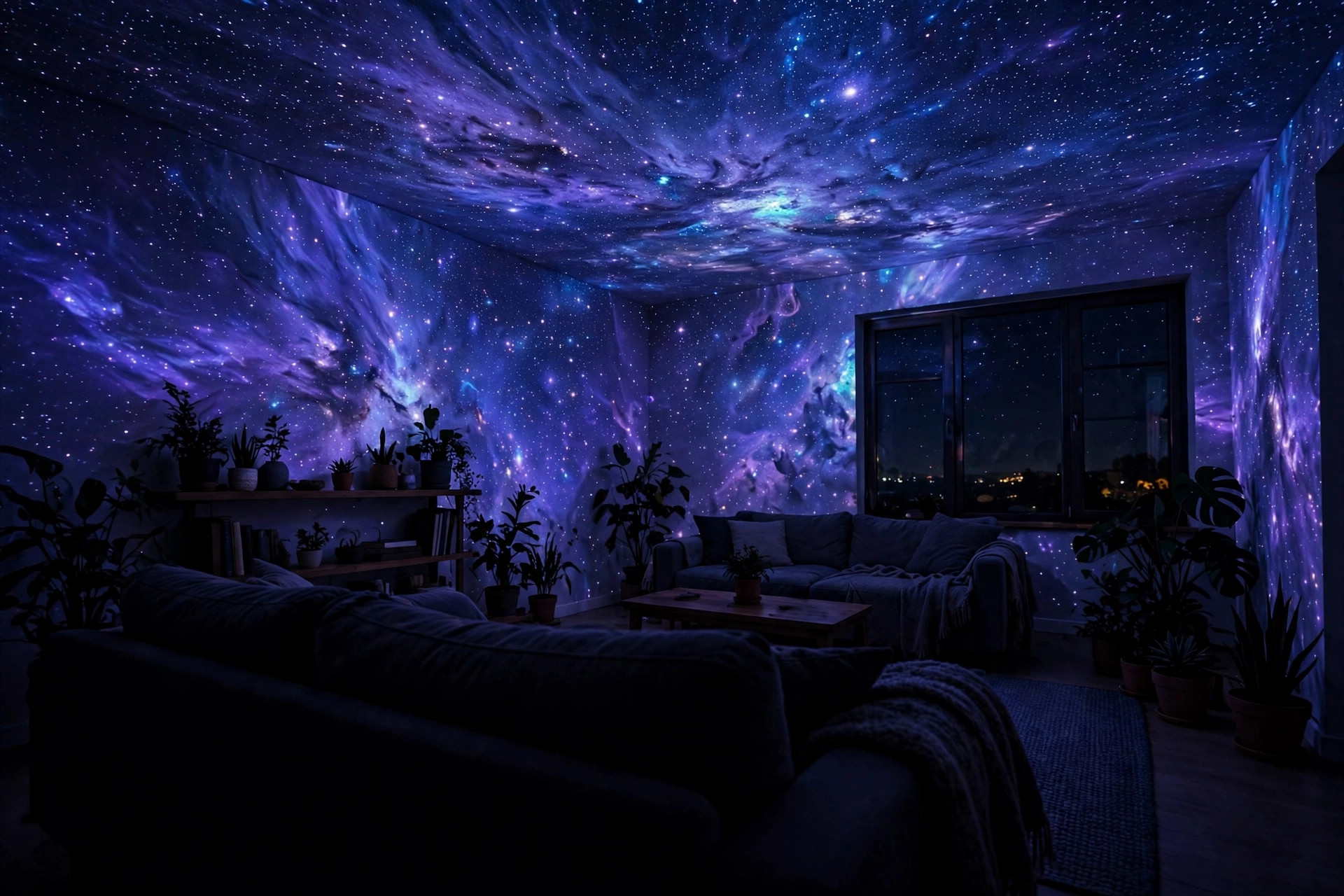
Best Home Planetarium 2026 — Top 5 Star Projector Picks
A home planetarium is not one product category — it is two, wearing the same costume. On one side are the accurate projectors: disc-based systems that throw the actual night sky — real constellations, real star positions — onto your ceiling. On the other side are the ambience projectors: swirling nebula clouds, drifting stars, and laser patterns that look gorgeous and teach you nothing about astronomy. Both are legitimate purchases. They are just not interchangeable, and most buyer’s remorse in this category comes from buying one while wanting the other.
So the honest starting point is this: decide accuracy vs ambience before you look at a single spec. If you want to learn constellations, impress a kid who asks “which one is Orion,” or fall asleep under something that looks like the sky outside — buy a disc-based system (the Sega Homestar line or the Pococo). If you want a beautiful, colorful room that feels like floating in space — buy a galaxy projector (the BlissLights or Encalife). Neither is better. They are different products for different desires, and this best home planetarium list ranks the best of each at its own job.
We ranked this 2026 lineup by what actually matters after the novelty wears off: honesty about what the projection really is (real star map or pretty effect), image sharpness on a real bedroom ceiling, a disc ecosystem that rewards long-term ownership for the accurate picks, bedroom practicalities (noise, sleep timers, light spill), and build quality that survives nightly use. Every pick is a real, currently available model with specs verified against 2026 editorial reviews.
Best Home Planetarium 2026 — Comparison Table
| Projector | Type | Coverage | Control | Best For | Buy |
|---|---|---|---|---|---|
| Sega Toys Homestar Flux | Accurate (disc system) | 8.9 ft / 2.7 m | On-body | Best overall — most realistic | Buy from Amazon |
| Pococo Galaxy Projector | Accurate (disc system) | 12 m² | On-body | Best value — rechargeable | Buy from Amazon |
| BlissLights Sky Lite 2.0 | Ambience (laser + nebula) | 30×30 ft laser / 15×15 ft nebula | App + button | Best ambience/mood | Buy from Amazon |
| Sega Toys Homestar Matataki | Accurate (disc + twinkle) | 106 in / 270 cm | On-body | Best twinkling stars | Buy from Amazon |
| Encalife Ambience | Ambience (laser + stars) | Wide room coverage | Remote + on-body | Best with sound + remote | Buy from Amazon |
How We Picked These Real Night Skies
A home planetarium has five jobs, in this order:
Job one: be honest about accuracy. The single most important spec is not on any box: is this the real sky or a pretty light? Disc-based projectors (Homestar Flux, Homestar Matataki, Pococo) project actual star fields — the Flux’s discs are built from NASA-based imagery with 60,000 stars, true to time and date. Laser/nebula projectors (Sky Lite 2.0, Encalife) project randomized stars and drifting clouds that look stunning and correspond to no actual constellation. We label every pick accordingly so you buy the right category.
Job two: stay sharp on a real ceiling. A star projector lives or dies on focus at bedroom distance — typically 8–12 feet to the ceiling. The disc systems win here: real optics projecting a real image stay crisp across the rated projection size (8.9 feet for the Flux, 12 m² for the Pococo). Ambience projectors trade sharpness for coverage — the Sky Lite’s laser throws across a 30×30 foot area, but it is atmosphere, not detail.
Job three: reward long-term ownership (accurate picks). A disc system you get bored of in a month is a bad purchase. The Flux justifies its premium with an ecosystem of extra discs — different skies, celestial objects, views from across the solar system — that keep it interesting for years. The Pococo counters with affordable expansion disc packs. A fixed-effect projector cannot grow; factor that into the value math.
Job four: behave in a bedroom. These run at night, often while people sleep. That means a sleep timer is not a feature; it is a requirement (every pick here has one), fan/operational noise must be near-silent, and the projection should not light up the whole room like a nightclub when you want stars. Check the timer options before you buy, not after the first sleepless night.
Job five: be safe and sane for the household. Laser-based ambience projectors use Class 1 or Class 2 lasers — safe in normal use, but the lens should never be stared into, and small children should not handle them unsupervised. We note the laser classification on every pick that has one.
Best Home Planetariums 2026 — Detailed Reviews
1. Sega Toys Homestar Flux — Best Overall (Most Realistic)
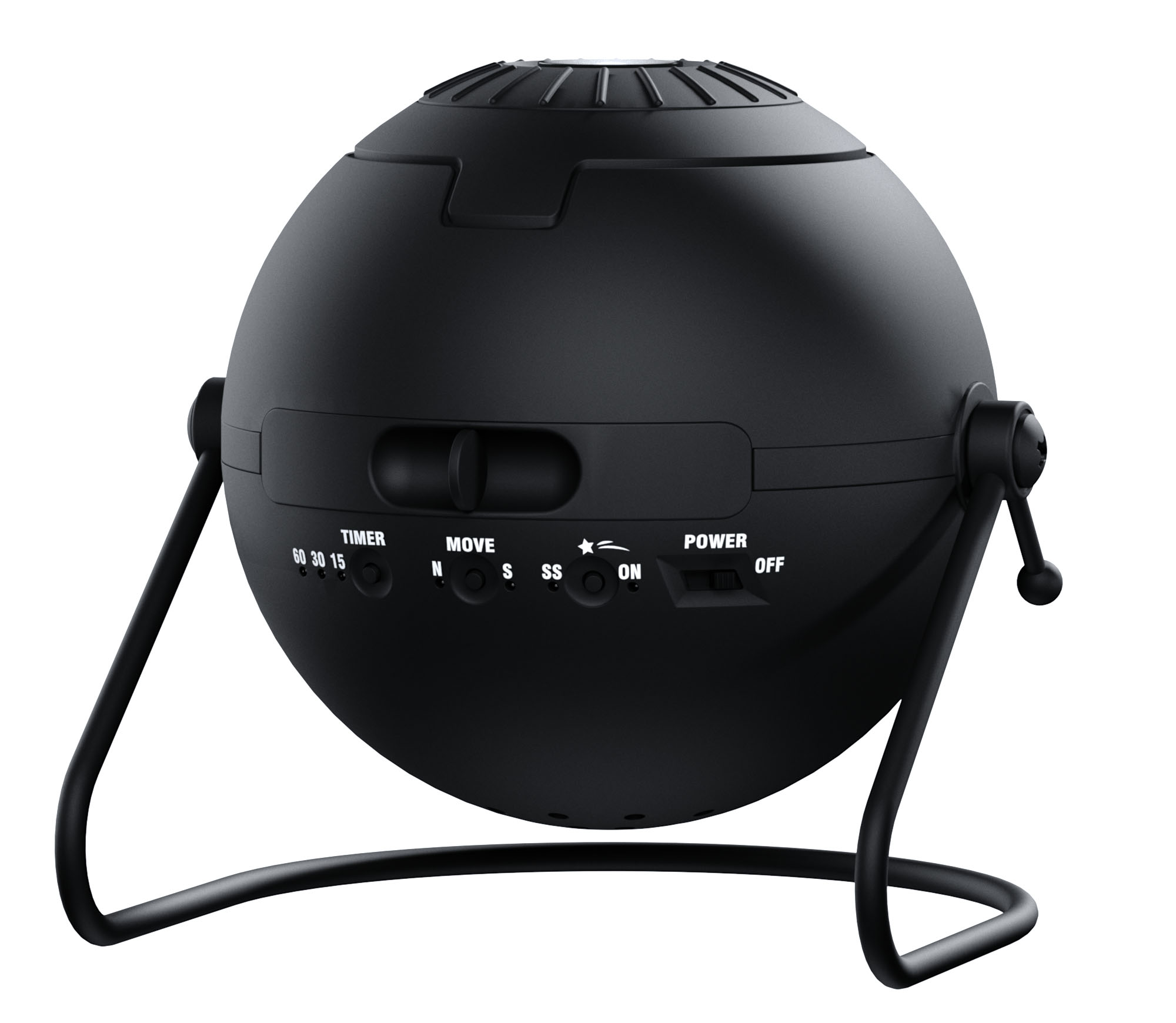
The Homestar Flux is the consensus best star projector you can buy in 2026 — Space.com calls it the most sophisticated, realistic star projector on the market, and the reasons are concrete: 60,000 stars projected from interchangeable discs built on NASA-based imagery, true to time and date, with a shooting-star mode and adjustable brightness and focus. On an 8.9-foot ceiling projection, it does not look like a “star projector.” It looks like the sky.
What separates the Flux from everything else here is that it is an instrument first and a gadget second. The disc ecosystem is the long-term value: extra discs cover different skies and celestial objects, so the projector you buy this year is still revealing new things next year.
It is USB-powered (cable plus wall pack), geared toward adults and serious stargazers, and the 4.5-star reviews reflect what it is — the closest thing to a planetarium visit you can put on a nightstand.
The honest caveats: it is the most expensive pick on this list by a clear margin — if you just want a pretty light for the bedroom, this is overkill, and you should buy the BlissLights below for less.
Space.com‘s review notes there are no lens covers, which is a real annoyance for something with precision optics that sits on a nightstand collecting dust. And it is not wireless or app-controlled — on-body controls only, which feels basic at this price.
✓ Pros
- As realistic as it gets — actual night sky, not an effect
- Disc ecosystem — extra skies and objects keep it fresh for years
- Shooting-star mode — the detail that sells the realism
- Geared toward adults — a serious instrument, not a toy
✗ Cons
- Most expensive pick here — overkill if you just want mood lighting
- No lens covers — precision optics left exposed to dust
- On-body controls only — no app or remote at this price
2. Pococo Galaxy Projector — Best Value (Rechargeable)
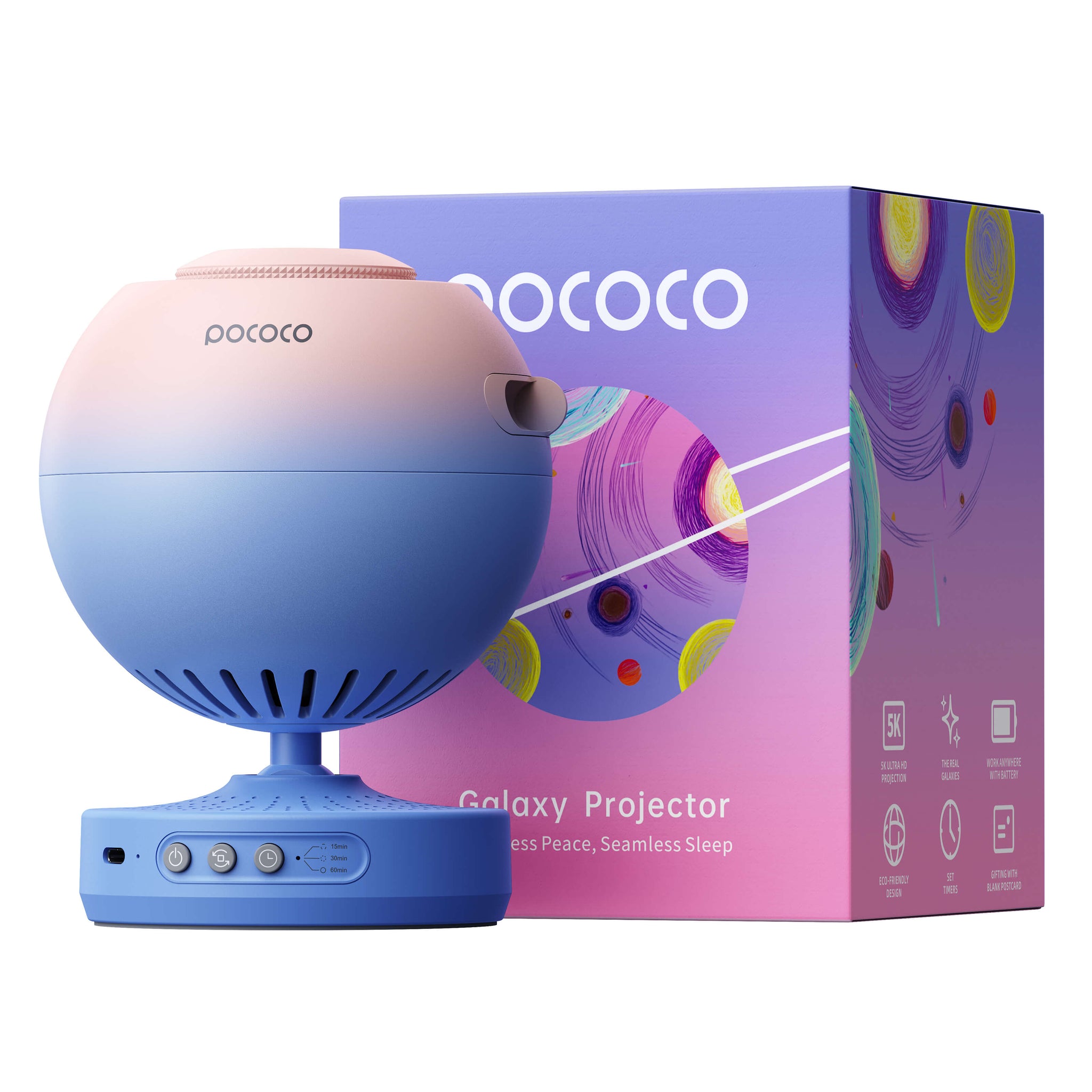
The Pococo is the pick that embarrasses projectors twice its price. It uses a real projection-disc system — gorgeous, clear cosmos images rather than the randomized star blobs of cheap projectors — with a 12-square-meter projection area that fills a small to mid-size bedroom wall-to-wall.
The rechargeable battery is the feature that changes how you use it. No cable to the nightstand, no wall-wart hunting — charge it, carry it to the kid’s room, the living room for a movie night, or even the backyard on a clear night. It ships with two image discs and affordable expansion packs, has a sleep timer and rotation, and at 157×120×120 mm it disappears on a shelf. Launched in December 2022 and still recommended across 2026 guides, it has outlasted a generation of cheaper clones.
The honest caveats: there is no remote and no app — every adjustment means walking to the unit, which gets old when you are already in bed. A handful of reviewers note it could be a little brighter — in a room with any ambient light, the image softens. And while the disc system is genuinely good, it is not the Flux: fewer stars, less precision, no time-and-date accuracy. At less than half the price, that is a fair trade — just know which side of it you are on.
✓ Pros
- Real disc-based cosmos images — not randomized star blobs
- Rechargeable — use it in any room, no cable tethering
- Affordable expansion discs — grows without growing the budget
- Proven longevity — recommended across 2026 guides since 2022 launch
✗ Cons
- No remote or app — walk to the unit for every adjustment
- Could be brighter — softens with any ambient light in the room
- Not Flux-level precision — fewer stars, no time/date accuracy
3. BlissLights Sky Lite 2.0 — Best Ambience / Mood
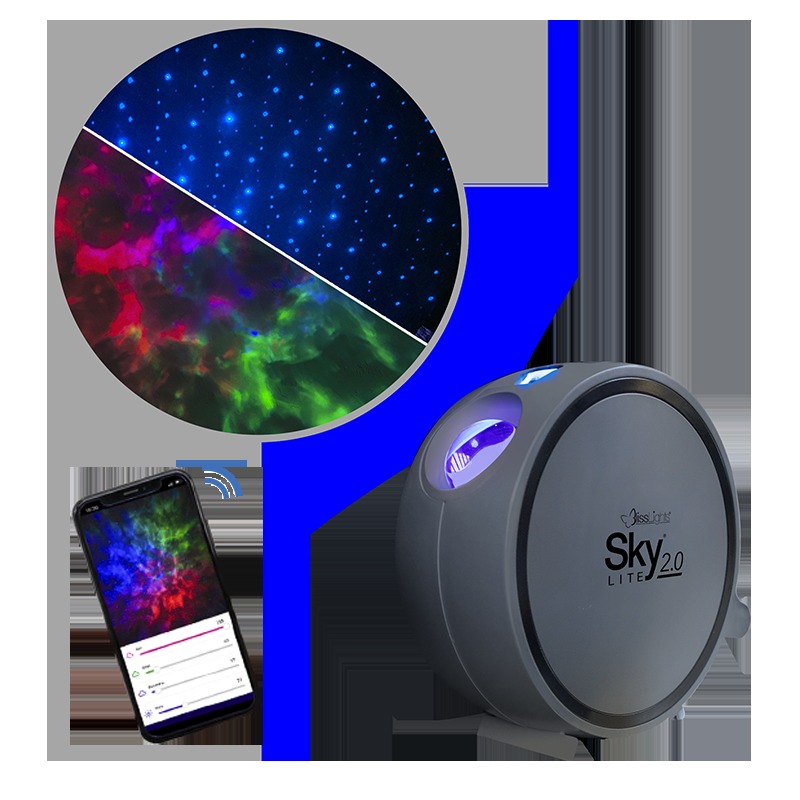
If the Homestar Flux is a planetarium, the Sky Lite 2.0 is a lava lamp that went to space — and we mean that as a compliment. It pairs a direct laser starfield (covering up to 30×30 feet) with a drifting nebula cloud (15×15 feet) from a 5W LED, creating the floating-in-the-cosmos effect that made galaxy projectors a phenomenon.
Controlled by app or a single on-body button, with adjustable brightness, multiple color options, and a sleep timer via the app, it is the easiest pick on this list to live with nightly.
The coverage is the story: the laser throws stars across a huge area — walls and ceiling at once — while the nebula cloud drifts slowly underneath. For a bedroom, a gaming room, or a party, nothing else here fills a space with atmosphere this completely. It is compact (235×207×76 mm), simple to set up, and the app control means brightness and timer adjustments happen from bed.
The honest caveats, stated clearly because they decide the purchase: this is ambience, not accuracy. The stars are randomized laser points, the nebula is an effect — it will not teach anyone a constellation, and if that is what you want, you bought the wrong category (see the Flux or Pococo above).
It contains a laser, so the usual rules apply: do not stare into the lens, and supervise small children. And the sleep timer lives in the app — if you do not want another app on your phone, the on-body button is your only fallback.
✓ Pros
- Huge atmospheric coverage — fills walls and ceiling at once
- App control — brightness and timer from bed
- Adjustable colors and brightness — dial the mood precisely
- Compact and simple — easiest nightly-use pick here
✗ Cons
- Ambience, not accuracy — teaches no constellations
- Contains a laser — lens-staring and unsupervised kids are out
- Sleep timer needs the app — on-body button alone is limited
4. Sega Toys Homestar Matataki — Best Twinkling Stars
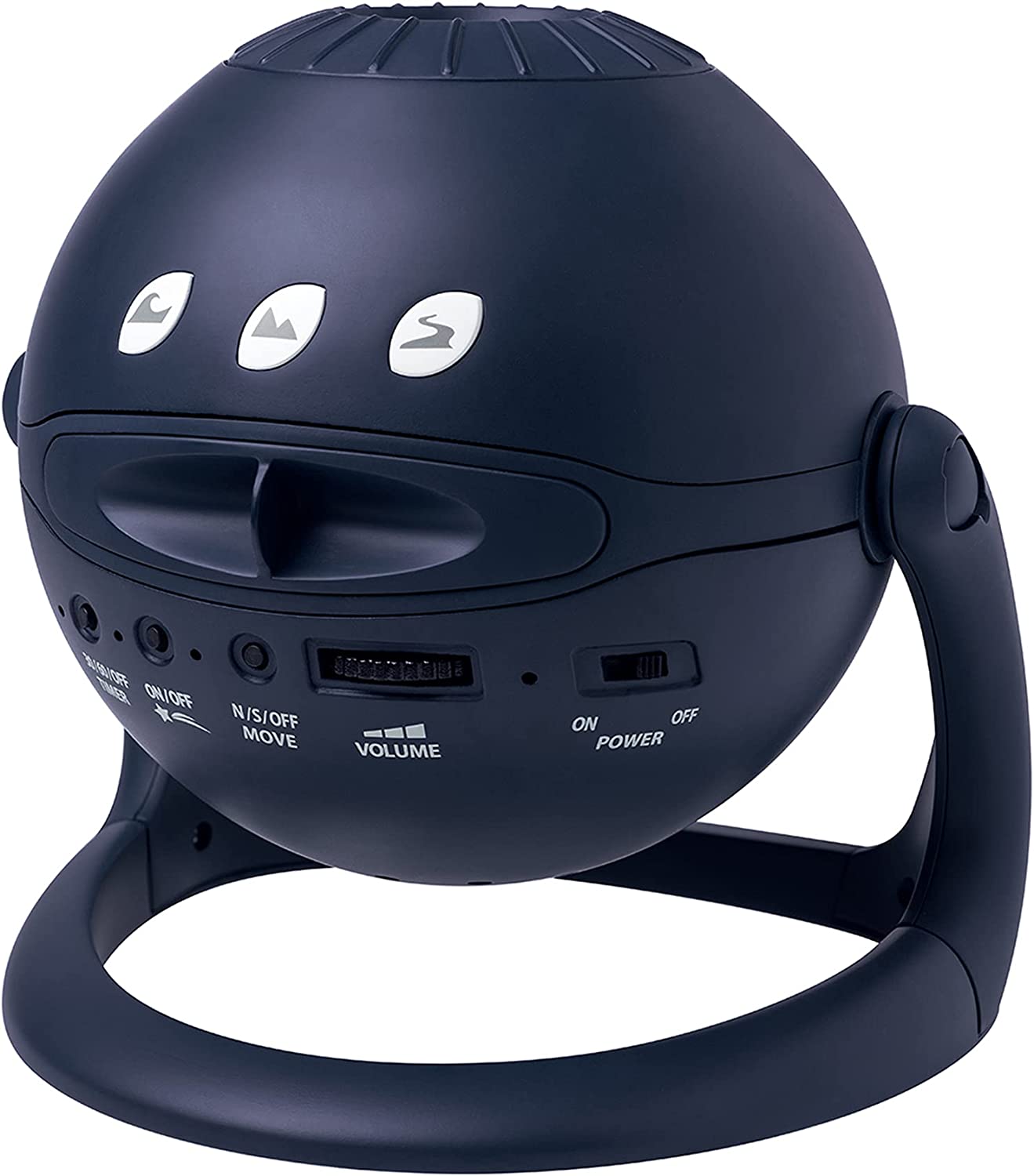
The Homestar Matataki is the first Homestar that makes the stars twinkle — and that single trick changes the whole feel of the room. A second disc, the effect plate, sits under the star disc and, combined with the slow diurnal rotation, makes 10,000 of the 60,000 stars shimmer softly, giving the projection a sense of depth that static discs can’t match. It’s the closest any home planetarium gets to the feeling of lying under a real night sky.
It’s also the most bedroom-friendly Homestar. A built-in speaker plays natural sounds — sea and mountain ambience — while the shooting-star mode fires occasional meteors across the sky, and the sleep timer shuts everything down after you drift off.
Power comes over USB, so it runs from a wall plug or a power bank, and the 106-inch projection circle fills a bedroom ceiling from about 5 to 7.5 feet away. Two star discs are included in the box.
The honest caveats: twinkle mode uses the special effect disc, so you choose between the full 60,000 static stars and the 10,000 twinkling set — not both at once. Like the rest of the family, controls are on-body only, and the optics sit exposed, so keep it dusted or covered. It costs more than the Original it replaces, but if you’re buying a planetarium to relax or fall asleep under, the twinkle effect earns the step up.
✓ Pros
- Twinkling star effect — the only Homestar with genuine depth
- Built-in speaker with nature sounds — made for falling asleep
- Shooting-star mode + sleep timer — the full bedtime package
- USB-powered — runs from a wall plug or a power bank
✗ Cons
- Twinkle or full star count — can’t have both at once
- On-body controls only, exposed optics — same family quirks
- Costs more than the Original it replaces
5. Encalife Ambience Galaxy & Star Projector — Best with Sound + Remote
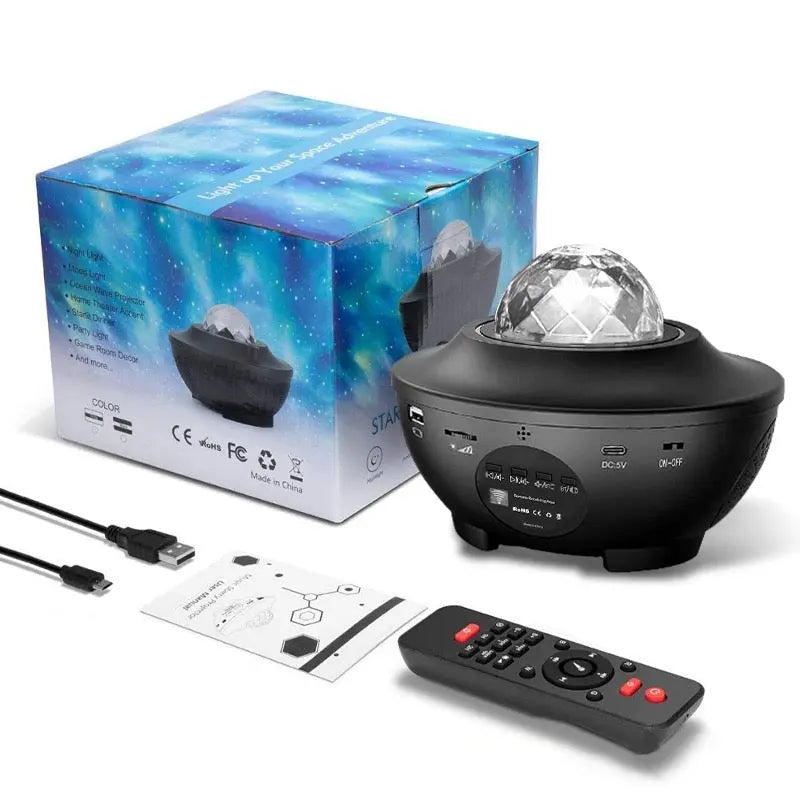
The Encalife Ambience is the “everything included” galaxy projector: laser stars plus nebula effects, a built-in speaker, a remote control, and a sleep timer — the full bedroom package in one unit. Where the BlissLights asks you to use your phone, the Encalife hands you a remote; where most galaxy projectors are silent, the Encalife plays sound to go with the visuals.
The practical wins are all about the nightstand experience. Remote plus on-body controls mean no app to install and no walking across a dark room. The built-in speaker covers white noise, nature sounds, or music to fall asleep to — a genuine differentiator if the projector is a sleep aid rather than a showpiece. Rotation, timer, and wide room coverage round out a package that asks nothing extra of the buyer.
The honest caveats: like the BlissLights, this is ambience, not accuracy — randomized stars and drifting effects, no real constellations, no educational value. The built-in speaker is a convenience, not a sound system — fine for sleep sounds, not for music you care about. And the laser means the same safety note as the Sky Lite: enjoyable to watch on the ceiling, not to stare into, and small children should not operate it alone.
✓ Pros
- Built-in speaker — sleep sounds and music without a second device
- Remote included — no app required, no cross-room walks
- Complete bedroom package — timer, rotation, sound in one unit
- Wide coverage — fills the room like the BlissLights
✗ Cons
- Ambience, not accuracy — no real star maps or constellations
- Speaker is basic — fine for sleep sounds, not for real listening
- Contains a laser — same lens/safety rules as the Sky Lite 2.0
Best Home Planetarium Buying Guide 2026
1. Accuracy vs ambience: decide what you are actually buying
This is the entire purchase decision, so make it first.
Accurate projectors (Homestar Flux, Homestar Matataki, Pococo) use physical discs to project the real night sky — constellations you can learn, star positions that match the outdoors.
Ambience projectors (BlissLights Sky Lite 2.0, Encalife) use lasers and LED clouds to create beautiful, randomized cosmic effects that correspond to nothing in the sky.
Ask yourself: “Do I want to find Orion, or do I want to feel like I am floating in space?” There is no wrong answer — but buying ambience while wanting accuracy is the number-one regret in this category.
2. Disc systems vs built-in effects: the long-term value math
A disc system is a platform; a fixed-effect projector is a finished product. With the Flux or Pococo, new discs mean new skies — the projector stays interesting for years, which is how you justify the higher upfront cost. Expansion packs for the Pococo are affordable; the Flux’s NASA-based discs are the premium tier.
A galaxy projector’s effects never change — what you see on night one is what you see on night one hundred. If this is a gift for a kid who will use it nightly, the disc system’s staying power matters more than the spec sheet suggests.
3. Room size and darkness beat specs
Every star projector on this list assumes a dark room — that is not a footnote; it is the operating condition. Even the brightest pick here softens with ambient light, so blackout curtains do more for the image than any upgrade. Then do the ceiling math: measure floor-to-ceiling height and compare it to the projection size in the table (8.9 feet for the Flux, 12 m² for the Pococo, 30×30 feet of laser for the Sky Lite).
A projector rated for a huge area in a small bedroom just means dimmer, more spread-out light — match the coverage to the room. For the general brightness logic, see How Many Lumens Do I Need for a Projector?
4. Noise, timers, and bedroom practicalities
These run while people sleep, so judge them as bedroom appliances. Every pick here has a sleep timer — verify the timer length options suit the sleeper (kids often need longer). Operational noise should be near-silent; disc systems have a faint mechanical drift sound that most people find soothing, but light sleepers should know it exists.
Light spill matters too: a projector throwing a 30-foot laser field will paint the hallway through an open door — close the door, or choose the tighter disc projection. And think about placement: a nightstand projector gets bumped; a shelf-mounted one does not.
5. Laser safety, kids, and honest expectations
The ambience picks (Sky Lite 2.0, Encalife) use low-class lasers — safe in normal use and widely sold, but the rule is simple and non-negotiable: enjoy the ceiling, never stare into the lens, and do not let small children operate them unsupervised. For young kids’ rooms, the non-laser disc picks (Homestar line, Pococo) remove the question entirely.
Finally, set expectations honestly: no home projector replicates a real planetarium dome or a dark-sky site. What the good ones do — especially the Flux — is bring a genuinely moving piece of the night sky indoors, which is plenty.
Frequently Asked Questions
Are home planetariums accurate?
Disc-based ones, yes — genuinely. The Sega Homestar Flux projects 60,000 stars from NASA-based disc imagery, true to time and date, and the Homestar Matataki and Pococo use the same real-sky-disc principle. Laser and nebula “galaxy” projectors are not accurate at all — their stars are randomized effects. Accuracy is a property of the disc system, not the price tag.
Do star projectors work in a room that is not fully dark?
They work, but everything softens. Every pick on this list is designed for a dark room, and ambient light washes out the fainter stars first — which disproportionately hurts the accurate projectors, since their value is in fine detail. Blackout curtains improve the image more than any upgrade. If the room cannot be darkened, the high-coverage ambience projectors (Sky Lite 2.0, Encalife) hold up better because their effect is about overall atmosphere, not fine points of light.
Are laser star projectors safe for kids?
In normal use, yes — the lasers in home galaxy projectors are low-class (Class 1 or 2), and the products are widely sold for bedroom use. The rules are: never stare directly into the projector lens, and small children should not operate them unsupervised. If you want to remove the question entirely, the non-laser disc projectors (Sega Homestar Flux/Original, Pococo) have no laser at all.
What is the difference between the Homestar Flux and the Homestar Matataki?
The Flux is the flagship: 60,000 stars, 8.9-foot projection, 5-watt LED, and the full premium disc ecosystem. The Matataki trades a little raw output for the twinkling-star effect — 10,000 stars shimmer through the effect plate — and adds a built-in speaker with nature sounds plus a sleep timer. Pick the Flux for maximum realism; pick the Matataki for the most relaxing bedtime sky.
Do I need WiFi or an app for a home planetarium?
No — and that is a feature, not a limitation. The disc-based picks (Flux, Original, Pococo) are fully on-body controlled with no connectivity at all. The Encalife includes a remote, also with no app needed. Only the BlissLights Sky Lite 2.0 meaningfully uses an app (for the sleep timer and fine brightness control) — and even it works from its on-body button without one. Nothing here requires WiFi, accounts, or firmware updates.
The Bottom Line
If you want the real night sky indoors, buy the Sega Toys Homestar Flux — nothing else here touches its accuracy, and the disc ecosystem keeps it interesting for years. If the Flux price stings, the Pococo Galaxy Projector delivers genuine disc-based cosmos images with a rechargeable battery for far less — the value pick that embarrasses pricier rivals.
If you want beauty over accuracy, the BlissLights Sky Lite 2.0 is the atmosphere king with the best app control, while the Encalife Ambience is the pick for anyone who wants sound and a remote with no phone involved. And for the most relaxing night sky, the Sega Homestar Matataki adds twinkling stars, nature sounds, and a sleep timer the others don’t offer.
The only wrong purchase here is buying ambience while wanting accuracy, or vice versa. Decide that first, and any of these five will do its job beautifully.
Hi! Your article “Best Home Planetarium 2023 – Star Projectors Reviews & Guide” is very helpful for. After reading your article I got a lot of knowledge from your article projector guides. I learned some interesting facts about the projector that I was not aware of. In the modern world, projectors play an increasingly important role. Thank you for sharing the information.