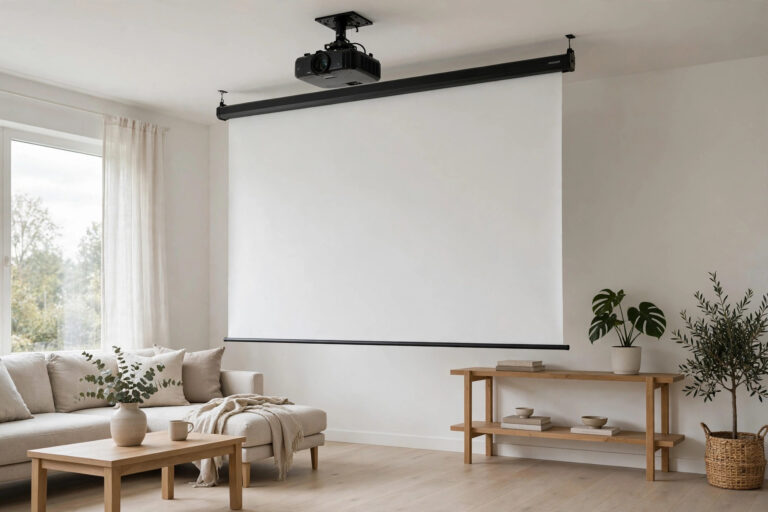
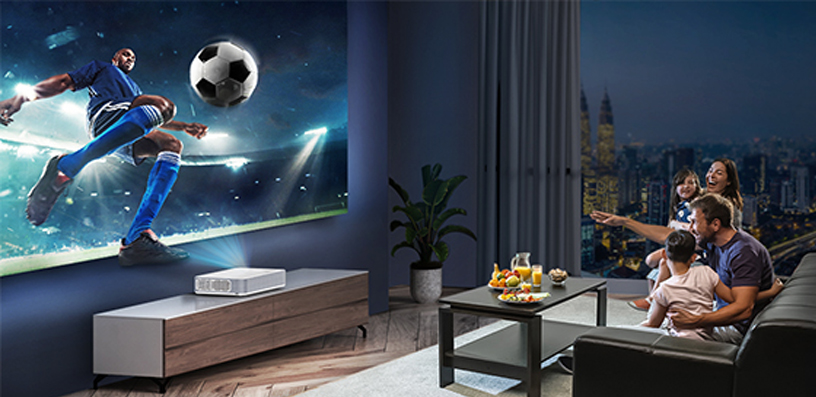
Best Projector for Sports Bar 2026 — Top 5 Picks for Game Day
A sports bar projector has the hardest job of any projector on this site. Home theater projectors get a dark room. Outdoor projectors get the night, but a sports bar projector gets noon kickoff with the doors open, neon signs glowing, and fifty people who will absolutely notice if the picture washes out during the fourth quarter. Brightness isn’t a nice-to-have here — it’s the entire purchase.
So here’s the honest starting point: buy lumens and a laser engine first, everything else second. A best projector for sports bar runs 8–12 hours a day, six or seven days a week. That’s 3,000+ hours a year.
A lamp projector at that pace eats a $200+ replacement bulb every 18–24 months — and goes dim in between. A laser engine runs 20,000–30,000 hours with no bulb swaps and no brightness fade: roughly a decade of game days.
Every pick on this list is laser except one, and that one earns its place on smart features alone (with the lamp caveat stated plainly).
We ranked this 2026 lineup by what actually matters behind a bar: honest brightness that survives ambient light, throw flexibility for ceiling mounts 15–30 feet from the screen, installation features (lens shift, HDBaseT, network control) that make a multi-display venue manageable, and a laser light source that doesn’t quit mid-season. Every pick is from an established manufacturer with published, measured specs — no inflated-lumen budget brands, no exceptions.
Best Sports Bar Projectors 2026 — Comparison Table
| Projector | Resolution | Brightness | Throw Ratio | Best For | Buy |
|---|---|---|---|---|---|
| ViewSonic LS740HD | 1080p Full HD | 5,000 ANSI lumens | 1.13–1.47 | Best overall sports bar projector | Buy from Amazon |
| Optoma ZH506T | 1080p Full HD (1920×1080) | 5,000 ANSI lumens | 1.4–2.24 | Best for big venues | Buy from Amazon |
| Epson Pro EX11000 | 1080p Full HD | 4,600 lumens | 1.32–2.12 | Best wireless / best color | Buy from Amazon |
| Optoma GT1090HDR | 1080p | 4,200 ANSI lumens | 0.50:1 | Best for tight spaces | Buy from Amazon |
| BenQ EH600 | 1080p Full HD | 3,500 ANSI lumens | 1.49–1.64 | Best smart features / budget | Buy from Amazon |
How We Picked These Sports Bar Projectors
A sports bar projector has five jobs, in this order:
Job one: beat the ambient light. Bar lighting is the enemy — windows, signage, overheads. You need 4,000+ ANSI lumens for a typical lit bar, 5,000 if the room is genuinely bright. Three of our five picks hit 5,000. This is also why “lumens” claims from no-name brands are dangerous: only ANSI/ISO-measured lumens from real manufacturers are comparable, and that’s all we used.
Job two: mount where the room allows. Bars mount projectors on high ceilings, often 15–30 feet from the screen, around ducts and beams. A generous zoom range (1.3x–1.6x) and lens shift decide whether the install is a one-hour job or a construction project. The long-throw picks here exist for exactly that reason.
Job three: survive the schedule. 8–12 hours a day, every day. Laser engines (20,000–30,000 hours, sealed against dust, instant on/off) are the only sane choice for commercial duty. We went all-laser except the smart-features pick, where we state the lamp trade-off explicitly.
Job four: connect to everything. A bar’s projector takes feeds from cable/satellite boxes, streaming sticks, and sometimes a media PC — often over long cable runs. Multiple HDMI inputs, HDBaseT (video over a single network cable up to 100m), and network control (Crestron/AMX) separate commercial projectors from home ones.
Job five: be bright, not beautiful. Color accuracy matters less in a bar than punch. Sports content — fast motion, bright uniforms, green fields — wants brightness and contrast over cinema-grade color. 1080p is the sweet spot; broadcast sports is still delivered in 720p/1080i, so 4K buys you almost nothing on game day.
Best Projector for Sports Bar 2026 — Detailed Reviews
1. ViewSonic LS740HD — Best Overall Sports Bar Projector
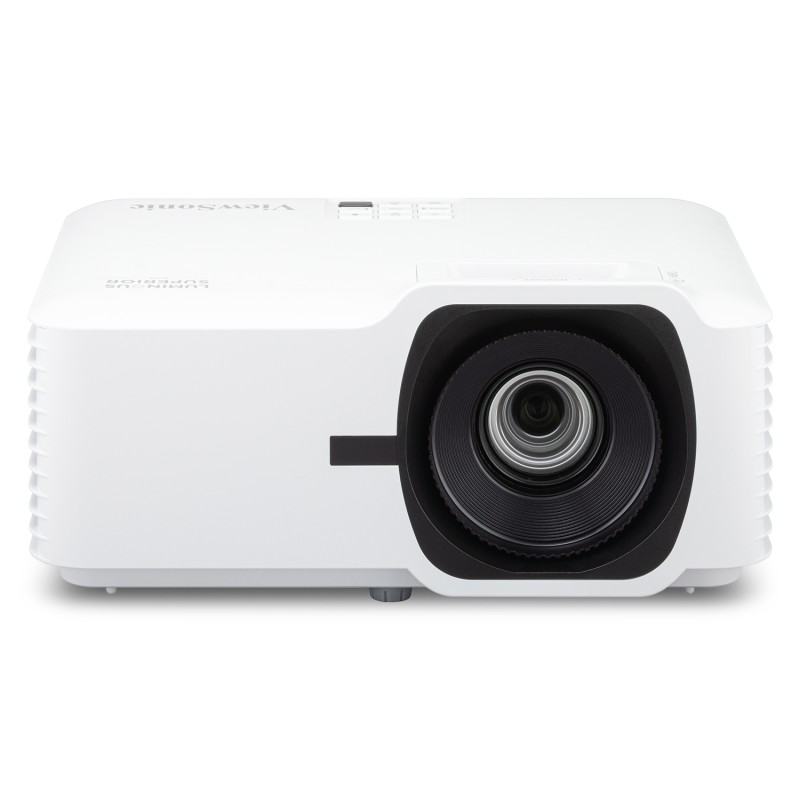
The LS740HD is the projector we’d spec for a typical sports bar sight unseen: 5,000 ANSI lumens from a laser engine, 1080p resolution, and a 1.13–1.47 throw ratio with 1.3x optical zoom — bright enough for a lit room, flexible enough for most ceiling mounts, and priced well under the commercial-installation flagships. It throws a 100-inch image from about 8 feet and stretches to 300 inches, which covers everything from a booth-area screen to the main wall.
What makes it a bar projector rather than just a bright projector is the commercial-duty engineering. The laser engine is sealed to IP6X against dust — relevant in a kitchen-adjacent, high-traffic room — and rated 20,000 hours at full power, 30,000 in SuperEco. That’s roughly ten years of 8-hour days before the light source is a concern. The USB-A port delivers 5V/1.5A, which is exactly enough to power a wireless HDMI dongle or streaming stick directly — one less cable, one less power adapter behind the bar. Two HDMI inputs cover the cable box and a backup source.
The honest caveats: there’s no lens shift here, so the mount position has to be right (use the throw math below before drilling). Input lag is 49.5ms — irrelevant for watching sports, but don’t buy this for the gaming corner. And the 15W speaker is fine for a small room but a non-factor in a real bar, where the house sound system does the work. For the core job — a huge, bright, always-on game-day image — nothing at this level does more for the money.
✓ Pros
- 5,000 ANSI lumens from a sealed laser engine — built for lit rooms
- IP6X dust-sealed light source — survives kitchen-adjacent, high-traffic bars
- USB-A port powers a wireless HDMI dongle or streaming stick directly
- 20,000 hours normal / 30,000 SuperEco — roughly a decade of game days
✗ Cons
- No lens shift — mount position must be exact; do the throw math first
- 49.5ms input lag — fine for sports, not for a gaming corner
- 15W speaker is a non-factor in a real bar (house PA does the work)
2. Optoma ZH506T — Best for Big Venues
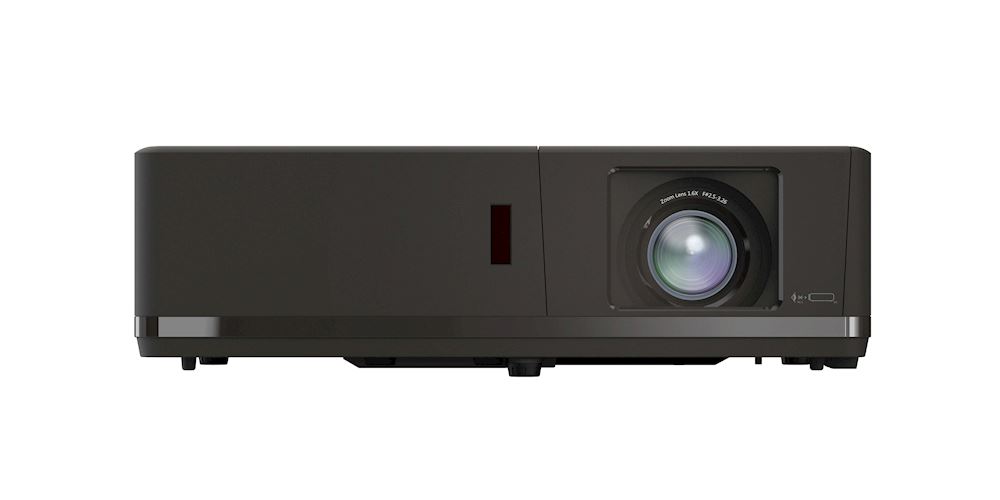
When the venue gets big — high ceilings, a 20-foot throw, multiple displays on one control system — the ZH506T is the commercial installer’s answer. It’s a ProScene installation projector: 5,000 ANSI lumens, 1080p Full HD (1920×1080) resolution, and a 1.4–2.24:1 throw ratio with 1.6x zoom that reaches screens from the back of a large room. The 1080p resolution is the native format of every sports broadcast — no scaling, no softness on game day.
The install features are what you’re really buying. HDBaseT carries video, audio, and control over a single Cat6 cable up to 100 meters — no HDMI extenders, no signal boosters, one clean run from the equipment rack to the ceiling.
Vertical lens shift (+8%) and four-corner correction forgive imperfect mount positions. LAN and RS-232 with Crestron, Extron, AMX, and Telnet support mean the projector joins the venue’s control system: scheduled on/off, remote monitoring, one button for “game mode” across every screen. It’s rated for 24/7 operation with a 30,000-hour DuraCore laser.
The honest caveats: at this brightness and feature set, you’re paying for the install-grade control stack — a two-TV neighborhood bar doesn’t need Crestron integration, and if you don’t, the LS740HD above gets you the same brightness for less. The 1.6x zoom is manual, not motorized, so dial in the throw at install time. But for a venue with an AV rack and a control system, this is the right tool.
✓ Pros
- HDBaseT — video, audio and control over one Cat6 cable up to 100m
- Vertical lens shift + 4-corner correction forgive imperfect mounts
- LAN/RS-232 with Crestron, Extron, AMX, Telnet — joins the venue control system
- 24/7-rated DuraCore laser — built for always-on commercial duty
✗ Cons
- Manual 1.6x zoom — set the throw at install, no remote adjustment
- Overkill for a small two-TV bar — the LS740HD gives the same brightness for less
- Heavier install conceptually — needs an AV rack mindset to justify it
3. Epson Pro EX11000 — Best Wireless / Best Color
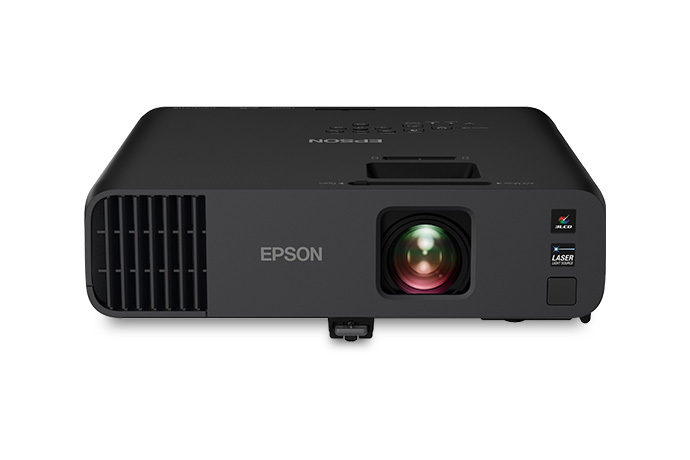
The EX11000 is the pick for the bar that wants the game on screen with minimum wiring fuss — and the best-looking picture of the five while it’s at it. It’s a 3LCD laser projector with 4,600 lumens of both color and white brightness (Epson’s whole pitch is that the two numbers match, where single-chip DLP projectors often quote a white-brightness number their color output can’t touch). For sports — saturated jerseys, green pitches, vivid graphics — that equal color brightness shows up as a punchier, more alive image at the same headline lumens.
The wireless story is the practical win. Built-in Miracast and network connectivity let you cast from a phone or laptop without running a cable to the ceiling — handy for playoff watch parties, fantasy draft nights, or the manager’s halftime playlist.
Two HDMI inputs plus USB power cover a cable box and a streaming stick simultaneously; it accepts 4K input signals, and auto vertical keystone plus 1.6x zoom (1.32–2.12 throw) make the install forgiving. The 16W speaker is genuinely decent for announcements and pre-game.
The honest caveats: 4,600 lumens is a half-step down from the 5,000-lumen picks — in a very bright room at noon, that gap is visible. There’s no lens shift, so placement still needs the throw math. And at 37dB on full brightness, it’s audible directly overhead; in a loud bar nobody notices, but don’t mount it over the quiet dining section. For the bar that values color punch and wireless convenience over absolute maximum brightness, this is the sweet spot.
✓ Pros
- 4,600 lumens of matched color AND white brightness (3LCD) — punchy sports color
- Built-in Miracast/wireless — cast from phone or laptop, no ceiling cable run
- Accepts 4K input signals; auto vertical keystone + 1.6x zoom ease install
- 16W speaker genuinely decent for announcements and pre-game
✗ Cons
- Half-step dimmer than the 5,000-lumen picks — visible in a very bright noon room
- No lens shift — placement still needs the throw math
- 37dB at full brightness — audible directly overhead in quiet moments
4. Optoma GT1090HDR — Best for Tight Spaces
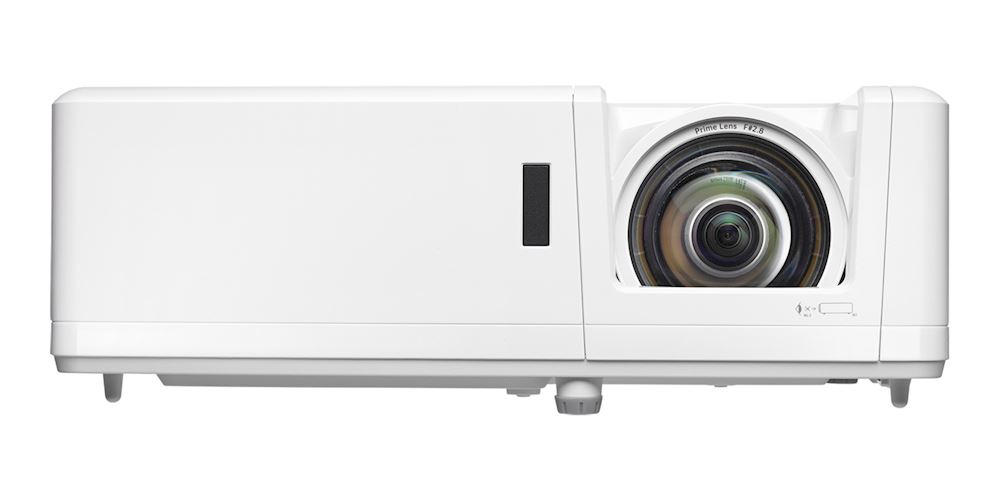
Not every bar has a 25-foot ceiling run. Low ceilings, booth dividers, a projector tucked above the back bar — when the mount point is close to the screen, the GT1090HDR’s 0.50:1 fixed short throw is the answer: a 100-inch image from under 4 feet away. Mount it tight above the screen, completely clear of sightlines, staff, and the occasional flying napkin. With 4,200 ANSI lumens from a DuraCore laser (20,000–30,000 hours), it’s still bright enough for a lit room.
The low input lag (16.4ms at 1080p/60) is a bonus most bar projectors can’t claim — if the venue runs gaming nights, a console corner, or interactive darts/golf simulators on a side screen, this is the only pick here that won’t smear fast input. HDR10/HLG support and 4K signal input keep it current, and the laser engine means the same decade-of-game-days longevity as the bigger picks.
The honest caveats: the fixed 0.50 throw is a specialist tool — screen size is locked to mounting distance (screen width ≈ distance × 2), so there’s no zoom to bail out a mismeasured mount. No lens shift either. And 4,200 lumens, while strong, is the second-dimmest here — fine for evening and moderate ambient light, but for a sun-blasted front window at noon, the 5,000-lumen picks pull ahead. For tight installs and multi-use venues, though, nothing else on this list fits where this fits.
✓ Pros
- 0.50:1 fixed short throw — 100-inch image from under 4 feet away
- 4,200 ANSI lumens from a DuraCore laser — bright enough for lit rooms
- 16.4ms input lag — the only pick here suited to gaming nights and simulators
- HDR10/HLG + 4K input keep it current
✗ Cons
- Fixed throw = zero zoom margin — screen size locked to mounting distance
- No lens shift — mismeasured mounts can’t be corrected
- 4,200 lumens is the dimmest laser here — not for sun-blasted front windows
5. BenQ EH600 — Best Smart Features / Budget Pick
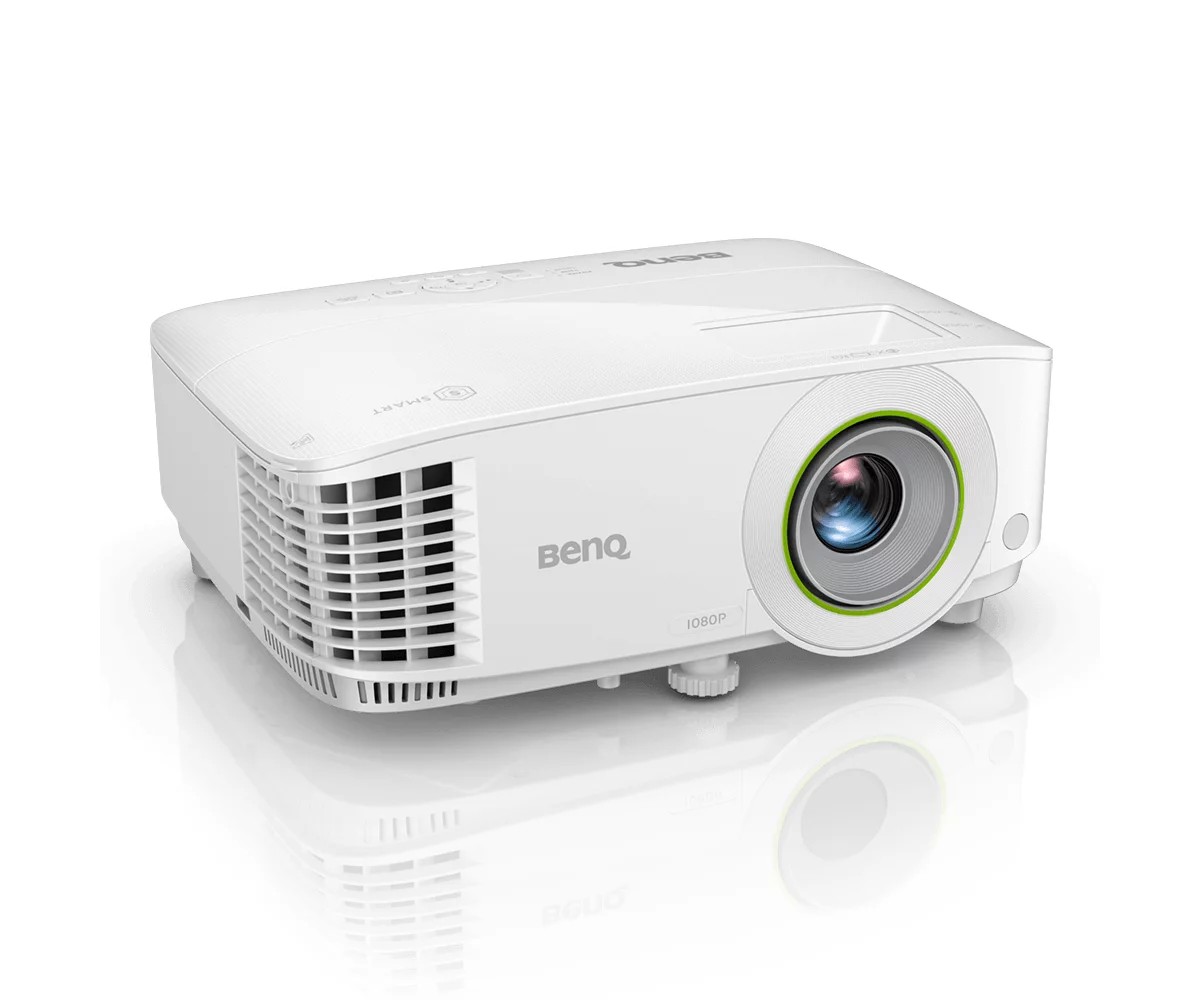
The EH600 is the odd one out — the only lamp projector and the dimmest at 3,500 ANSI lumens — and it’s here for one reason: it’s the smartest projector on the list, and the cheapest way into a bar-worthy image. Built-in Android with the BenQ Launcher, dual-band Wi-Fi, wireless mirroring from phones and laptops, Bluetooth audio-out, and a wireless dongle in the box: for a small bar, a restaurant back room, or a venue that streams as much as it watches cable, this removes a tangle of source devices.
The 1.49–1.64 throw ratio with 1.1x zoom suits medium ceiling mounts, the 10,000:1 contrast keeps sports watchable, and 33.4ms input lag is fine for casual use. Setup is genuinely painless — mirror a phone for the fight night stream, no laptop tethered to the ceiling.
The honest caveats, stated plainly because they matter at bar duty cycles: it’s a lamp projector (5,000 hours normal, up to 15,000 in SmartEco/LampSave). At 8–10 hours a day, that’s a replacement bulb every 2–3 years and gradual dimming in between — budget for it, or this pick’s value math breaks.
3,500 lumens is the floor for a lit bar, not the ceiling: this suits smaller or dimmer rooms, not a sunlit sportsbook. And the Android 6.0 smart system is dated — it works for mirroring and basic apps, but don’t expect a modern streaming UI. If the room is small and the budget is tight, it’s a legitimate pick; if the room is big and bright, step up to the laser picks above.
✓ Pros
- Smartest pick — Android, wireless mirroring, dongle in the box, Bluetooth audio-out
- Cheapest way into a bar-worthy image; painless phone-mirroring setup
- 1.49–1.64 throw suits medium ceiling mounts; 33.4ms lag fine for casual use
✗ Cons
- Lamp projector — budget a $200+ bulb every 2–3 years at bar duty cycles
- 3,500 lumens is the floor for a lit bar — not for big bright rooms
- Dated Android 6.0 smart system — fine for mirroring, not a modern streaming UI
Best Sports Bar Projector Buying Guide 2026
1. Brightness first: 4,000 ANSI lumens is the floor
Everything in a bar fights your projector: windows, overhead lights, neon, the glow of the kitchen pass. For a typical lit bar, 4,000 ANSI lumens is the minimum for a watchable image; 5,000 is the comfort zone for bright rooms and daytime games.
Three picks here hit 5,000. One critical rule: only compare ANSI (or ISO) lumens from established manufacturers. No-name brands advertise “10,000 lumens” measured by fantasy — those numbers are meaningless, and in a bar they’ll leave you with a washed-out rectangle.
2. Throw distance: do the ceiling-mount math before you buy
Ceiling mounts in bars are often 15–30 feet from the screen, threaded around ducts and beams. The formula: mounting distance = screen width × throw ratio. A 120-inch 16:9 screen is about 8.75 feet wide — with the LS740HD’s 1.13–1.47 throw, that means mounting 10–13 feet back; with the ZH506T’s 1.4–2.24, 12–20 feet.
Measure your actual mount point first, then pick the projector whose throw range contains it. Zoom range is your margin for error — 1.3x–1.6x gives you real latitude; a fixed-throw lens gives you none.
3. Laser, not lamp — the bar-hours math
A bar projector runs roughly 3,000 hours a year. A lamp lasts 4,000–5,000 hours at full power: that’s a $200+ bulb every 18 months, plus months of gradual dimming before each swap, plus the fun of a bulb dying during the playoffs. A laser engine runs 20,000–30,000 hours — 7 to 10 years at bar pace — with no dimming curve and instant on/off. Four of our five picks are laser for exactly this reason. The lamp pick (EH600) only makes sense if you budget the bulb cycle honestly.
4. Resolution: 1080p is the sweet spot for sports
Broadcast sports still arrives as 720p or 1080i. On a 120–150 inch bar screen viewed from 15+ feet, 1080p resolves everything the broadcast contains. 4K buys you essentially nothing for live sports — and 4K commercial-bright projectors cost multiples more.
The ZH506T sticks to 1080p (1920×1080), the native resolution of every sports broadcast — no scaling, no softness on game day. If the same display doubles as digital signage or menu boards and you want extra vertical pixels, that’s a WUXGA (1920×1200) projector’s job — a different pick for a different need.
5. Inputs and control: plan for the equipment rack
A bar projector’s sources live in a rack, not next to the screen: cable/satellite box, a streaming stick, maybe a media PC. You want two or more HDMI inputs, and for runs over 25 feet, HDBaseT (video/audio/control over one Cat6 cable up to 100m) beats HDMI extenders every time.
For multi-display venues, network control (Crestron, AMX, Extron — supported by the ZH506T and EX11000) means scheduled power, remote monitoring, and one-button source switching across every screen from behind the bar.
6. Wireless and smart features for game-day flexibility
Not everything is a cable box anymore: fight-night streams, the manager’s phone for highlights, a laptop for the fantasy draft. Built-in wireless (EX11000’s Miracast, EH600’s mirroring) or a USB-powered streaming stick (the LS740HD’s USB-A port powers one directly) covers the ad-hoc sources without new cable runs. Decide which sources are permanent (wire them) and which are occasional (wireless is fine).
7. Screen size and ambient light: go big, and consider ALR
For sports viewing, the rule of thumb is screen diagonal ≈ viewing distance ÷ 2.5. A 20-foot viewing distance wants roughly a 96–120 inch image; most bars land at 120–150 inches. In bright rooms, pair the projector with an ambient-light-rejecting (ALR) screen — it preserves contrast under overhead lighting in a way a white wall or basic screen can’t — our bright-room projector picks use the same logic. A 5,000-lumen projector on an ALR screen beats a brighter projector on a bad surface.
8. Audio: the projector’s speakers don’t matter
Every bar has a house sound system — the game audio runs through ceiling speakers, not the projector. So ignore speaker wattage when comparing (we list it in specs for completeness, but it’s a non-factor). What matters is getting audio out cleanly: a 3.5mm audio-out or HDMI-ARC path to your mixer. All five picks provide one.
Frequently Asked Questions
How many lumens does a sports bar projector need?
4,000 ANSI lumens minimum for a typical lit bar; 5,000 ANSI lumens for bright rooms, daytime games, or screens over 150 inches. Only compare ANSI/ISO lumens from established manufacturers — inflated no-name “lumens” claims are not comparable.
What throw ratio do I need for a ceiling-mounted bar projector?
Use: mounting distance = screen width × throw ratio. Measure your actual mount point first. For 15–30 ft ceiling runs, you want a projector with a generous zoom range (1.3x–1.6x) — the LS740HD (1.13–1.47) and ZH506T (1.4–2.24) cover most bar installs. Short-throw models like the GT1090HDR (0.50:1) are for tight spaces only — see our short-throw projector picks for more.
Laser or lamp for a sports bar?
Laser, decisively. Bar projectors run ~3,000 hours a year; a lamp needs a $200+ replacement every 18–24 months and dims in between, while a 20,000–30,000-hour laser runs 7–10 years with no bulb swaps. Four of our five picks are laser.
Can I use a home theater projector in a sports bar?
You can, but you’ll fight it: home theater projectors optimize for dark rooms (2,000–3,000 lumens won’t survive bar lighting), lack long-throw zoom and lens shift for high ceiling mounts, and have no HDBaseT or network control for commercial installs. A bright commercial projector costs more upfront and far less in headaches.
How big should the screen be in a sports bar?
Screen diagonal ≈ viewing distance ÷ 2.5. Most bars land at 120–150 inches for the main display. In bright rooms, pair it with an ambient-light-rejecting (ALR) screen — it does more for daytime contrast than extra lumens alone.
Do I need 4K for watching sports?
No. Live sports broadcasts are delivered in 720p/1080i, and at bar viewing distances (15+ feet), 1080p resolves everything the signal contains. Spend the budget on brightness and a laser engine instead. WUXGA (1920×1200) is worth considering only if the display doubles as signage.
**How do I connect a cable box that’s 50 feet from the projector?
Use HDBaseT (supported by the ZH506T): one Cat6 cable carries HDMI video, audio, and control up to 100 meters. For shorter runs, a quality active HDMI cable works. Wireless (Miracast/casting) is fine for occasional sources, but wire anything that runs all day.