
How Long Does a Mini Projector Battery Last in 2026
How long does a mini projector battery last on a single charge? It decides whether a battery projector is genuinely portable or just portable in the box — one that dies halfway through a film is an interruption, not a cinema.
The honest answer is that most battery-powered mini projectors run roughly 2 to 5 hours on one charge. Where a model lands in that range depends on its size, brightness setting, and how you use it — a pocket projector sipping power in eco mode and a bright portable at full brightness do very different jobs.
This guide explains what the numbers really mean, what drains the battery fastest, and how to stretch one charge through a whole film.
How Long Does a Mini Projector Battery Last in Real Use?
In normal evening viewing, expect about 2 to 3 hours from a pocket projector and 2.5 to 5 hours from a larger portable model — a wide spread, because “normal viewing” covers many settings, and brightness is the biggest lever, eco mode the second.
Here is a realistic picture by size class — typical ranges across current models, not a promise for any one projector, and the maker’s claimed figure is usually measured in the most forgiving conditions.
| Projector size class | Typical battery life | What it suits |
|---|---|---|
| Pocket (under about 1 lb) | Around 2 to 2.5 hours | One film in a dark room, or a short presentation |
| Portable (roughly 1 to 3 lbs) | Around 2.5 to 4 hours | A film plus a bit of headroom, or two shorter shows |
| Larger portable (over about 3 lbs) | Around 4 to 5 hours | A double feature, or a long evening outdoors |
The pattern is simple: bigger body, bigger battery, longer run time. Pocket projectors trade hours for size, so one film is the realistic limit.
One more thing the headline number hides: it is usually for video playback. Music with the picture off, where a model supports it, can last far longer, because the light source — the hungriest part — is off.
What Drains a Mini Projector Battery Fastest?
Five things decide how long a charge lasts. Brightness dominates, but the others add up — together they explain why two evenings with the same projector can end very differently.
Brightness mode. The light source is the biggest power draw in any projector. Full brightness can cut run time by roughly a third to a half compared with eco mode — and in a dark room, eco mode often looks nearly as good.
Speaker volume. Built-in speakers at high volume draw noticeably more power. A projector working hard to fill a garden with sound dies sooner than one whispering dialogue in a bedroom — pairing a separate speaker helps, as covered in our guide to connecting speakers to a projector.
Wi-Fi and streaming. Streaming over Wi-Fi costs more energy than playing a file from USB or HDMI: the wireless radio runs constantly, and the processor works harder decoding the stream. Downloaded content is the kindest thing you can feed a battery.
Content type. Bright, fast-moving scenes draw more power than dark, slow ones. A bright animated film costs more battery than a dim drama at the same setting, and gaming — constant motion, high frame rates — is heavier on the battery than a film.
Temperature and battery age. Cold nights outdoors shorten run time, because lithium batteries deliver less energy when cold. Heat is worse long-term: regular hot conditions age the battery faster, so a battery that once managed three hours may manage two after a couple of years of heavy use.
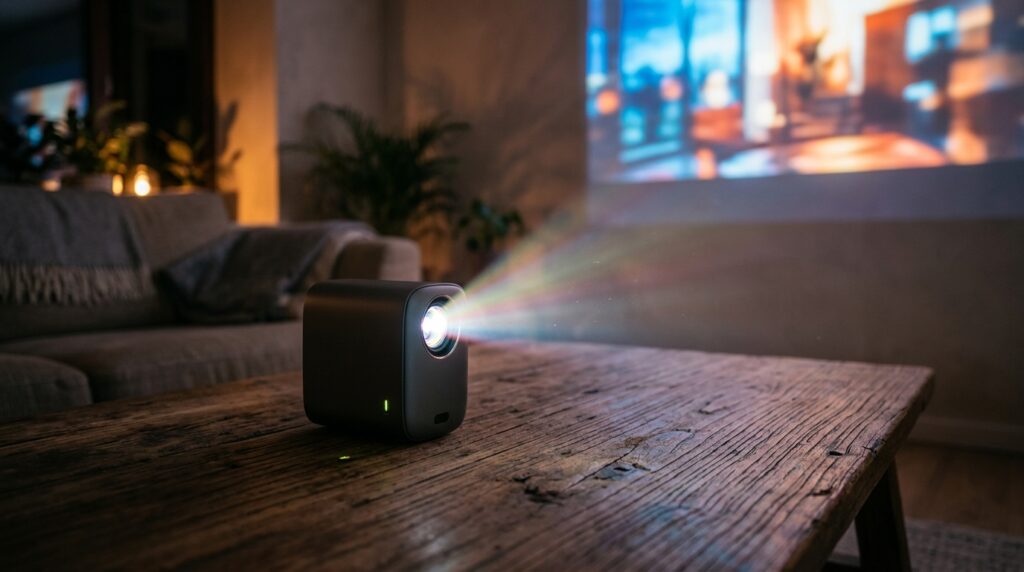
Why the Claimed Hours and Your Hours Differ
Most makers quote battery life measured in eco mode, at low brightness and volume, often with local content rather than streaming. Those are fair lab conditions, but not a typical film night — real-world use usually lands 20 to 40 percent below the headline figure.
Read the small print on any claimed figure: which brightness mode, what volume, video or audio only. A “5 hours” claim that turns out to be audio-only tells you nothing about film playback — and if no conditions are stated, assume best case and plan for less.
Also watch the capacity units. Battery size is quoted in milliamp-hours (mAh) or watt-hours (Wh), and mAh alone misleads — the same mAh at different voltages holds different energy. Watt-hours already accounts for voltage, so compare watt-hours, not milliamp-hours.
How to Make a Mini Projector Battery Last Longer
Stretching a charge is mostly about turning down the hungriest parts. None of these tips needs new gear — just settings and habits that cost nothing.
Use eco mode for films. In a dark room, it is usually the single biggest win, and the picture difference is smaller than expected — save full brightness for rooms with some light, where it earns its power.
Lower brightness one notch rather than living at maximum. One step down often buys a meaningful chunk of extra time with barely any visible change in a dim room.
Keep the volume moderate, or use an external speaker. A small Bluetooth speaker beside the seating carries dialogue better than a straining projector, and takes the audio load off its battery entirely.
Download before you go. Where your app allows it, download the film at home and play it locally — you skip the wireless drain and weak outdoor signal, which otherwise makes the radio work harder.
Close what you are not using. Turn off Bluetooth if nothing is connected, and close background apps on a smart projector — each idle radio is a small, constant drain.
Start fully charged, and mind the cold. On cold nights, keep the projector in a bag until showtime rather than letting it sit in the chill. Our guide to powering a projector outdoors without an outlet covers the wider off-grid setup.
Can You Run a Mini Projector From a Power Bank?
Often yes — but not with any power bank, and not always while it is running. Check three things before relying on one.
First, the bank’s output must match what the projector asks for. Small pocket models may run from ordinary 5V USB, but larger portables typically need USB-C Power Delivery at much higher wattage — sometimes 65W or more.
A bank that cannot deliver the required watts will either fail to start the projector or drain while plugged in.
Second, check pass-through charging — running while it charges. Some models support it and can run indefinitely from a suitable bank. Others disable the picture while charging, or trickle-charge during playback, so the bank extends the evening rather than removing the limit.
Third, use the right cable. A thin, low-rated USB-C cable can throttle power even from a capable bank — use the supplied cable, or one rated for the wattage the projector needs. If a bank “should work” but the projector still drains, suspect the cable first.
One practical rule: size the bank generously — roughly twice the projector’s battery capacity in watt-hours covers conversion losses of typically 10 to 20 percent.
What to Check Before Buying a Battery Projector
If battery life matters to you — and on a battery projector it should — run through this checklist before buying.
- Video hours, not just hours. Confirm the figure is for video playback, and in which mode — audio-only figures do not count for film nights.
- Watt-hours over milliamp-hours. Compare capacity in Wh where published — the only apples-to-apples number.
- Eco mode behaviour. Does it drop into eco automatically on battery, or must you find the setting? Automatic eco is one less thing to remember at showtime.
- Pass-through charging. Can it run from a bank or wall charger while playing? This alone decides whether the battery is a hard limit or a soft one.
- Charging time. A projector that runs two hours but takes four to recharge is awkward on a trip — look for recharge time near or below run time.
- Your real evening. Match the battery to your longest normal session, not your average one — if film nights run two and a half hours, a two-hour battery frustrates you every time.
For phone viewing, the connection matters too — see how to connect a phone to a projector for a backyard movie — since wireless casting adds battery cost on both phone and projector.
Frequently Asked Questions
How long does a mini projector battery last on one charge?
Most battery-powered mini projectors run roughly 2 to 5 hours on one charge — pocket models about 2 to 2.5 hours, larger portables about 2.5 to 5 hours, depending on brightness, volume, and whether content is streamed or local.
Does eco mode really make the battery last longer?
Yes — eco mode is usually the single biggest battery saver, extending run time by roughly a third or more over full brightness. In a dark room, the picture difference is often small, making it the default for film nights.
Can I charge a mini projector while using it?
It depends on the model. Some support pass-through charging and run from a bank or wall charger while playing. Others only charge with the picture off, or so slowly during playback that the battery still drains — check the manual before relying on it.
What size power bank do I need for a mini projector?
Match the bank to the projector’s power needs, not just its battery size. Small pocket models may run from 5V USB; larger portables often need USB-C Power Delivery at 65W or more — as a rule, choose a bank rated at roughly twice the projector’s battery capacity in watt-hours.
Why does my projector battery die faster than the claimed hours?
Claimed figures are usually measured in eco mode, at low brightness and volume, often with local content. Real film nights — brighter picture, louder speakers, Wi-Fi streaming — typically land 20 to 40 percent below the headline figure, and cold weather and battery age shorten it further.
Is mAh or watt-hours the right way to compare projector batteries?
Watt-hours (Wh) is the honest comparison. Milliamp-hours (mAh) alone ignores voltage, so two batteries with the same mAh can hold very different energy. Where Wh is published, compare that — a 50 Wh battery holds roughly twice the energy of a 25 Wh one.
Can I take a battery projector on a plane?
Usually yes, in cabin luggage. Most consumer projector batteries fall under the common 100 Wh airline limit for lithium batteries in the cabin. Check the watt-hour rating and your airline’s rules first, and never pack a lithium battery in checked luggage unless the airline explicitly allows it.
How do I make my projector battery last for a whole movie?
Start fully charged, switch to eco mode, keep the volume moderate or use an external speaker, and play downloaded content instead of streaming. Together, those four steps usually stretch a borderline battery through a full-length film.
Bottom Line
How long does mini projector battery last? For most models, plan on 2 to 3 hours for a pocket projector and 2.5 to 5 hours for a larger portable one — the lower end for a bright, loud, streamed film night. The headline figure is a best case, measured in eco mode under kind conditions.
The practical takeaway: buy the battery for your longest evening, not your average one, and treat eco mode, moderate volume, and local playback as free battery extenders.
If the battery is still short, a correctly sized power bank — pass-through charging confirmed — turns the limit from a hard stop into a soft one. Get those basics right, and the film ends when the credits roll, not when the battery gives up. Look after it too — moderate storage charge, no hot cars, no regular full drains.