Can You Use Projector Outside During Day? (2026 Guide)
Yes — you can use a projector outside during the day, but only if you respect one law of physics: the light hitting your screen from the sun has to lose to the light coming from your projector.
In open shade or on an overcast afternoon, a bright projector (3,000+ ANSI lumens) paired with the right screen delivers a genuinely watchable image. In direct sunlight, no consumer projector on earth will save you — the sun is roughly a hundred times brighter than what your projector can put on the screen.
This guide shows you exactly where that line sits, how many lumens each daytime scenario really needs, and the setup tricks that make daylight viewing actually work.
Why Daylight Destroys a Projected Image (the 60-Second Physics)
A projector doesn’t “shine through” daylight — it competes with it. What your eyes perceive as a good image is contrast: the difference between the brightest white and the darkest black on the screen.
Every bit of ambient light that lands on the screen raises the black floor. Blacks turn grey, colors wash out, and eventually the whole image disappears into a glowing rectangle.
Here’s the math that decides everything. Brightness on the screen is measured in lux, and 1 lux = 1 lumen per square meter.
A 100-inch 16:9 screen measures about 2.76 square meters. So a 3,000-lumen projector puts roughly 3,000 ÷ 2.76 ≈ 1,090 lux on that screen. Now compare: open shade on a bright day is 5,000–10,000 lux. An overcast sky delivers 10,000–25,000 lux. Direct sunlight blasts past 100,000 lux.
Your projector isn’t slightly outgunned in daylight — it’s outnumbered ten to one, and that’s before you enlarge the screen.
One more critical distinction: ANSI lumens. It’s the only brightness number you should trust — a standardized measurement taken across a 9-point grid. No-name brands love advertising “10,000 lumens” projectors that actually output 300–500 ANSI lumens; those inflated figures (sometimes labeled “LED lumens” or “light source lumens”) can run 3–4x higher than the honest ANSI number. When comparing projectors for daytime use, only compare ANSI lumens from established manufacturers. Everything else is marketing fog.
How Many Lumens Do You Actually Need? (By Scenario)
Forget the single magic number — the answer depends entirely on how much ambient light hits your screen. These minimums assume a 100-120 inchs screen, which is the sweet spot for backyard viewing:
Deep shade (under a patio cover or dense trees, ~1,000–3,000 lux ambient): 2,500–3,000 ANSI lumens. This is the comfortable zone — a solid mid-range projector looks genuinely good here.
Open shade on a bright day (~5,000–10,000 lux): 3,500–4,500 ANSI lumens. Watchable and enjoyable, though blacks will be dark grey rather than true black.
Overcast sky (~10,000–25,000 lux): 4,000–5,000+ ANSI lumens. Acceptable for sports and casual viewing; don’t expect cinematic contrast.
Bright daylight with sun near (but not on) the screen (25,000+ lux): 5,000+ ANSI lumens. You’re at the edge — the image will look washed out, but scores and subtitles stay readable.
Direct sunlight on the screen (100,000+ lux): no consumer projector exists for this. You’d need commercial installation projectors (20,000+ lumens, five-figure prices), and even those struggle. Don’t bother — move the screen into shade instead.
And remember the screen-size trap: the same 3,000 lumens spread over a 120-inch screen is about 30% dimmer per square inch than on a 100-inch screen. In daylight, keep the image 100–120 inches max. Bigger is not better when you’re fighting the sun — it’s dimmer.
If you’re shopping specifically for brightness, our daylight projector guide breaks down which projector types hold up best when the sun is out.
Your Screen Matters as Much as Your Projector
Beginners obsess over projector lumens and project onto a bedsheet. That’s backwards — in daylight, the screen is half the battle.
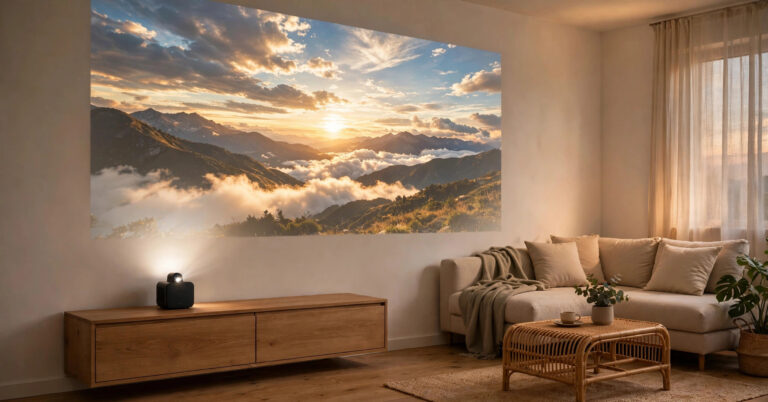
Matte white (gain 1.0) is the honest all-rounder: brightest image, widest viewing angle, lowest cost. In real shade, it’s excellent. But it’s also the first to surrender as ambient light rises, because it reflects all light equally — projector and sun alike.
Grey screens (gain ~0.8–0.9) are the daylight compromise most people should consider. The grey surface absorbs some ambient light, which deepens the black floor and improves perceived contrast. The trade-off: whites get dimmer too, so pair a grey screen with a brighter projector to compensate. In unkillable ambient light, grey beats white.
ALR (ambient light rejecting) screens are the real technology play. Their optical surface — microscopic lenticular or Fresnel structures — reflects the projector’s light toward the viewers while rejecting ambient light arriving from above and the sides.
A good ALR screen can make an image look two to three times punchier in bright shade. The honest caveats: viewing angles narrow (move off-center and brightness falls off), cheap ALR screens hotspot, they cost several times more than a white screen — and they still cannot defeat direct sunlight hitting the screen surface.
What not to use: a wrinkled bedsheet (every crease is a bright line), a glossy painted wall (hotspotting and reflections), or anything textured. If you’re choosing between screen types, see our full breakdown of outdoor projector screens for what works in real backyards.
Positioning and Timing: The Free Brightness Upgrade
Before spending a dollar on more lumens, try the upgrades that cost nothing:
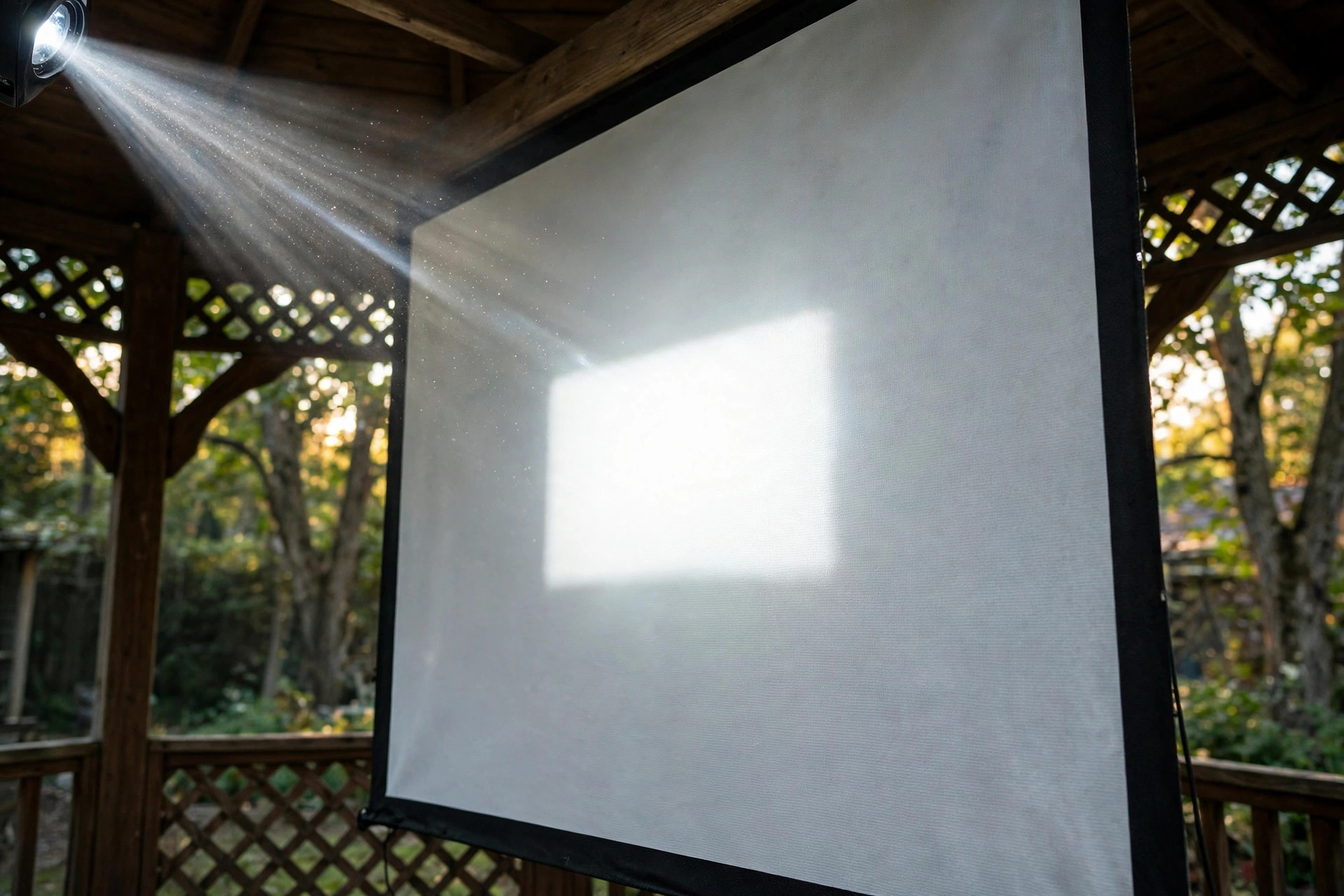
Shade the screen, not just the projector. This is the single most misunderstood point in daytime projection. One patch of sunlight on the screen destroys contrast across the whole image — even if the projector itself sits in perfect shade. Walk your yard at the time you plan to watch and confirm the screen location stays shaded.
Face the screen away from the sun. In the northern hemisphere, a north-facing screen avoids direct sun for the longest stretch of the day. East-facing works for afternoon viewing; west-facing is the worst choice for evenings.
Dusk is king. The hour around sunset is the cheat code of outdoor projection. Ambient light falls off a cliff as the sun drops — from ~10,000 lux to a few hundred — while your projector’s output stays exactly constant. A modest 2,500-lumen projector at dusk will visibly outperform a 4,000-lumen projector at noon. If your schedule flexes at all, start the movie at sunset, not at 3 PM.
Manufacture shade. A $50 pop-up canopy or shade sail over the viewing area does more for image quality than upgrading to a projector costing hundreds more. Patio covers, gazebos, and even a large umbrella positioned to block sun from the screen (not just the seats) all count.
Keep the projector itself cool and shaded. Direct sun on the projector body drives internal temperatures up, and most projectors respond by dimming the lamp or shutting down entirely to protect themselves. Heat doesn’t just hurt the image — it can end the movie.
What Actually Works in Full Daylight — Honest Answers
Let’s clear up what daytime projection can and can’t do, because this category is full of wishful marketing.
Laser vs. lamp vs. LED for daytime: for daylight use, you need every lumen you paid for — not just on day one, but in year three. Laser projectors hold their brightness over 20,000+ hours with minimal dimming. Traditional lamps dim noticeably over their 3,000–5,000 hour life, and many LED models dim too. If daytime viewing is your primary use case, laser’s brightness longevity is worth real money.
The realistic ceiling: a 4,000–5,000 ANSI lumen laser projector paired with an ALR or grey screen, set up in bright shade, produces a genuinely good daytime image — sports, cartoons, and presentations all look great. The same rig with sun hitting the screen looks washed out. Physics doesn’t negotiate, and no spec sheet overrides it.
Don’t believe “daylight viewable” mini projectors. Most portable minis output 200–500 ANSI lumens. That’s plenty in a dark room and completely invisible at noon. If a product page claims daylight performance without stating ANSI lumens, that silence is your answer.
Content choice matters. Bright, high-contrast content (sports, animation, presentations with dark text on light backgrounds) survives daylight far better than dark cinematic films. A moody night scene in a movie will always be the first casualty of ambient light — plan your daytime watchlist accordingly.
Daytime Projector Setup Checklist
Run through this before every daytime viewing session:
1. Scout the sun. Check the sun’s path for your viewing time — the screen location must stay shaded, not just the seating.
2. Confirm real brightness. Minimum 3,000 ANSI lumens for shade, 4,000+ for bright conditions. Verify the ANSI number; ignore “LED lumens.”
3. Match the screen to the light. Grey or ALR screen if ambient light is unavoidable; matte white only in genuine shade.
4. Cap the image size. 100–120 inches max in daylight — larger screens spread your lumens thinner.
5. Shade the projector. Keep it out of direct sun to prevent thermal dimming or shutdown.
6. Do the menu test. Project the projector’s menu before the movie — if white menus look grey, you need more shade, not a better projector.
7. Have a dusk backup plan. If the afternoon image disappoints, the same setup at sunset will look dramatically better.
8. Pick daylight-friendly content. Save the dark prestige drama for after dark; sports and animation thrive in daylight.
For the projector side of the equation — brightness, throw distance, and weather resistance — our best outdoor projectors guide covers what to look for beyond raw lumens.
Frequently Asked Questions
Can I watch a projector in direct sunlight?
No — not with consumer equipment. Direct sunlight delivers over 100,000 lux, while even a 5,000-lumen projector puts under 2,000 lux on a 100-inch screen. You would need a commercial 20,000+ lumen installation projector costing five figures, and even that would struggle. Shade the screen or wait for dusk; those are the only practical answers.
Is 3,000 lumens enough for daytime viewing?
In shade or on an overcast day, yes — on a 100 to 120-inch screen with a suitable screen material, 3,000 ANSI lumens gives you a genuinely watchable image. In bright open daylight, you’ll want 4,000 or more. And confirm they’re ANSI lumens: 3,000 “LED lumens” from a no-name brand is typically under 1,000 ANSI lumens, which won’t cut it outside a dark room.
Do ALR screens really work outdoors?
Yes, within limits. A good ALR (ambient light rejecting) screen rejects off-axis ambient light while reflecting the projector’s beam toward viewers, which can make the image look dramatically punchier in bright shade. But the screen surface must stay out of direct sun, viewing angles are narrower than matte white, and quality ALR screens cost several times more. They’re an upgrade, not a miracle.
Should I get a white or grey screen for daytime use?
Grey if you can’t eliminate ambient light: it deepens the black floor and improves perceived contrast, though it dims whites too — so pair it with a brighter projector. Matte white if your screen genuinely sits in shade: you’ll get a brighter image, wider viewing angles, and a lower price. When in doubt between the two, grey is the safer daylight choice.
What time of day is best for outdoor projection?
The hour around sunset. Ambient light collapses as the sun drops — from roughly 10,000 lux to a few hundred — while your projector’s output doesn’t change at all. That means a modest projector at dusk visibly outperforms a much brighter projector at noon. If you can shift your movie night even one hour later, do it.
The Bottom Line
Daytime projection isn’t won by buying the brightest projector — it’s won by managing light. Shade the screen, aim for dusk, insist on real ANSI lumens (3,000 minimum), and choose a grey or ALR screen, and you’ll get a genuinely enjoyable daytime image. Try to fight the sun head-on, and no projector wins. Work with the light instead, and even a mid-range setup shines.