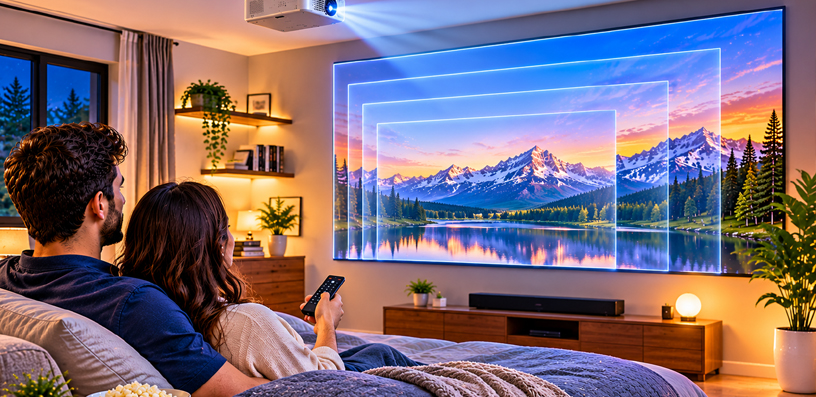
What Size Projector Screen Fits a Bedroom Wall 2026 – Complete Guide
A bedroom is the easiest room in the house to turn into a home theater, and the hardest to size a screen for. The walls are shorter than in a living room, the bed takes up much of the floor, and the viewing distance is often barely ten feet.
So the question of what size projector screen fits a bedroom wall is not about the biggest screen you can afford. It is about the biggest screen your wall and your bed will allow.
A screen that is too large feels overwhelming from the pillow, while one that is too small wastes the one wall that could carry a real theater image.
This guide, What Size Projector Screen Fits a Bedroom Wall, covers the bedroom angle only: measuring a small wall, judging distance from the bed, comparing the three sizes that fit most bedrooms, and choosing a projector type.
What Size Projector Screen Fits a Bedroom Wall?
For most bedrooms, a 100-inch screen is the sweet spot: large enough to feel cinematic from the bed, and it fits the usable width of a typical bedroom wall with room to spare.
An 80-inch screen is safer for a small bedroom or a wall broken up by a door or window, while a 120-inch screen only works when the wall is wide and the bed sits far enough back.
How to Measure Your Bedroom Wall for a Screen
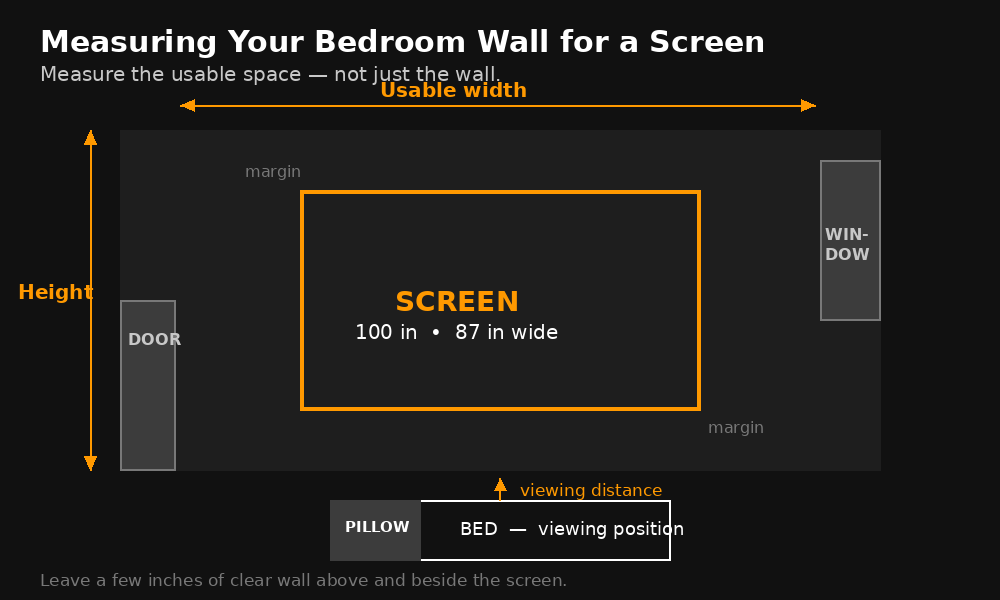
Start with the wall itself. Measure the full width from corner to corner, then the height from floor to ceiling. These are your outer limits.
Next, mark every obstacle. A door needs clearance to swing, a window needs its frame and curtains, and a wardrobe takes up width you cannot project across. Measure the distance between the obstacles, not between the corners. That gap is your usable width, and it decides your maximum screen size.
Then think about where the bed sits. Measure from where your head rests on the pillow to the wall where the screen will hang. That is your viewing distance.
Leave a few inches of margin above and beside the screen, and measure the full outside dimensions of a fixed-frame screen, not just the diagonal.
Check the height too. A 100-inch 16:9 screen is about 49 inches tall, and a 120-inch screen is about 59 inches tall. In a room with a low or sloped ceiling, height can limit you before width does.
Viewing Distance in a Small Bedroom: The Rule of Thumb
Viewing distance is the part of bedroom screen sizing most people get wrong, because bedrooms are short. In a living room, you can move the sofa back; in a bedroom, the bed is fixed. The screen has to suit that distance.
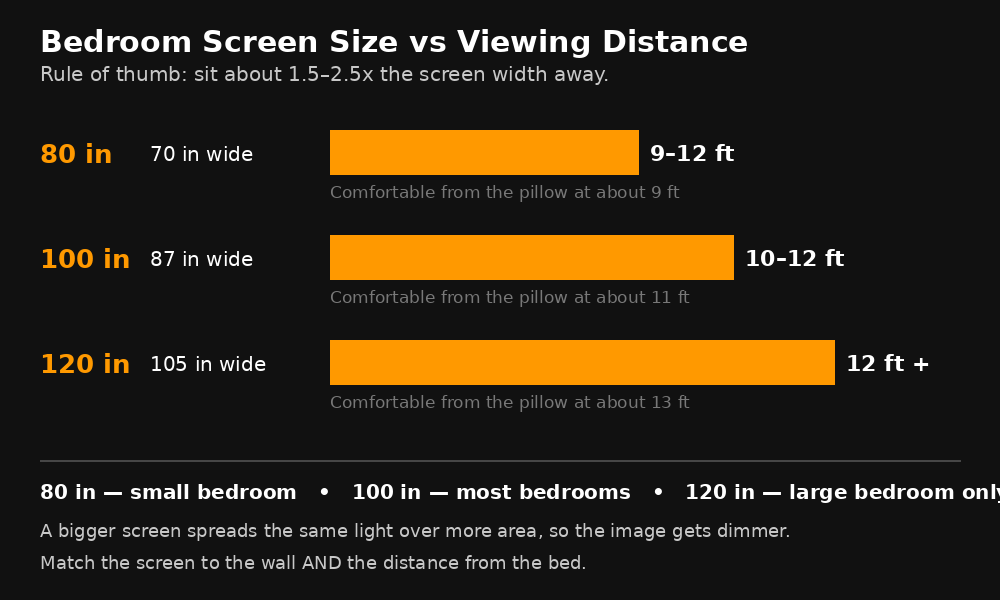
A widely used rule of thumb is to sit at a distance of roughly one and a half to two and a half times the width of the screen. This is a guideline, not a precise lab figure. The screen should fill a good part of your field of view without forcing your eyes to scan edge to edge.
Take a real bedroom. A 100-inch 16:9 screen is about 87 inches wide, a little over seven feet. The rule of thumb suggests roughly 11 to 18 feet, but most bedrooms offer only 9 to 12 feet from pillow to wall. That does not make a 100-inch screen wrong.
Most bedroom viewers sit slightly closer than the guideline, and a high-resolution image stays smooth up close.
Eye height matters too. When you watch from bed, your eyes are lower than they would be on a sofa, and you are usually reclined against pillows.
Mount the screen so its center sits roughly at eye level from your normal watching position, or only slightly above it. A screen mounted too high forces you to crane your neck upward for a whole movie.
80-Inch vs 100-Inch vs 120-Inch: What Fits a Bedroom Wall?
80-Inch Screen: The Small-Bedroom Choice
An 80-inch screen is about 70 inches wide and 39 inches tall. It fits on a wall with as little as six and a half feet of usable width, making it the right pick for a small bedroom, a wall broken up by a door or window, or a bed that sits very close to the screen wall. From a pillow nine feet away, an 80-inch image still feels large.
100-Inch Screen: The Bedroom Sweet Spot
A 100-inch screen is about 87 inches wide and 49 inches tall, and needs roughly eight feet of usable wall width once the frame and margins are counted.
That fits most master bedrooms and best balances impact and comfort at the typical bedroom viewing distance of 10 to 12 feet. For most bedrooms, this is the size to buy unless a measurement says otherwise.
120-Inch Screen: Only for a Large Bedroom
A 120-inch screen is about 105 inches wide and 59 inches tall, and it needs close to nine and a half feet of clear wall width. It also needs roughly 12 feet or more of viewing distance.
In a room that does not qualify, it overwhelms the space and forces the image too high or too wide. Measure twice before choosing this size.
A larger screen also spreads the projector’s light over a bigger area, so the image gets dimmer as the screen grows. Read about how much brightness a bedroom projector needs before choosing the largest size your wall can hold.
Throw Distance and Screen Size: Why Short-Throw and UST Fit Bedrooms
Throw distance, the distance between the projector’s lens and the screen, is the hidden constraint in almost every bedroom setup.
A standard projector needs roughly 10 to 13 feet to fill a 100-inch screen, and even more for 120 inches. In a bedroom only 12 or 13 feet long, there may be nowhere to put it except above the bed.
That is why short-throw projectors suit bedrooms so well. A short-throw model can fill a 100-inch screen from roughly half the distance of a standard projector, so it can sit on a dresser or shelf partway across the room. The cable run stays short, and nobody walks through the beam at night.
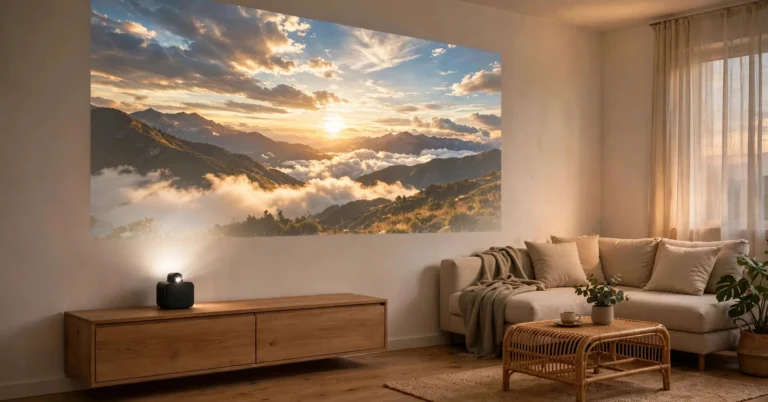
Ultra-short-throw (UST) projectors take this further, sitting on a low cabinet just inches from the wall. In a small bedroom, this is often the cleanest setup: no ceiling mount, no long cable, and no shadows from anyone moving around the room.
The trade-off is that UST projectors work best with a screen made for them, since the steep light angle makes an ordinary screen show uneven brightness.
Check the throw distance before you buy the screen, not after. Projector makers publish throw distance ranges for each screen size, and those ranges are the final check on whether your room can produce the image you want.
If you are still choosing the projector, a guide to the best projector for a bedroom setup can help narrow the choice to models that suit a small room.
Ceiling Mount or Wall Mount for a Bedroom Screen?
Once the size is settled, the screen still has to be mounted. The two main choices are a fixed-frame screen mounted flat on the wall and a retractable screen that rolls down from the ceiling or a high wall mount.
A fixed-frame screen is the simplest option and often the best-looking one. It hangs like a large picture, stays perfectly flat, and is always ready.
A fixed frame works well on the wall opposite the bed. Its only drawback is that it is always visible, so it can dominate a wall that also holds a television or artwork.
A retractable screen solves that problem. A pull-down or motorized screen mounts near the ceiling and rolls away when not in use, leaving the wall free during the day. In a small bedroom, this is a genuine advantage, because wall space is precious.
A motorized screen is the most convenient version, but a manual pull-down costs less and does the same job.
Ceiling mounting is usually the tidier choice, because it keeps the screen clear of the headboard and wardrobe. Wall mounting works too, but only with a clear stretch of wall above any furniture.
Either way, make sure the bottom edge clears any furniture below it. Renters should check their agreement before drilling, or consider a freestanding screen.
When a Painted Wall Works Instead of a Screen
Not every bedroom needs a screen. A smooth, flat wall painted matte white or very light gray can make a surprisingly good projection surface. It costs almost nothing, takes up no space, and lets you try projector viewing before committing to a screen size.
The wall has to be genuinely smooth, though. Any texture, bump, or patch will show up in the image, especially in bright scenes. A matte finish matters, because glossy or satin paint reflects light unevenly and creates bright spots.
A dedicated screen still wins when the wall is textured, colored, or uneven; when ambient light washes a plain wall out; or when you want the sharpest, most even image the projector can produce.
The practical path is simple: try the wall first if it is smooth and light-colored, and buy a screen once you know the size that suits the room. By then you will know whether 80, 100, or 120 inches is the right call.
Frequently Asked Questions
What is the most common screen size for a bedroom?
A 100-inch screen. It fits the usable width of most bedroom walls, suits the typical viewing distance of 10 to 12 feet from the bed, and feels cinematic without overwhelming a small room.
Can I put a 120-inch screen in a small bedroom?
Only if the wall and the viewing distance both support it. A 120-inch screen needs close to nine and a half feet of clear wall width and roughly 12 feet or more from the pillow to the wall. In a smaller bedroom, an 80-inch or 100-inch screen is the better choice.
How far should I sit from a 100-inch screen in a bedroom?
Aim for about 10 to 12 feet from the pillow to the screen, which is the distance most bedrooms naturally provide. A high-resolution image stays smooth even if you sit slightly closer.
Is a short-throw projector better for a bedroom?
Usually, yes. A short-throw projector fills a large screen from roughly half the distance of a standard projector. An ultra-short-throw projector goes further still, sitting inches from the wall on a low cabinet.
Should the screen go on the wall opposite the bed?
In most bedrooms, yes. The wall opposite the bed gives the longest viewing distance the room allows. If that wall has a door or window in the way, use the longest clear wall you have, with the bed turned to face it.
Do I need a screen at all, or is a white wall enough?
A smooth, matte white or light gray wall is enough to start with. A dedicated screen is worth it when the wall is textured or colored, when ambient light washes the image out, or when you want the sharpest, most even picture the projector can produce.
Bottom Line
Choosing a screen for a bedroom wall comes down to three measurements: the usable width of the wall, the height from floor to ceiling, and the distance from the pillow to the screen. Measure those three first, and the right size usually picks itself. For most bedrooms, that size is 100 inches.
Pair the size with a projector that can actually fill it from inside a small room, which is where short-throw and ultra-short-throw models earn their place. For the broader principles, the general guide to choosing a projector screen size covers them in full.