Best Portable Projector Screen for Camping Trips 2026 – Top 5 Reviews
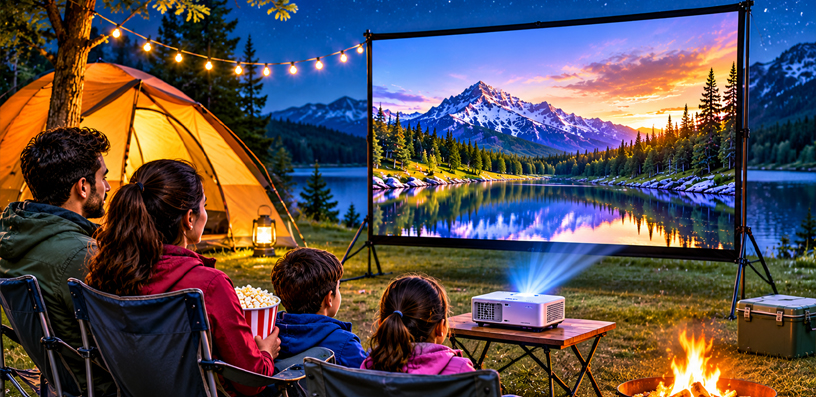
A camping movie night lives or dies on the screen, not the projector. The projector is a box you carry; the screen is a 100-inch sail that has to stand up in the dark, on uneven ground, in a breeze, and then pack back down into the car before the dew settles.
Get the screen wrong and the evening is a wrestling match. Get it right, and the campsite becomes a cinema with crickets for a soundtrack.
This roundup, Best Portable Projector Screen for Camping Trips, covers five portable screens that are actually made for the job, from an 84-inch tripod screen light enough to carry one-handed to a 125-inch freestanding frame that turns a clearing into a theater.
Every screen here packs down, sets up without tools, and comes with its own carry bag or case. None of them is a backpacking screen: the lightest here is 5 pounds, and the largest needs a car boot, so plan for car camping, not a trail.
If the movie night is in the backyard rather than the woods, our main outdoor screen roundup covers the bigger permanent-style options too.
One honest note before the list: wind is the enemy, not darkness. A portable screen is a large flat surface, and every screen here has a wind limit or a staking system for a reason.
The folding-frame models handle a breeze with stakes and ropes; the tripod models need their legs weighted or staked once the air starts moving. Buy the screen for the wind you actually get, not the calm evening you hope for.
Best Portable Projector Screen for Camping Trips 2026: Quick Comparison
| Product | Type | Screen sizes | Best for | Buy |
|---|---|---|---|---|
| Elite Screens Yard Master 125″ Outdoor | Folding frame, freestanding | 125 in | Big outdoor movie nights | Buy from Amazon |
| Vamvo 80 INCH Portable Projector Screen | Foldable frame + stand | 80 in | Fast setup, small groups | Buy from Amazon |
| VISUALAPEX 100 Inch Projector Screen Stand | Tripod pull-down | 100 in | Simple tripod setup | Buy from Amazon |
| Kodak Portable Projector Screen | Tripod pull-down | 100 in | A sturdy tripod for family use | Buy from Amazon |
| SUPER DEAL 84 INCH Projector Screen Stand | Tripod pull-down | 84 in | Lightest carry | Buy from Amazon |
Best Portable Projector Screen for Camping Trips 2026 Reviews
1. Elite Screens Yard Master 125″ Outdoor — Best for Big Outdoor Movie Nights
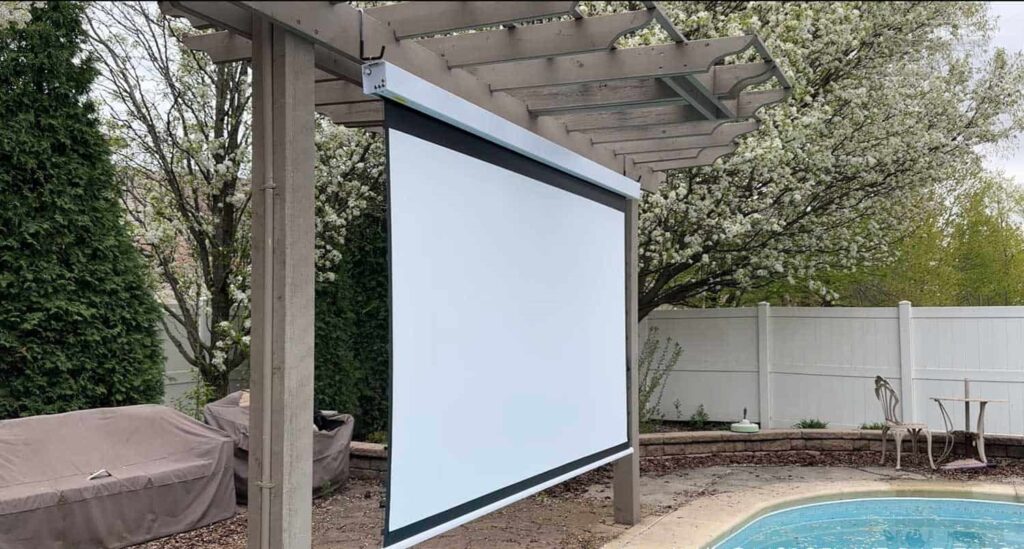 The Yard Master is the only screen in this roundup that is built like outdoor equipment first and a projector screen second. It is a fast-folding aluminum frame with detachable legs, and the screen material snaps onto the frame with buttons and corner pull-tabs, tensioning flat without tools.
At 125 inches diagonal in 16:9, with a viewing area of 109.0 by 61.3 inches, it is the biggest picture here by a clear margin, and the one that makes a campsite feel like an event rather than a gadget demo.
The material is CineWhite UHD-B, a tensioned matte white with a 1.3 gain and a 180-degree viewing angle, ISF certified and black-backed, rated for 4K, 8K, Active 3D and HDR. It works with standard, short-throw, UST and triple-laser projectors, so the screen does not lock you into one projector type.
The frame packs into a soft-padded carry bag, and stakes, rope and support rings are included in the box, which is exactly the kit a screen this size needs: at 125 inches, the screen catches real wind, and Elite rates it for a light breeze up to 7 mph only.
That wind figure is the number to respect. Seven miles per hour is a gentle evening breeze, not a gusty night, so the Yard Master is a fair-weather screen that needs its stakes in the ground and its ropes taut, and it should come down if the weather turns.
The payoff for that care is the best image in this roundup: a properly tensioned 125-inch surface with a 1.3 gain that holds brightness across a wide seating arc, with no tripod leg in anyone’s sightline.
At around 17.7 pounds, it is not light, but it is honest about what it is: a two-person carry from the car to the clearing, assembled in minutes by two people who have done it once before. Optional extension legs add 27 inches of height and are sold separately.
Key Specifications
- Model: OMS125H2 (Yard Master 2 series)
- Material: CineWhite UHD-B tensioned matte white, black-backed, ISF certified
- Gain: 1.3
- Viewing angle: 180 degrees
- Size: 125 inches diagonal, 16:9 (viewing area 109.0 x 61.3 inches)
- Setup: Fast-folding aluminum frame, detachable legs, snap-button material, no tools
- Wind limit: Light breeze up to 7 mph, with stakes and ropes included
- Carry: Soft-padded carry bag included
- Weight: About 17.7 pounds
- Projector type: Standard, short-throw, UST and triple-laser compatible
✓ Pros
- Biggest picture here at 125 inches, properly tensioned and flat
- 1.3 gain with a 180-degree viewing angle suits wide group seating
- Stakes, rope, and support rings included, not sold separately
- Works with every projector type, including UST
- Tool-free assembly once you have done it once
✗ Cons
- Wind limit is only 7 mph, so it is a fair-weather screen
- Heaviest in this roundup at about 17.7 pounds
- Needs two people to carry and set up comfortably
- Extension legs for extra height cost extra
When NOT to choose this one: Skip it if your campsite gets real wind, because a 125-inch sail at 7 mph is a kite waiting to happen. Also look elsewhere if you camp alone or hike in, since this screen wants a car boot and a second pair of hands.
2. Vamvo 80 INCH Portable Projector Screen — Best Fast Setup Camping Trips Screen
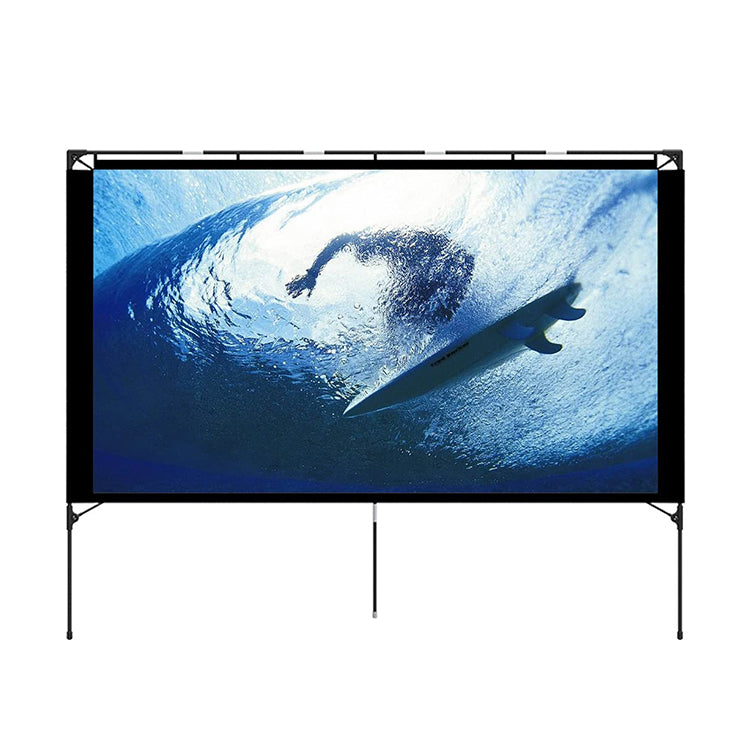
The Vamvo 80-inch is the screen for the camper who wants the movie running five minutes after arriving. It is a foldable frame with a stand, assembled with elastic ropes and no tools, and Vamvo rates the setup at under five minutes.
The frame folds down into a carry box of 22 by 14 by 4 inches, and at 9 pounds, it is a genuine one-person carry from the car to the pitch.
At 80 inches diagonal in 16:9, with a viewing area of 181 by 102 centimetres, it is the smallest screen here, and that is a deliberate trade: a smaller screen is a stiffer screen, it catches less wind, and it needs a shorter throw from the projector, which matters when the flat ground is limited.
Ropes on each side steady it against a breeze, and the natural anti-wrinkle polyester fabric is made for being folded and unfolded repeatedly without holding creases. It works indoors and outdoors, and for front projection.
One figure is missing on purpose: Vamvo does not publish a gain figure for this screen anywhere, so this article states none.
The viewing angle is listed at 160 degrees in retail listings, which is wide enough for a small group sitting in a semicircle, and the screen is the official 80-inch model M180 in Vamvo’s own store.
Key Specifications
- Model: M180
- Material: Natural anti-wrinkle polyester fabric
- Gain: Not published by the manufacturer
- Viewing angle: 160 degrees
- Size: 80 inches diagonal, 16:9 (viewing area 181 x 102 cm)
- Setup: Foldable frame + stand, tool-free elastic-rope assembly, under 5 minutes
- Wind: Side ropes included for steadying in a breeze
- Carry: Carry box 22 x 14 x 4 inches
- Weight: 9 pounds
- Use: Front projection, indoor and outdoor
✓ Pros
- Fastest setup here, under five minutes with no tools
- Light at 9 pounds with a compact carry box
- Anti-wrinkle fabric survives repeated folding
- Side ropes steady it in a breeze
- Small size needs less flat ground and less throw distance
✗ Cons
- 80 inches is the smallest picture here
- No published gain figure, so brightness comparisons are guesswork
- Too small for a large group spread wide
- Foldable frame is less rigid than a fully tensioned frame in strong wind
When NOT to choose this one: Skip it if the group is large or spread out, because 80 inches will not carry a wide audience. Also look elsewhere if you want the biggest possible picture and are willing to carry the weight for it.
3. VISUALAPEX 100 Inch Projector Screen — Best Simple Tripod Camping Screen
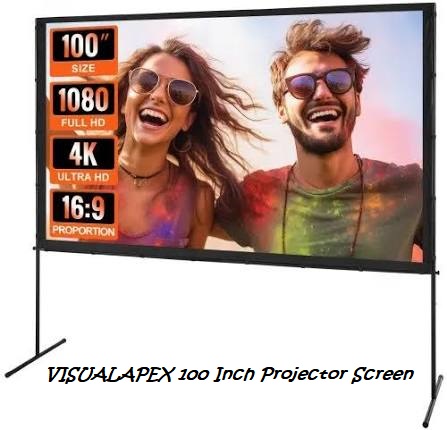 The VISUALAPEX 100-inch is the classic tripod screen, and its virtue is that there is almost nothing to learn. A tripod opens, the screen pulls down, and the movie starts.
At 100 inches diagonal in 16:9, with a display of 87 by 49 inches, it is the standard camp-movie size: big enough for a group, small enough for one person to carry and set up alone.
The fabric is a thickened polyester the maker calls milk silk, made to resist wrinkles after being rolled and unrolled, and the screen works for both front and rear projection, which is a genuine option outdoors: with rear projection the projector sits behind the screen, out of the audience’s sightline and out of the way of anyone walking past.
The viewing angle is 160 degrees, and the manual lists a 1.3 gain figure, with 4K HD support. A carry bag is included, and the assembled screen stands 77 inches wide and 87 inches tall.
The honest caveat is the brand itself. VISUALAPEX has no discoverable official website, so these specifications rest on the product’s own user manuals rather than a brand page, and the weight is listed differently in different manuals, at under 9 pounds either way.
That is not a reason to reject the screen, but it is a reason to check the listing carefully before ordering, and to test the pull-down mechanism on arrival rather than discovering a fault at the campsite.
Key Specifications
- Material: Thickened polyester “milk silk”, wrinkle-free
- Gain: 1.3 (from the product manual)
- Viewing angle: 160 degrees
- Size: 100 inches diagonal, 16:9 (display 87 x 49 inches)
- Setup: Tripod mount, manual pull-down
- Projection: Front and rear projection
- Carry: Carry bag included
- Weight: Under 9 pounds
- Assembled size: 77 inches wide x 87 inches tall
✓ Pros
- Simplest setup here: open the tripod, pull the screen down
- Front and rear projection gives a useful outdoor option
- 100 inches is the standard group size
- Wrinkle-free fabric survives rolling
- Light enough for one person to carry and set up
✗ Cons
- No official brand website, so specifications rest on manuals alone
- Tripod screens catch wind and need staking or weighting in a breeze
- Pull-down screens can show a gentle curl at the bottom edge over time
- Weight is listed differently in different manuals
When NOT to choose this one: Skip it if you want a brand with a verifiable official support page, because this one has none. Also look elsewhere if your site is windy, since a tripod screen is the hardest type to steady in a gust.
4. Kodak Portable Projector Screen — Best Tripod Camping Screen for Family Use
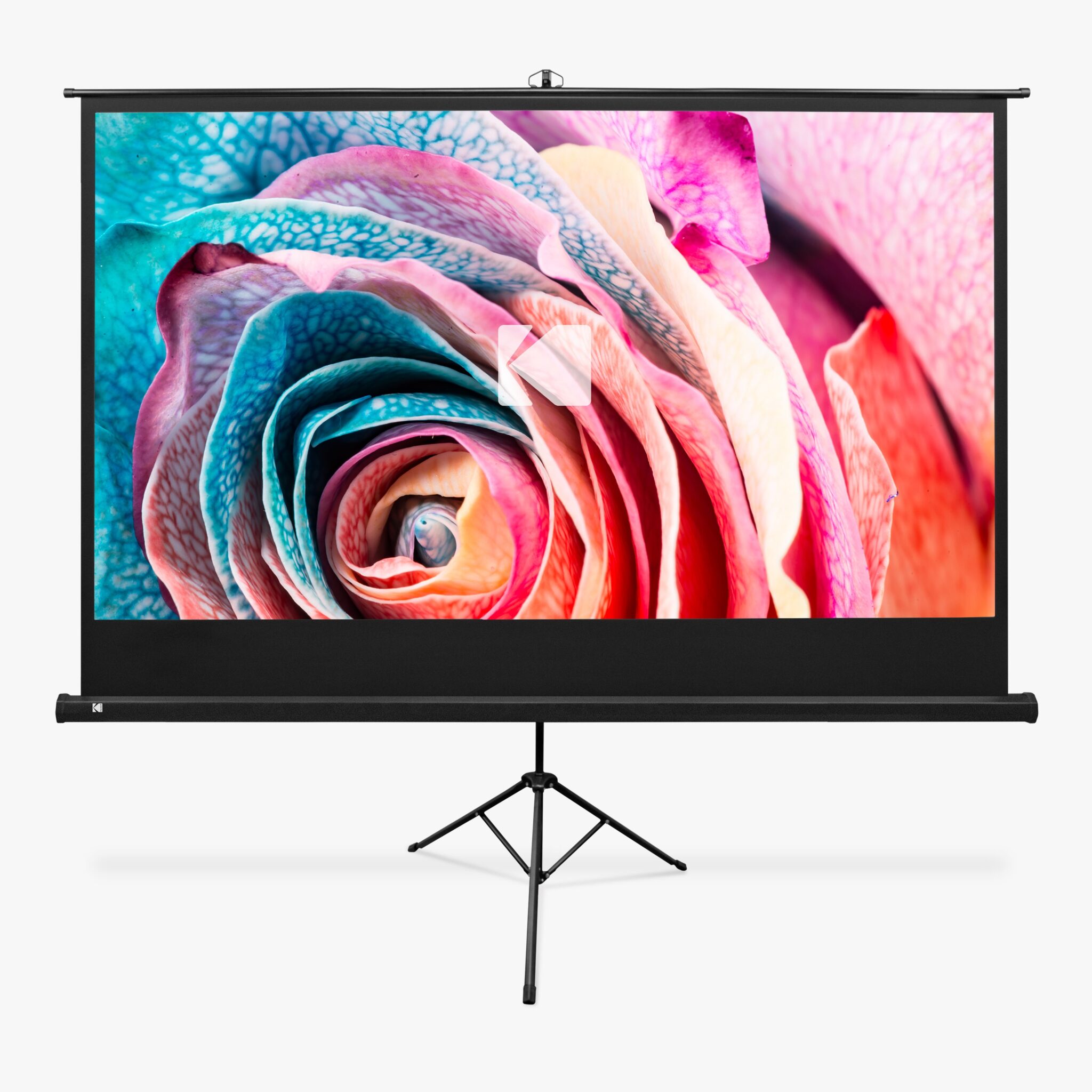
The Kodak screen is the tripod option for the camper who would rather carry weight than fight wobble. Its model is the RODPJSTS100.16, a 100-inch 16:9 screen with a viewing area of 87.16 by 49.01 inches, built around a black metal alloy tripod with a built-in locking system.
At 19.4 pounds, it is the heaviest tripod screen here, and that weight is the point: a heavier tripod stands steadier on soft ground and in a breeze than a lighter one.
The fabric is a matte white PVC and terylene blend, made for front projection and rated for 4K, 8K and 3D content. The screen pulls down manually, the tripod locks in place, and a carry bag is included.
It is a straightforward, no-surprises product from a brand with a real official store, which matters when something needs replacing: Kodak’s projector screens are sold through its official projectors store, and this model carries a one-year warranty.
Kodak does not publish a gain figure for this screen, so this article states none. Retail listings put the viewing angle at 160 degrees.
One claim to ignore: some retail metadata describes this screen as ambient light rejecting. Kodak’s own page makes no such claim, and a matte white tripod screen is not an ALR surface, so do not buy it expecting daylight performance it was never built for.
Key Specifications
- Model: RODPJSTS100.16
- Material: Matte white PVC and terylene fabric
- Gain: Not published by Kodak
- Viewing angle: 160 degrees
- Size: 100 inches diagonal, 16:9 (viewing area 87.16 x 49.01 inches)
- Setup: Black metal alloy adjustable tripod with locking system, manual pull-down
- Projection: Front projection
- Carry: Carry bag included
- Weight: 19.4 pounds
- Warranty: 1 year
✓ Pros
- Heaviest tripod here, so the steadiest on soft ground
- Locking tripod system holds its height
- Real brand with an official store and a one-year warranty
- 100 inches is the standard group size
- Matte white fabric suits 4K, 8K and 3D content
✗ Cons
- Heaviest in this roundup to carry at 19.4 pounds
- No published gain figure
- Not an ALR screen despite some retail metadata claiming otherwise
- Manual pull-down only, no motor or auto-lock beyond the tripod
When NOT to choose this one: Skip it if weight matters most, because 19.4 pounds is a real carry. Also look elsewhere if you need rear projection or a screen that packs into a small bag.
5. SUPER DEAL 84 INCH Projector Screen Stand — Best Lightest Carry Camping Screen
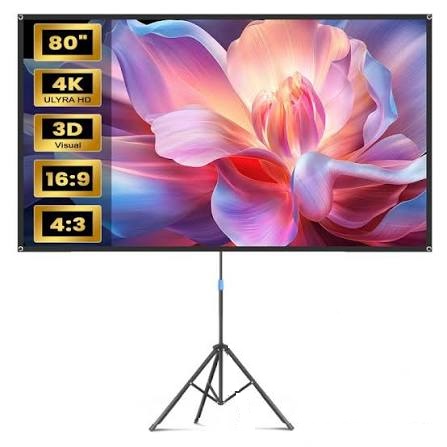 The SUPER DEAL 84-inch is the lightest screen in this roundup at 5 pounds, and for a camper who is already carrying a projector, a power station, and chairs, that number matters.
It is an 84-inch 16:9 tripod pull-down screen with a wrinkle-free fabric, a carry bag included, and an assembled size of 79.9 inches wide by 98.9 inches tall. It works indoors and outdoors, and it supports 4K HD content.
The viewing angle is 160 degrees, which suits a small group sitting close in, and the 84-inch size needs less flat ground and less throw distance than the 100-inch tripods, which is a real advantage on a crowded or sloping pitch. Setup is the familiar tripod routine: open the legs, raise the pole, pull the screen down.
The honest caveat is the same as the VISUALAPEX: SUPER DEAL is a generic Amazon-only brand with no official website, so there is no brand page to check specifications against, and no gain figure is published anywhere, so this article states none.
The specifications here rest on retail listings of the same 84-inch with-stand model. Check the listing carefully before ordering, and test the screen at home before the trip rather than at the campsite.
Key Specifications
- Material: Wrinkle-free fabric
- Gain: Not published by the manufacturer
- Viewing angle: 160 degrees
- Size: 84 inches diagonal, 16:9
- Setup: Tripod mount, manual pull-down
- Carry: Carry bag included
- Weight: 5 pounds
- Assembled size: 79.9 inches wide x 98.9 inches tall
- Use: Indoor and outdoor, 4K HD
✓ Pros
- Lightest here at 5 pounds, a genuine one-handed carry
- Smallest footprint needs the least flat ground
- Simple tripod setup anyone can do
- Carry bag included
- 84 inches suits small groups and tight pitches
✗ Cons
- No official brand website or support page
- No published gain figure
- 84 inches is small for a large group
- Lightest tripod is also the easiest to topple in wind, so stake or weight it
When NOT to choose this one: Skip it if the group is large, because 84 inches will not carry a wide audience. Also look elsewhere if you want a verifiable brand or the biggest picture for the weight.
How to Choose a Portable Projector Screen for Camping Trips 2026 – Buyer’s Guide
What “Portable” Actually Means for Camping
Portable means different things to different campers, and the distinction decides the purchase. Every screen in this roundup is portable in the car-camping sense: it packs into a bag or box, rides in the boot, and sets up at the pitch.
None of them is a backpacking screen. The lightest is 5 pounds and the largest needs two people and a car, so if the plan involves a trail, the answer is a white sheet on a washing line, not a screen from this list.
For car camping, the real portability question is pack size, not just weight. A folding frame packs flat and long; a tripod packs as a tube with a separate rolled screen.
Measure the boot before the screen, and check the carry dimensions in the specifications above: the Vamvo’s 22 by 14 by 4 inch box is the most honest pack figure here, because it tells you exactly what has to fit.
Folding Frame vs Tripod Pull-Down
The two designs in this roundup behave very differently outdoors. A folding frame, like the Yard Master and the Vamvo, holds the fabric under tension across a rigid frame, so the picture stays flat and the wind has a structure to push against rather than a sail to flap. It takes two people and a few minutes longer, and it packs longer, but the image is steadier.
A tripod pull-down, like the VISUALAPEX, Kodak and SUPER DEAL, is faster and simpler: open the legs, pull the screen down, done.
The trade is flatness and wind. A pull-down screen hangs from a roller, so the bottom edge can curl over time, and the whole assembly is a tall, narrow sail on three legs. In still air it is perfect; in a breeze it needs staking, weighting, or a windbreak.
Size and Seating: How Big for a Campsite?
For a small group of four to six people sitting 8 to 12 feet back, 80 to 100 inches is the sweet spot, which is why three screens here sit in that range.
A 125-inch screen like the Yard Master earns its size when the group is ten or more, or when seating spreads wide, because the picture has to stay readable from the end chairs as well as the middle. For the full sizing logic, what size screen a backyard actually needs works out the same maths for an outdoor setting.
Remember the ground as well as the group. A bigger screen needs more flat ground, more throw distance from the projector, and a longer clear sightline. On a sloping or crowded pitch, the 84-inch SUPER DEAL or the 80-inch Vamvo will fit where the 125-inch Yard Master simply will not.
Wind: The Real Enemy Outdoors
Wind decides more camping movie nights than darkness does. A screen is a sail, and a gust that a tent shrugs off will fold a tripod or send a frame tumbling.
The Yard Master’s 7 mph limit is the only honest wind figure published in this roundup, and it is a useful rule of thumb for all five: a light breeze is fine, anything stronger needs action.
The action is simple and worth doing before the movie starts. Stake the frame or weight the tripod legs, run the guy ropes if the screen has them, and point the screen’s face away from the prevailing wind where the pitch allows.
Our guide to keeping a screen steady when the wind picks up covers the same techniques in detail. If the forecast turns gusty, take the screen down: a folded screen is a screen that works tomorrow.
Gain and Viewing Angle Outdoors
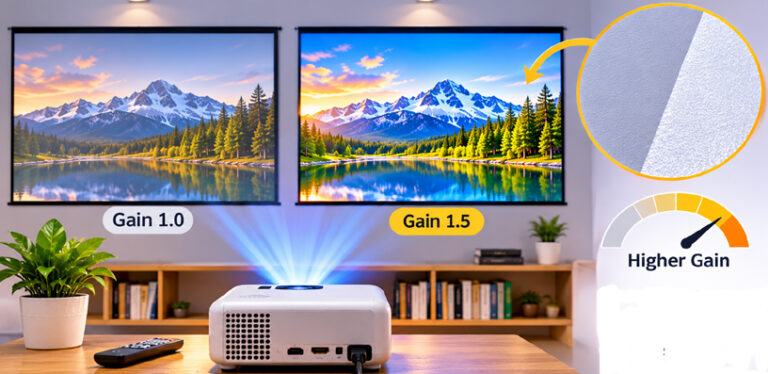
Outdoors, gain matters less than it does indoors, because the audience sits in the dark and the projector is the only light source. A 1.3 gain, like the Yard Master and the VISUALAPEX manual figure, gives a little extra brightness that helps the picture hold up against a campfire’s glow or a late dusk.
A 180-degree viewing angle, like the Yard Master’s, matters more: campers do not sit in rows, they sit in a semicircle, and a wide angle keeps the end seats bright.
Two screens here publish no gain figure at all, the Vamvo and the SUPER DEAL, and one, the Kodak, publishes none through the brand itself. That is not a defect; it is a gap in the paperwork. Pair those screens with a reasonably bright projector and a dark site, and the missing number will not be missed.
Front vs Rear Projection
Most camping screens are front projection: the projector sits with the audience and throws onto the screen’s face. The VISUALAPEX also supports rear projection, where the projector sits behind the screen and the audience watches through it.
Rear projection has a real outdoor advantage: the projector is out of the audience’s sightline, nobody walks through the beam, and the projector itself is sheltered behind the screen. The cost is space behind the screen and a dimmer image, since some light is lost passing through the fabric.
For a small pitch, front projection is simpler; for a larger site with room behind, rear projection is worth trying.
Setup Time and Pack Size
Setup time is the difference between a movie night and a chore. The Vamvo claims under five minutes, and a folding frame with elastic ropes really is that fast once practised.
A tripod is faster still on the first try, because there is nothing to assemble: open, pull down, watch. The Yard Master is the slowest first time, because snap-button tensioning takes a practice run, and the fastest after that, because the frame goes up as one piece.
Practise at home. Every screen here is easier the second time, and the campsite is the wrong place to learn which corner tab goes where. Pack size matters as much as weight: check the carry dimensions against the boot, and keep the stakes and ropes in the same bag as the screen, not in a separate box that stays behind.
Weather, Ground and Dew
Outdoor screens are not weatherproof in the way a tent is. The Yard Master’s fabric is a proper outdoor material, but even it is rated for a light breeze, not rain.
A tripod screen’s fabric will survive a light dew, but a soaked screen should be dried before it is rolled up, or it will smell of mildew by the next trip.
Ground matters too: a tripod on soft grass sinks and tilts, so bring a flat board or a paving slab for the feet, and a frame on a slope will lean, so pick the flattest patch of the pitch.
Dew is the quiet problem. As the night cools, moisture settles on the fabric and dulls the picture, and a screen left out overnight will be wet by morning. The fix is to take the screen down when the movie ends, wipe it, and pack it dry. It takes five minutes and saves the fabric.
Pairing the Screen With the Projector
The screen is only half the system. A camping projector needs to be bright enough for the screen size, which is why the 1.3-gain screens here pair well with mid-brightness portable projectors, and why the 125-inch Yard Master asks for the brightest projector you own.
Power is the other half: a portable power station runs a small projector for a film, but a bright home projector will drain it fast, so match the projector’s draw to the station’s capacity before the trip.
Sound is the forgotten third piece. A projector’s built-in speaker is lost outdoors, so bring a Bluetooth speaker and place it near the audience, not next to the projector. The screen does not need to do anything for sound, but the setup does.
Frequently Asked Questions
Can you use a portable projector screen in wind?
Yes, in a light breeze, if the screen is staked or weighted and its guy ropes are used. The Yard Master is rated for wind up to 7 mph. In stronger wind, take the screen down: a folded screen survives, a flying one may not.
What size portable screen is best for camping?
For four to six people sitting 8 to 12 feet back, 80 to 100 inches is the sweet spot. For ten or more people, or wide seating, a 125-inch screen like the Yard Master earns its size and weight.
Do I need a special screen for outdoor use?
A screen made for outdoor use handles wind, dew, and uneven ground better than an indoor screen, with stakes, ropes, and a tensioned frame. An indoor pull-down screen will work on a calm night, but it will flap in a breeze and has no way to anchor it.
How do you keep a camping screen steady?
Stake the frame or weight the tripod legs, run the guy ropes, and face the screen away from the prevailing wind. A flat board under tripod feet stops them sinking into soft ground.
Can a camping screen stay out overnight?
It can, but dew will settle on the fabric and dull the picture, and a wet screen rolled up will smell of mildew. Take it down when the movie ends, wipe it, and pack it dry.
Front or rear projection for camping?
Front projection is simpler and brighter, with the projector among the audience. Rear projection hides the projector behind the screen and keeps the beam clear of walkers, but needs space behind the screen and gives a dimmer image.
Bottom Line
The best portable projector screen for camping trips depends first on the group, and only then on the screen. For a big outdoor movie night, start with the Elite Screens Yard Master 125″ Outdoor: the biggest, flattest picture here, with stakes and ropes in the box, as long as the wind stays under 7 mph and a second pair of hands is available.
Small groups who want the movie running fast should take the Vamvo 80 INCH: under five minutes to set up, 9 pounds to carry, and small enough for a tight pitch.
The VISUALAPEX 100 Inch is the simplest tripod pick, with the useful bonus of rear projection, while the Kodak Portable Projector Screen is the sturdiest tripod, at a weight that shows in its steadiness. And the SUPER DEAL 84 INCH is the lightest carry of all, for campers who count every pound.
Pick the size for the group, check the wind before the movie, and practise the setup at home. Get those three right and the campsite does the rest.