What Size Screen Do You Need for A Backyard Movie Night?
For most backyards, a 100 to 120-inch diagonal screen is the sweet spot. Big enough to feel like a real theater from a blanket on the lawn, small enough that a normal projector can actually fill it with a bright image. If your yard is tiny, 84 to 100 inches still works. If you’re hosting the whole block, 135 to 150 inches is where the magic happens.
But “most backyards” isn’t your backyard. The right size depends on three things: how far your seats are from the screen, how far your projector can sit from the screen, and how wide your space is. Get those three numbers, and the answer to this question- what size screen do you need for a backyard movie night? will follow. Here’s how.
The Simple Rule: Screen Size Follows Seating Distance
Cinema engineers solved this decades ago. The Society of Motion Picture and Television Engineers (SMPTE) says a screen should fill at least 30 degrees of your horizontal field of view — that’s the minimum for it to feel like a theater rather than a big TV. THX goes further and recommends 36 degrees for the full cinematic effect.
You don’t need a protractor. Those angles translate into one easy rule of thumb:
- Cinematic and immersive: seating distance ≈ 1.5× the screen diagonal
- Comfortable for everyone: seating distance ≈ 2 to 2.5× the screen diagonal
So if your chairs and blankets sit about 15 feet (180 inches) from the screen, divide by 1.5, and you get 120 inches for the full theater feel. Divide by 2, and you get 90 inches for a relaxed, easy-on-the-eyes setup. Anything in that 90–120 inch window will look right from 15 feet.
One backyard-specific note: outdoors, err toward the bigger end of your range. Ambient light — porch lights, streetlights, the neighbor’s security floodlight — washes out the image edges and makes a screen feel smaller than it is.
A 100-inch screen that looks huge in a dark basement looks merely “nice” on a lawn at dusk. When in doubt between two sizes, take the bigger one.
Real Backyard Scenarios: Which One Is Yours?
The small patio (8–12 feet deep, 4–8 people). You’re working with a concrete slab or a small deck, seats maybe 10 feet from the screen. Target 84 to 100 inches. A 100-inch screen from 10 feet is genuinely cinematic — right at that 1.5× ratio — and it fits between most patio posts or railings without looking ridiculous.
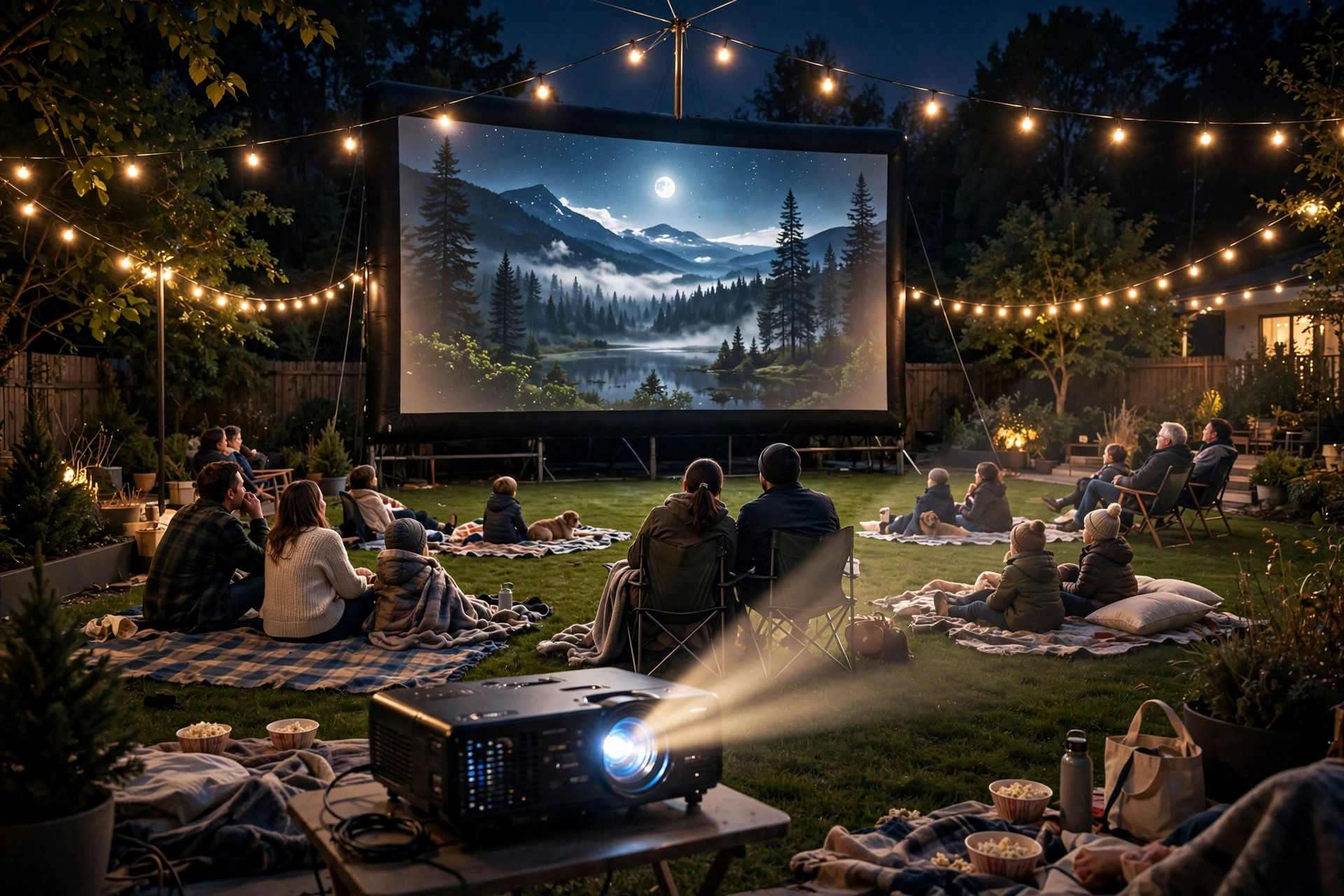
The medium yard (15–20 feet of lawn, 8–15 people). This is the classic American backyard movie night: blankets up front, lawn chairs behind, maybe a second row. Seats land 12 to 18 feet back. Target 100 to 120 inches. A 120-inch screen from 15 feet is the single most common backyard setup in existence, and it exists for a reason — it just works.
The big lawn or block party (20–30+ feet, 15–30 people). Now you’re projecting across a real distance, and the back row matters. Target 135 to 150 inches. At 25 feet back, a 150-inch screen still delivers that 30-degree SMPTE minimum for the back row. Below 120 inches at this distance, the people in the back are basically watching television.
Audience size matters as much as distance. With one row, anyone can see the whole screen. With two or three rows, the screen needs to be tall enough that the back row sees over heads — and taller means a bigger diagonal. If you’re regularly seating rows, add 10 to 15 inches to whatever the distance formula gives you.
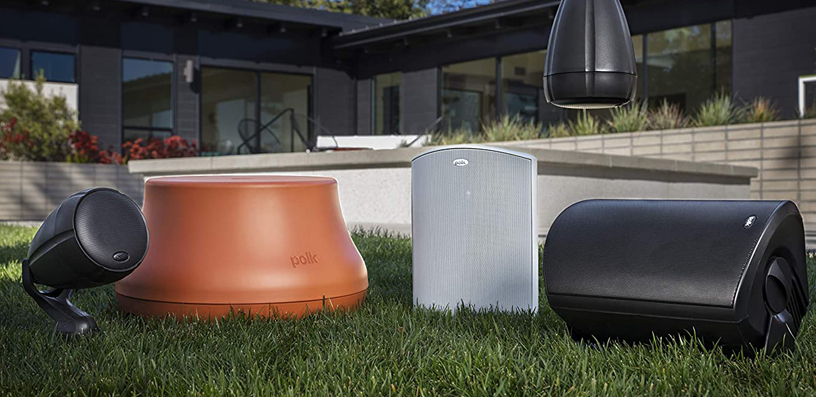
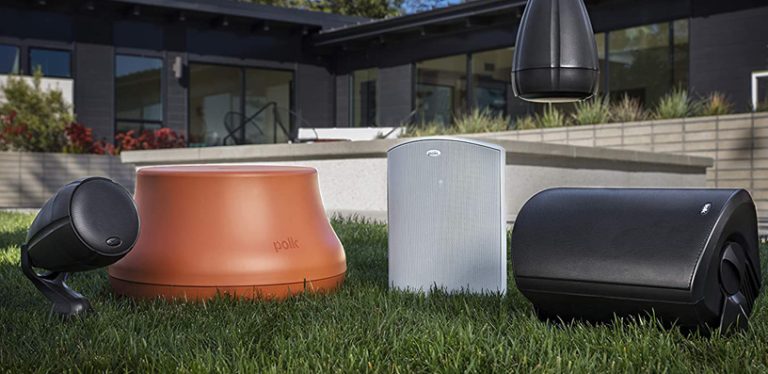
And don’t forget sound carries the experience as much as picture. A great screen with laptop speakers is still a bad movie night — plan for real outdoor projector speakers while you’re planning the screen.
How to Measure Your Space in Five Minutes
Grab a tape measure and do this before you buy anything:
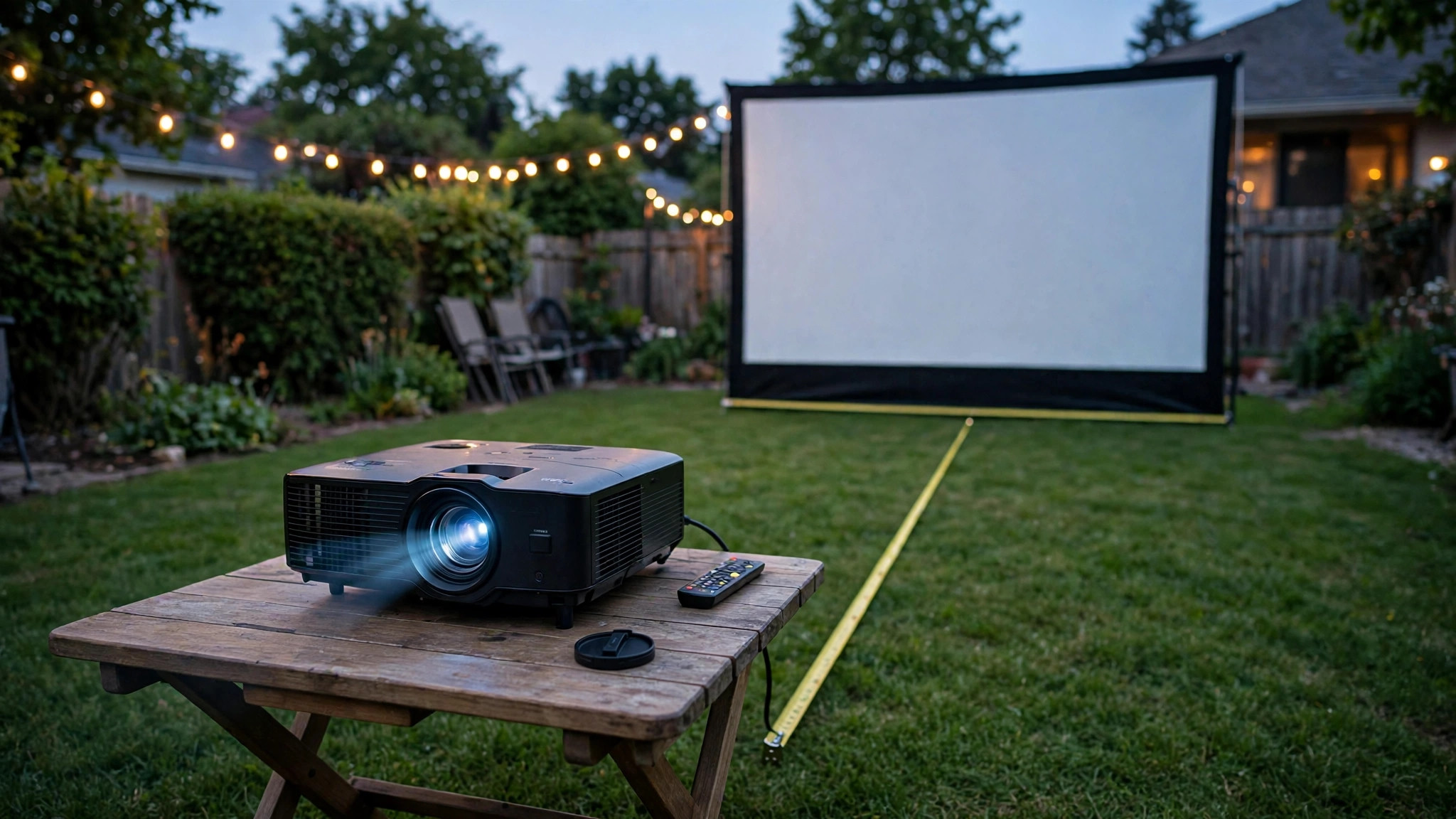
- Mark your seating line. Decide where the front row actually sits — not where you’d like it in theory, but where the blankets land given your patio furniture, fire pit, and the kids’ trampoline. Measure from there to where the screen will stand. That’s your viewing distance.
- Measure your screen wall width. Whether it’s a fence, the side of the garage, or open lawn with a frame, measure the usable width. A 120-inch 16:9 screen is about 105 inches wide (8.75 feet) including a minimal frame. A 150-inch screen needs nearly 11 feet. Make sure it physically fits.
- Check the height. The bottom of the screen should sit 24 to 36 inches off the ground so the front row sees over the grass and the back row sees over heads. A 120-inch screen is about 59 inches tall — plus 30 inches of clearance means you need roughly 7.5 feet of vertical space. Low fences and pergolas can rule out the biggest sizes.
- Walk it at night. Stand where the screen goes after dark and look for light: porch lights, streetlights, windows. Every light source facing the screen is contrast you’re giving away. You can’t always eliminate them, but knowing where they are tells you whether to bias bigger and brighter.
Your Projector Sets the Maximum Size (Don’t Skip This)
Here’s the constraint most people discover too late: your projector can only make an image so big from where it sits. This is the throw ratio — throw distance divided by image width — and every projector has one.
The math is simple: image width = throw distance ÷ throw ratio.
Example: your projector has a 1.2:1 throw ratio and sits 12 feet from the screen. Image width = 12 ÷ 1.2 = 10 feet. A 10-foot-wide 16:9 image is about a 138-inch diagonal. So that projector, from 12 feet, maxes out around 138 inches — plenty for a 120-inch screen, with room to spare.
But flip it around: the same projector pushed back to only 8 feet (small patio, nowhere else to put it) gives you 8 ÷ 1.2 = 6.7 feet of width, or roughly a 92-inch diagonal. If you bought a 120-inch screen for that patio, you’d be projecting a 92-inch image onto the middle of it, surrounded by empty screen.
Always check the throw math before ordering the screen — and if you’re still shopping, our guide to the best outdoor projectors covers which models handle big backyard throws.
Two practical notes. First, zoom lenses give you wiggle room — most projectors zoom 1.1× to 1.3×, so treat the calculated size as a range, not a single number. Second, brightness falls as the image grows: spreading the same lumens over a 150-inch screen instead of a 100-inch one makes every square inch dimmer.
For screens over 135 inches in anything less than full darkness, you want a genuinely bright projector, not a cute portable one.
16:9 vs. 2.35:1: Which Shape for the Backyard?
Movies come in two shapes, and your screen can only be one of them.
16:9 is the shape of your TV, YouTube, sports broadcasts, and most streaming shows. A 16:9 screen shows all of that perfectly, edge to edge.
2.35:1 (often called CinemaScope) is the shape of most Hollywood blockbusters — wider and shorter, no black bars on epic films.
For a backyard, go 16:9 unless you’re certain you’ll only ever watch movies. Backyard nights are gloriously mixed use: the big game Saturday, a kids’ movie Friday, maybe some video games after.
On a 2.35:1 screen, all of that 16:9 content plays as a smaller image floating in the middle with unused screen on the sides. On a 16:9 screen, movies just get thin black bars top and bottom — which outdoors, in the dark, you genuinely stop noticing after about ten minutes.
The one exception: the dedicated film buff with a permanent setup who hosts movie-only nights. For everyone else, 16:9 is the right call.
DIY vs. Manufactured Screens at Large Sizes
Once you’re past 100 inches, the screen itself becomes a real decision.
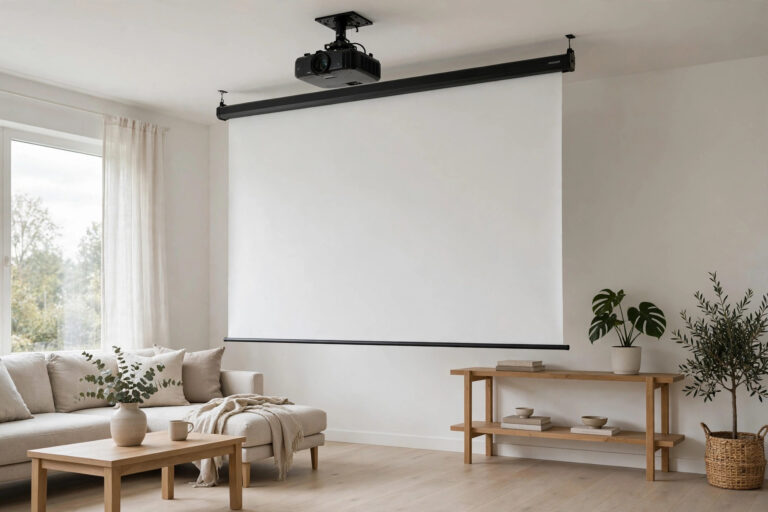
DIY screens — blackout cloth stretched over a PVC or lumber frame, or paint formulated for projection on a smooth wall — are unbeatable on price. Fifty dollars of blackout cloth makes a genuinely good 120-inch screen.
The catch is flatness and wind. Any wrinkle or wave shows up as a distortion in bright scenes, and a 10-foot span of fabric becomes a sail the moment the evening breeze picks up. DIY works best for 100 to 120 inches in sheltered spots, and you should plan on taking it down after every showing.
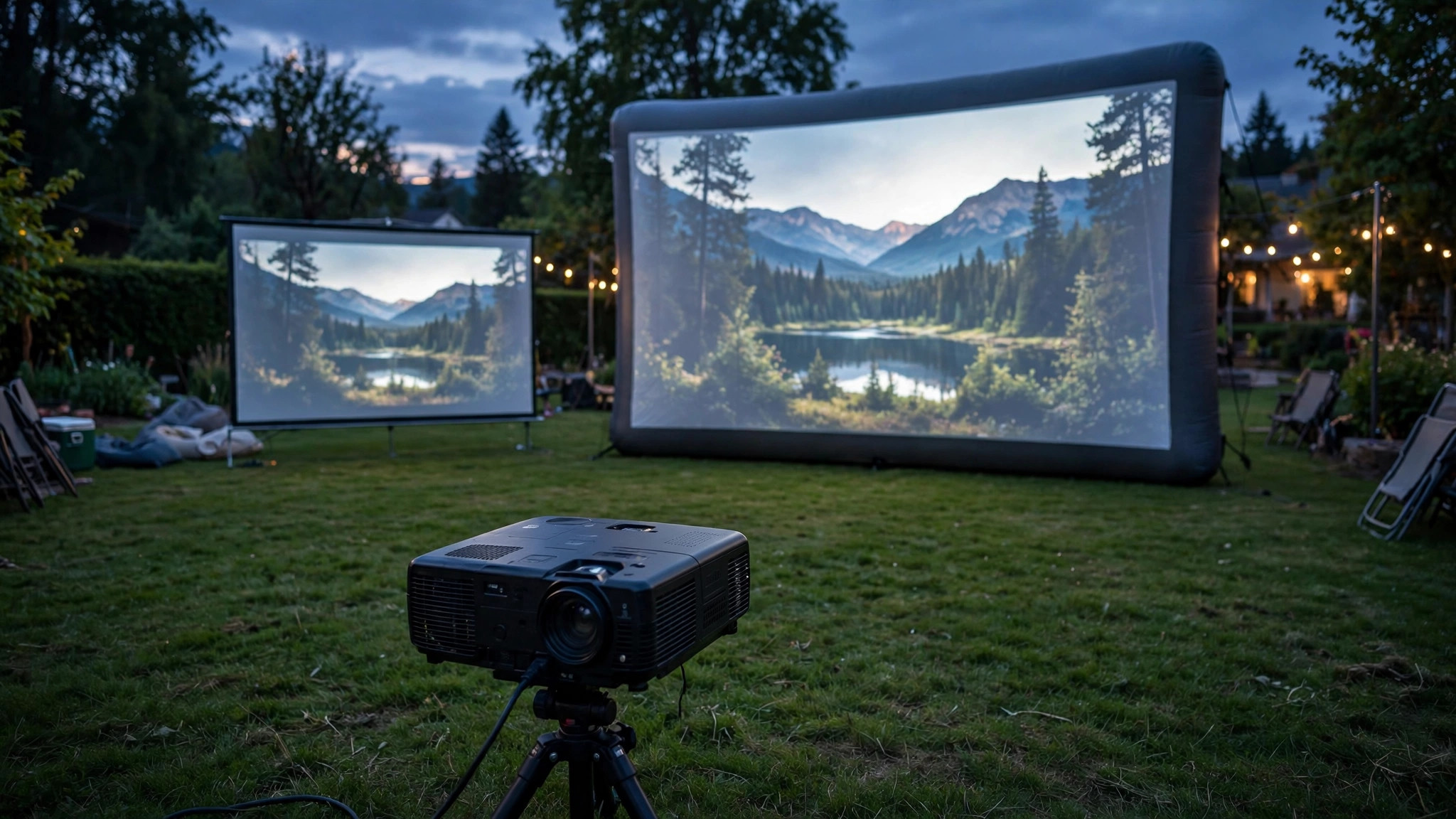
Manufactured screens solve the problems DIY creates. Inflatable screens (the ones you see at community events) set up in minutes, stand up to a breeze, and come in 120 to 144-inch sizes that are perfect for parties.
Fixed-frame screens give the flattest, best-looking image of anything — but they’re permanent, so they’re for the dedicated backyard theater, not the occasional movie night. Pull-up and tripod screens split the difference for 100-inch-class setups.
Whatever you choose, stake it, weight it, or tie it down. A 120-inch screen catches wind like a parachute, and a screen blowing over mid-movie — possibly onto the projector — is the classic backyard disaster. Sandbags on the feet, guy-lines on the frame, and never leave it up overnight.
If you want a deeper breakdown of the options, our outdoor projector screen guide walks through inflatable, fixed-frame, and portable picks by size.
Small Yard? Short Throw Is Your Answer
If your “backyard” is a 10-foot-deep patio and the projector has nowhere to sit, don’t give up on a big screen — change the projector type. Short-throw projectors (throw ratios around 0.5:1 to 1.0:1) produce a 100-inch image from just 3 to 4 feet away. Ultra-short-throw (UST) models sit inches from the screen and throw 100+ inches up the wall.
This completely changes the geometry of a small space: the projector goes on a small table right under the screen, nobody walks through the beam, and nobody casts shadows when they get up for popcorn.
For patios and balconies, a short-throw projector paired with a 100-inch screen gives you the full theater feel in a space where a standard projector would max out at 60 inches.
The 60-Second Size Calculator
Here’s the whole article as a formula. Do it on your phone right now:
Step 1: Measure from your front-row seats to the screen spot, in feet. (Example: 16 feet.)
Step 2: Multiply by 8 for the cinematic size, or by 6 for the comfortable size. (16 × 8 = 128; 16 × 6 = 96.)
Step 3: Round to the nearest standard screen size. (128 → 120 inches; 96 → 100 inches. Screens come in 84, 100, 110, 120, 135, 144, and 150-inch standards, so pick the closest.)
Step 4: Sanity-check against your projector. Image width = throw distance ÷ throw ratio. For a 120-inch 16:9 screen, you need about 8.75 feet of image width — so with a 1.2:1 projector, it needs to sit at least 10.5 feet back. If it can’t, drop a screen size or move to short throw.
Step 5: Sanity-check against your space. A 120-inch screen needs roughly 9 feet of width and 7.5 feet of height with ground clearance. If the fence is only 6 feet tall, 120 inches isn’t happening — go 100.
Worked example: 16-foot viewing distance, projector with 1.25:1 throw sitting 14 feet back, 8-foot fence. Step 2 gives 96–128 inches → target 120. Step 4: 14 ÷ 1.25 = 11.2 feet of width available — plenty for 120 inches. Step 5: 120 inches needs ~7.5 feet of height, but the fence is 8 feet — it fits, barely, with the bottom at 30 inches. Answer: 120 inches.
Is a 120-inch screen too big for a backyard?
For most backyards, no — it’s the most popular size for a reason. From 12 to 18 feet back, 120 inches lands right in the cinematic sweet spot. It only feels “too big” if your seating is closer than about 10 feet, where you’d be turning your head to follow the action. Match the screen to your seating distance using the formula above, and 120 inches is right far more often than it’s wrong.
Can I just project onto my fence or the side of my house instead of buying a screen?
You can, and plenty of people start there — but know what you’re giving up. Bare wood, vinyl siding, and stucco all have texture that softens the image, and their colors (even “white” paint) are rarely neutral, which shifts skin tones and dulls contrast. A $50 sheet of blackout cloth hung flat will visibly outperform a fence. Use the wall for your first movie night to prove the concept, then upgrade.
How far back should the projector itself sit?
As far back as your throw ratio allows while still filling the screen — there’s no benefit to sitting closer than necessary. A good default: place it 1.2 to 1.5× the screen width behind the screen. For a 120-inch screen (about 8.75 feet wide), that’s roughly 10.5 to 13 feet back. Keep it out of the seating area so nobody blocks the beam, and protect it from dew with a small table cover or plastic bin (ventilated — projectors run hot).
My yard has a lot of ambient light. Should I go bigger or smaller?
Bigger, paired with a brighter projector. Ambient light washes out the image and makes screens feel smaller than their measurements, so downsizing just gives you a dim and small picture.
Go for your full calculated size, kill every light you can (porch, landscape, windows facing the screen), and start the movie after full dark — the difference between dusk and true night is enormous. If light is truly unavoidable, an ambient-light-rejecting (ALR) screen helps, but they’re pricey at backyard sizes.
What screen size works if kids are sitting close and adults are far back?
Size for the back row, not the front. Kids sitting 8 feet from a 120-inch screen are perfectly happy — children tolerate (and enjoy) overwhelmingly large images. Adults at 20 feet from an 84-inch screen, on the other hand, will complain they can’t see faces. Run the formula on your farthest regular seats, and everyone closer gets a bonus.
The Bottom Line
Start with your seating distance, multiply by 8, round to a standard size, then verify your projector can fill it, and your yard can hold it. For most backyards, that lands you at 100 to 120 inches — the size that turns a lawn into a theater. Measure twice, buy once, stake everything down, and start the movie after dark.