Best Lightweight Projector for Backpacking Trips 2026 – Top 5 Reviews
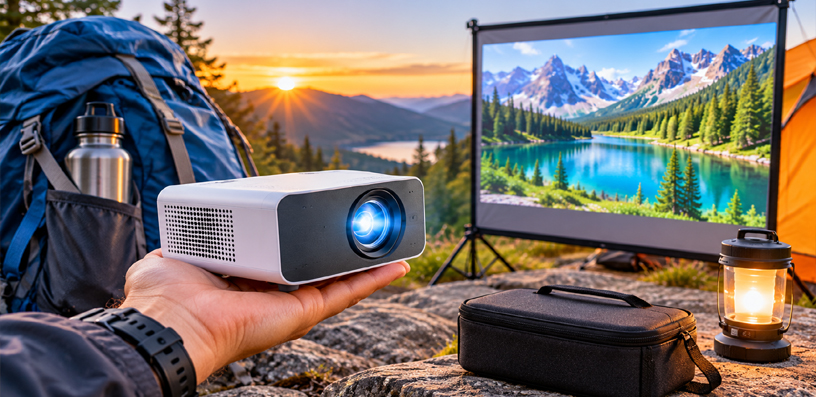
The best lightweight projector for backpacking trips is not the brightest projector you can buy, and it is not the cheapest one either. It is the one you will actually carry ten miles into the backcountry, power from a battery you already own, and set up on a tent wall in the dark without a fuss.
Every other kind of projector gets judged in a living room. This one gets judged in a backpack.
Why The Trail Changes What Makes a Projector Good
Backpacking rewrites the spec sheet. Weight stops being a footnote and becomes the first filter, because every gram rides on your shoulders all day. Battery life stops being a convenience and becomes the whole show, because there is no wall outlet at a campsite.
And brightness gets a fairer test than it ever gets indoors, because a trail night is genuinely dark, and a modest projector on a small, close image can look far better than its numbers suggest.
This list ranks five portable projectors for exactly that job. They are ordered for backpackers, not for home theater buyers: weight first, power second, trail setup third, and picture quality judged for nights on a tent wall or a hung sheet. Each pick carries an honest trade-off, because at this size and weight, every projector gives something up.
How We Ranked the Best Lightweight Projector for Backpacking Trips 2026
Five criteria decided the order, and they are worth knowing before you read the picks, because they explain why the lightest projector is not automatically number one and why the brightest one is not either.
Weight, in grams. Under one kilogram is the sweet spot for a backpacking projector. Between one and two kilograms is defensible only if the projector earns it with battery life or brightness.
Over that, you are carrying a camping projector, not a backpacking one, and it belongs on a short hike or a car-supported trip instead.
Battery and power. Built-in battery hours decide how much of a film you get, and USB-C power-bank charging decides whether the trip can last more than one night. A projector that charges from the same power bank as your phone is worth more on the trail than one that needs its own charger and cable.
Pack size and toughness. A projector that packs flat, rides in a side pocket, or survives a stuff sack beats a bigger one with better specs. Trail gear gets knocked around, rained on, and sat on, so a solid body and a simple shape count.
Brightness for nights. Trail viewing happens after sunset, on a small image, close up. That forgiving darkness means a dimmer projector can still satisfy, as long as you keep the image modest and the tent dark. Daylight performance is not part of this ranking at all.
Setup speed and sound. Autofocus and auto keystone turn a fiddly setup into a two-minute job at the end of a long day. A usable built-in speaker matters too, because carrying a separate speaker is weight most backpackers will not spend.
Our guide to powering a projector outdoors without an outlet covers the battery math in more depth.
Best Lightweight Projector for Backpacking Trips 2026: Quick Comparison
| Rank | Projector | Weight | Battery / Power | Brightness | Buy |
|---|---|---|---|---|---|
| 1 | AAXA P6X 1000 Lumen | 0.82 kg (1.8 lb) | 15,000 mAh, 1.5 h / 4 h eco | 1000 LED lumens (battery) | Buy from Amazon |
| 2 | ViewSonic M1MINIPLUS-S | 0.3 kg (0.66 lb) | 5000 mAh, up to 1.5 h | 120 LED lumens | Buy from Amazon |
| 3 | KODAK Luma 500 Mini | 0.54 kg (1.2 lb) | 10,500 mAh, about 2 h | About 150 ANSI lumens | Buy from Amazon |
| 4 | TCL C1 Smart Google TV Projector | About 1.8 kg | USB-C PD power-bank friendly | 230 ISO lumens | Buy from Amazon |
| 5 | Magcubic Smart Projector with WiFi | About 1.2 kg | DC mains, no built-in battery | About 390 ANSI lumens | Buy from Amazon |
1. AAXA P6X 1000 Lumen Battery Projector — Best Overall for Backpacking
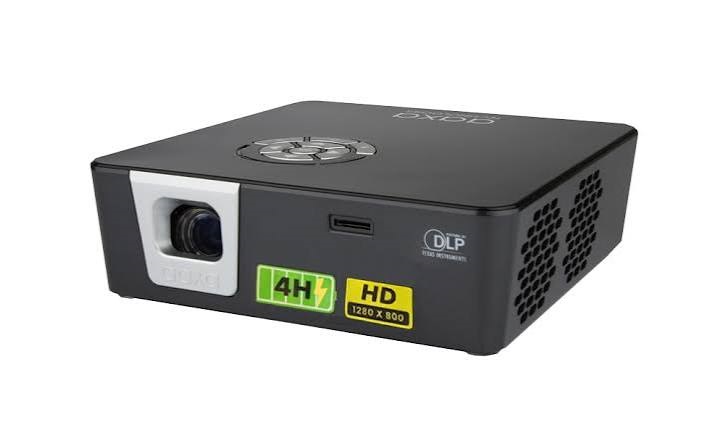 The AAXA P6X takes the top spot because it solves the two problems that end most trail movie nights early: brightness and power. It is the brightest battery-powered projector on this list, and its huge battery does double duty as a power bank for your phone.
That combination means one device covers the film and the phone charging, which is exactly the kind of weight-saving that matters in a pack.
On the trail, the P6X earns its place in practical ways. Its onboard media player plays films straight from a USB stick or memory card, so you do not need a phone signal, a streaming app, or a second device to watch anything.
WiFi mirroring and Bluetooth are there when you want them, and the 4-watt speaker is loud enough for a small group around a tent. The 15,000 mAh battery runs about an hour and a half at full brightness, or up to four hours in eco mode, which is a full film with room to spare if you keep the image modest.
- Resolution: 1280 x 800 native (WXGA), 1080p input supported
- Brightness: 1000 LED lumens on battery, 1100 LED lumens plugged in
- Weight: 0.82 kg (1.8 lb)
- Battery: 15,000 mAh, up to 1.5 hours standard, up to 4 hours eco; doubles as a power bank
- Light source: 30,000-hour Osram LED, DLP
- Image size: Up to 160 inches; throw ratio 1.2
- Speaker: 4W built-in speaker
- Connectivity: HDMI, USB, microSD, WiFi mirroring, Bluetooth
✓ Pros
- Brightest battery-powered picture here, and it holds that brightness off the charger
- Big battery doubles as a phone power bank, saving a second device in your pack
- Onboard media player means films play without signal, apps, or a second device
- Four-hour eco mode covers a full film on one charge
✗ Cons
- Heavier than the ultralight picks, so ultralight hikers will feel the extra grams
- Brightness is quoted in LED lumens, not ANSI, so compare it with care
- No built-in smart TV apps, so streaming needs a phone or stick
When NOT to choose: Skip it if your pack is weighed to the gram and every ounce is argued over, because the pocket-sized pick below is less than half its weight.
2. ViewSonic M1MINIPLUS-S — Best Ultralight Pick
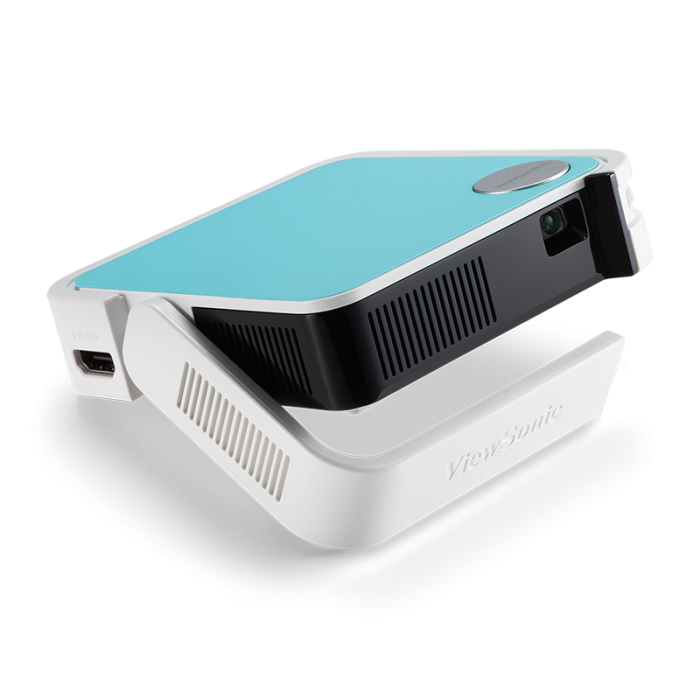 The ViewSonic M1MINIPLUS-S is the lightest projector on this list by a wide margin, and that is the whole point of it. At about 300 grams and roughly the size of a drink coaster, it disappears into a hip-belt pocket or a stuff sack, and you will forget you are carrying it until the tent is up and the film starts. For backpackers who count grams first and ask questions later, nothing else here comes close.
The trade-offs are real and should be understood before buying. This is a small, dim projector with a soft picture: its native resolution is 854 x 480, and its 120 LED lumens suit a small image in a properly dark tent, not a big bright screen.
What it gives back is trail practicality. The built-in battery runs up to an hour and a half; it charges from a standard USB-C power bank; the smart stand doubles as a lens cover; and the JBL speaker with Bluetooth covers sound for a tent or two.
WiFi and a smart interface mean it can stream where there is signal, and the USB reader plays local files where there is not. Full specifications are listed on the maker’s official page.
- Resolution: 854 x 480 native (WVGA), up to 1080p input supported
- Brightness: 120 LED lumens
- Weight: 0.3 kg (0.66 lb)
- Size: 110 x 104 x 27 mm
- Battery: 5000 mAh, up to 1.5 hours; USB-C power bank compatible
- Light source: 30,000-hour RGB LED
- Image size: 24 to 100 inches; throw distance: 0.64 to 2.66 m
- Speaker: JBL speaker with Bluetooth in and out
- Extras: WiFi smart UI, 8 GB storage, auto vertical keystone, swappable color panels
✓ Pros
- Lightest pick by far at about 300 grams, genuinely pocket-sized
- Charges from any USB-C power bank, so trail power is simple
- Smart stand doubles as a lens cover, protecting the lens in a pack
- JBL speaker and Bluetooth cover sound without extra gear
✗ Cons
- Softest, dimmest picture here: small dark-tent images only
- Shortest battery life at up to 1.5 hours, so long films need eco discipline or a top-up
- Not suited to text-heavy content or viewers who want sharp detail
When NOT to choose: Skip it if you want a sharp, bright picture or a full-length film without battery anxiety, because this pick trades picture quality for weight.
3. KODAK Luma 500 Mini Projector — Best 1080p Trail Cinema
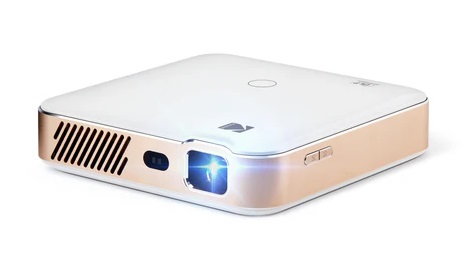 The KODAK Luma 500 is the pick for backpackers who refuse to give up a sharp picture to save weight. It is the only projector on this list under one kilogram with a true 1080p native image, and it pairs that with Google TV, so films stream from the usual apps wherever there is a signal, with no extra stick or phone needed. At about 540 grams, it is heavier than the pocket pick, but it is still light enough to earn its place in a pack.
On the trail, the Luma 500 behaves like a well-thought-out travel projector. Its 10,500 mAh battery runs about two hours, which covers most films, and it charges over USB-C from a power bank for a second night. Autofocus and four-way keystone correction make setup quick on uneven ground, and the metal frame with a recessed lens survives pack life better than a plastic body with an exposed lens. The honest limit is brightness: at around 150 ANSI lumens, this is a dark-tent projector, and the image should stay modest in size to keep it punchy.
- Resolution: 1920 x 1080 native, 4K input supported
- Brightness: About 150 ANSI lumens
- Weight: 0.54 kg (1.2 lb)
- Size: About 5.2 x 5.2 x 1.3 inches
- Battery: 10,500 mAh, about 2 hours; USB-C charging
- Light source: 30,000-hour LED, DLP
- Image size: Up to 150 inches; throw ratio 1.2:1
- Speaker: Dual 1.5W speakers with Dolby Audio
- Smart platform: Google TV with licensed streaming apps and Chromecast
✓ Pros
- True 1080p picture under one kilogram, the sharpest image at this weight
- Google TV built in, so streaming works without extra hardware
- Metal frame and recessed lens handle pack life well
- Autofocus and four-way keystone make trail setup fast
✗ Cons
- Dim at around 150 ANSI lumens, so dark tents and modest image sizes only
- Two-hour battery covers one film, not a double feature, without a top-up
- Small built-in speakers suit a tent, not a group spread around a fire
When NOT to choose: Skip it if your nights run long or your group is large, because the battery and brightness are built for one tent, not a campground crowd.
4. TCL C1 Smart Google TV Projector — Best for Short Hikes and Base Camp
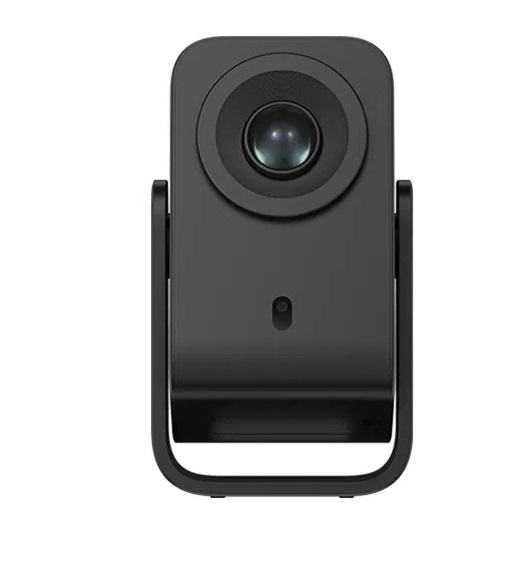 The TCL C1 is the heaviest projector on this list, and it is here anyway because it is the most complete trail cinema for trips where the walk is short, or the car is nearby. Its 285-degree gimbal stand is the standout feature: it tilts the projector to a tent ceiling, a shelter wall, or a sheet hung between trees without a tripod, and it has a handle for carrying.
With Google TV built in, films stream from the usual apps, and the 8-watt Dolby speaker is the strongest single speaker on this list.
Weight is the honest conversation with this pick. At about 1.8 kilograms, it is roughly six times the weight of the pocket pick, and no ultralight hiker should carry it.
For a weekend base camp, a short trail to a hut, or a trip where the projector rides in a car to the trailhead, that weight buys a genuinely better evening: a 1080p picture, 230 ISO lumens, autofocus with keystone and obstacle avoidance, and a smart platform that needs nothing else.
Power comes over USB-C PD, so a capable power bank can run it on the trail, but check the current listing for the exact battery specification before buying, because listings differ on this point.
- Resolution: 1920 x 1080 native, 4K input supported
- Brightness: 230 ISO lumens
- Weight: About 1.8 kg, with carry handle
- Power: USB-C PD power-bank friendly; battery specification varies by listing; check before buying
- Light source: 30,000-hour LED, LCD
- Image size: 40 to 120 inches
- Speaker: 8W Dolby Audio speaker
- Stand: 285-degree gimbal for ceiling, wall, and floor projection
- Smart platform: Google TV with licensed streaming apps and voice control
✓ Pros
- Gimbal stand aims the picture anywhere without a tripod
- Strongest built-in speaker here, good for a small group
- Google TV built in, so no extra streaming hardware is needed
- Auto focus, keystone, and obstacle avoidance make setup painless
✗ Cons
- Heaviest pick by far, unsuitable for weight-conscious backpacking
- Battery specification varies by listing, so trail power needs checking
- Brightness suits nights only, not dusk viewing
When NOT to choose: Skip it for multi-day hikes with a full pack, because its weight belongs on a short walk or a car-supported trip, not a long trail.
5. Magcubic HY450 Smart Projector — Best Bright Budget Pick for Powered Campsites
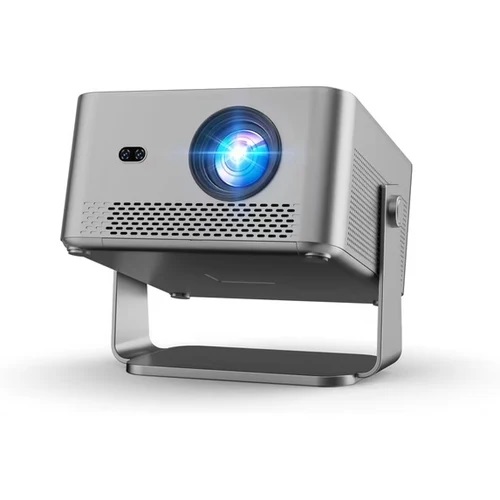 The Magcubic smart projector is the brightest 1080p picture on this list for the least weight penalty, and it comes with one condition that defines who should buy it: it has no built-in battery.
It runs from mains power, so it belongs on trips where power exists, whether that is a powered campsite, a camper van hookup, a hut, or a portable power station in the car. Within that job, it is a lot of projector for a pack-friendly 1.2 kilograms.
What you get is a proper smart projector: native 1080p, around 390 ANSI lumens, Android with WiFi for streaming and screen mirroring, dual stereo speakers, and a 180-degree rotatable design that aims the picture at a wall or a ceiling without extra gear.
Auto keystone correction keeps setup simple, and the picture holds up on a modest screen after dark. The honest framing is that this is a backpacking-adjacent pick, not a deep-backcountry one: carry it where power is planned, and it outperforms everything else here on brightness per kilogram, but do not take it where the nearest outlet is a day away.
- Resolution: 1920 x 1080 native, 4K video decoding supported
- Brightness: About 390 ANSI lumens (variant claims differ; check the listing)
- Weight: About 1.2 kg
- Power: DC mains, no built-in battery; needs campsite power or a power station
- Light source: 50,000-hour LED, LCD
- Image size: 40 to 150 inches
- Speaker: Dual HiFi stereo speakers
- Design: 180-degree rotatable for wall and ceiling projection
- Connectivity: WiFi 6, Bluetooth 5.0, HDMI, USB, headset jack
✓ Pros
- Brightest 1080p picture here at around 390 ANSI lumens
- Smart Android platform with WiFi streaming and mirroring built in
- Rotatable design aims at walls and ceilings without a mount
- Pack-friendly weight for the brightness on offer
✗ Cons
- No built-in battery, so deep backcountry trips are out
- Brightness claims vary across Magcubic variants, so verify the listing
- Needs a power plan: campsite hookup, van power, or a power station
When NOT to choose: Skip it for multi-night wild camping with no power plan, because a bright projector with no battery is a paperweight after the first night.
Trail Tips: Power, Screen, and Shelter
Power decides everything on a multi-night trip. Size your power bank for the projector plus the phone, and remember that a projector at full brightness eats a bank far faster than a phone does.
Eco mode and a smaller image are free battery life: a 60-inch picture in eco mode can stretch a single charge across a whole film, while a 120-inch picture at full brightness may not survive the opening act.
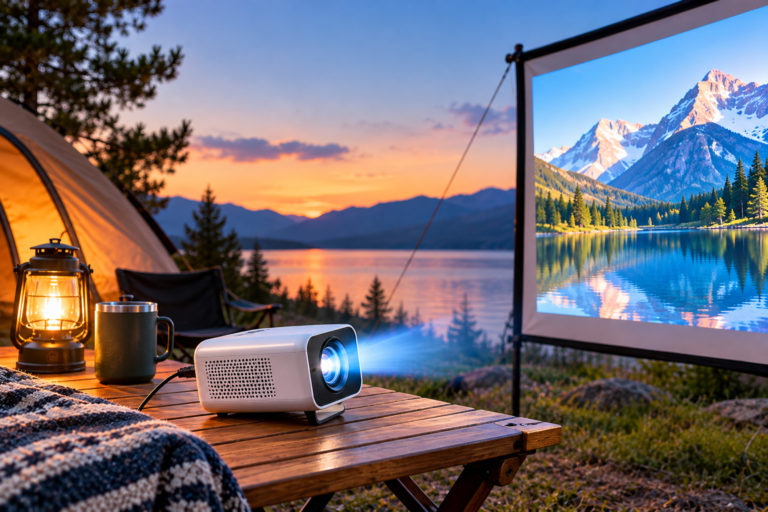
For the screen, a tent wall works if it is light-colored and reasonably smooth, and a cheap white sheet hung between trees is better still, because it gives a flat, bright surface and a bigger picture.
A small tripod, or even a trekking pole lashed to a rock, beats balancing the projector on a pack, and it keeps the picture steady when someone shifts in their sleeping bag. If rain is possible, keep the projector in a dry bag until showtime and never leave it out overnight, because none of these picks claim real weatherproofing.
Download before you go. Trail signal is a rumor, not a plan, so preload films on a USB stick, a memory card, or the projector’s own storage, if it has any.
For sound, the built-in speakers suit a tent, and a small Bluetooth speaker helps a group; our guide to connecting speakers to an outdoor projector covers the pairing options.
And if the film source is a phone, our guide to connecting an iPhone to a mini projector wirelessly walks through the wireless options.
Trail Power Planning: Battery Math Before You Leave
A battery rating is a best case, not a promise. Projector makers quote battery life in eco mode, on a small image, in a warm room, and a cold night in the mountains will give you less. Treat the quoted hours as a ceiling, plan for three-quarters of them, and you will rarely be caught with a film that dies before the ending.
Cold is the quiet thief here: lithium batteries lose usable capacity as the temperature drops, so sleep with your power bank in your sleeping bag and warm the projector before showtime rather than leaving either out in the night air.
Sharing one bank between phone and projector takes discipline. Budget roughly half the bank for the film and keep the rest for the phone, navigation, and emergencies, and never plan to drain the bank to zero on a movie. Charge in the right order at camp: top up the projector while you cook dinner, when you are awake to watch it, and let the phone sip overnight.
One USB-C cable that serves the projector, the phone, and the bank beats three separate cables, but check the wattage the projector wants, because a weak old phone charger may not keep up with a projector that expects proper USB-C PD power.
Solar deserves an honest word too. A small folding panel is a fine daytime trickle charger for a phone or a bank in camp, but it will not run a projector directly, and it will not refill a big bank in an afternoon under trees.
Treat solar as a supplement that buys you a little extra, not as the power plan itself. The real plan is boring and reliable: a bank sized for the trip, eco mode switched on, a modest image size, and films downloaded before you leave the trailhead.
Packing List: What Rides With the Projector
A backpacking projector is a system, not a single item, and the accessories around it decide whether the night works. The list is short, and every item earns its grams.
A dry bag or a zip-lock bag comes first, because a projector that gets wet on the hike is a projector that stays in the bag all night. A single USB-C cable comes second, chosen to match the projector’s power needs, plus the power bank itself, sized for the trip length rather than the lightest option that might fall short.
A tiny tripod or a mini stand comes third, because a steady picture beats a bright one, and a projector balanced on a sleeping pad will drift every time someone moves. A white sheet or a piece of Tyvek, folded flat, comes fourth for groups, because it turns any gap between trees into a proper screen and weighs less than a second battery.
Finally, pack the films themselves: a USB stick or memory card with downloaded movies, checked at home before departure, so the night does not depend on a signal that does not exist. Five small items, none of them heavy, and the difference between a film night that happens and one that does not.
Frequently Asked Questions
How many lumens do you need for a backpacking projector?
On a genuinely dark trail night with a modest image, around 100 lumens and up can satisfy, and 150 to 400 lumens gives real headroom. Keep the image small and the tent dark, and brightness matters far less than it does in a living room.
Can you charge a projector with a power bank on the trail?
Yes, if the projector charges over USB-C, which most picks here do. Match the bank to the projector: a 20,000 mAh bank comfortably tops up a pocket projector, while a brighter projector at full brightness will want a bigger bank or eco mode.
How much should a backpacking projector weigh?
Under one kilogram is the sweet spot, and under half a kilogram is ideal for ultralight hikers. Over about 1.5 kilograms, the projector belongs on short hikes, base camps, or car-supported trips rather than multi-day trails.
Can you project inside a tent?
Yes, and it works well on a light-colored tent wall, though a hung sheet gives a flatter, brighter picture. Keep the image small, sit close, and make sure the projector has airflow, because a sealed tent traps heat.
Do you need Wi-Fi on the trail?
No. Preload films on a USB stick, a memory card, or the projector’s own storage before you leave, and use the onboard media player or a direct phone connection. Wi-Fi only matters if you plan to stream, which needs a signal the trail rarely provides.
What happens if it rains during a trail movie night?
Pack the projector away in a dry bag and wait it out, because none of these picks is built to be rained on. A sheltered porch, a tarp, or a hut keeps the show going, but a wet projector is a dead projector.
Is a phone screen enough instead of a projector on the trail?
A phone works for one viewer, but a projector turns a solo watch into a shared campfire moment for the whole group. That shared screen is the reason to carry the extra weight at all.
Should you bring a separate speaker on the trail?
For a tent, no: the built-in speakers on these picks are enough for one or two viewers close up. For a group spread around a fire, a small Bluetooth speaker earns its weight, because voices carry further than a tiny projector speaker can throw them.
How big should the picture be on a trail night?
Smaller than you think. Forty to sixty inches looks bright and sharp from a sleeping bag, while pushing past eighty inches spreads the same light thin and washes the picture out. On the trail, a small bright picture always beats a big dim one.
Bottom Line
For most backpackers, the AAXA P6X is the pick that makes the fewest compromises: the brightest battery picture here, a battery that charges your phone too, and films that play without signal. If weight is the only thing that matters, the ViewSonic M1MINIPLUS-S at about 300 grams is in a class of its own, as long as you accept its soft, dim picture and short battery.
The KODAK Luma 500 splits the difference with a true 1080p image under one kilogram, while the TCL C1 and the Magcubic suit shorter walks and powered campsites rather than deep trails.
Whichever you choose, plan the power before you plan the film. A charged bank, a downloaded movie, and a dark tent will do more for your night than any spec on the box. Buy for the trip you actually take, not the one you imagine, and the projector will earn its place in the pack.
One last check before ordering: confirm the exact variant on the listing, because budget brands sell near-identical models with different batteries and brightness claims, and the listing in front of you is the only spec sheet that matters. Get the weight, the battery, and the power input confirmed, and the trail will take care of the rest.