Best Ambient Light Rejecting Screen for Living Room 2026 – Top 5 Re
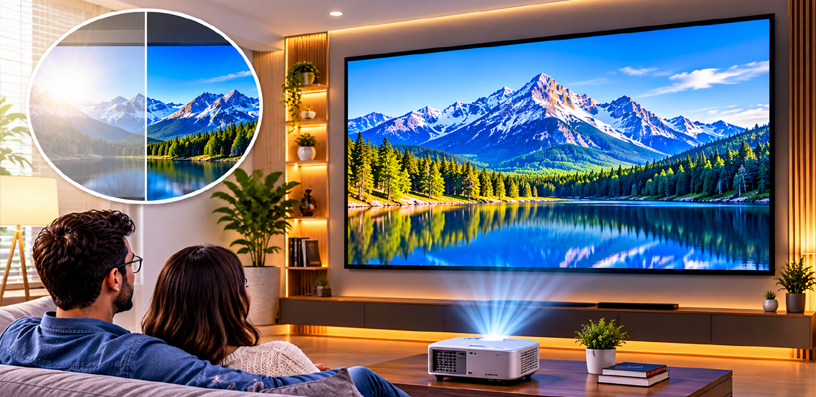
A living room is the worst room in the house for a projector. Windows let daylight pour in from the side, ceiling lights shine straight down on the screen, and nobody wants to watch the afternoon game in a blacked-out cave.
A plain white screen handles that light badly. It reflects the projector’s image and the room’s light equally, so blacks turn grey, colors wash out, and contrast disappears long before the picture does.
This is not just a movie-night problem. Daylight sports, weekend gaming and kids watching cartoons at noon all happen in lit rooms, and a projector setup that only works after dark ends up used a fraction as much as the television it replaced.
An ambient light rejecting (ALR) screen fixes the geometry instead of fighting it. Its surface is engineered to send the projector’s light toward your seats while absorbing or deflecting light that arrives from other angles, which keeps contrast alive with the lights on.
Before anything else, though, there is one fork in the road that decides which screens you can even consider. ALR screens are built for a specific projection angle, so a screen made for a standard-throw projector will not work with an ultra-short-throw (UST) model, and the reverse is just as true.
That is why this list leads with the Elite Screens CineGrey 3D. It is the one pick here made for the standard and long-throw projectors most living rooms already own, and its published figures are strong. The other four picks serve the fast-growing UST crowd, where a laser TV sits inches from the wall.
Every screen below was compared on the manufacturer’s published specifications: gain, viewing angle, light rejection, throw compatibility, sizes, and format. Match your projector type first, then pick your favorite from the screens that remain.
This guide, Best Ambient Light Rejecting Screen for Living Room, covers fixed indoor only. If the movie night moves outdoors instead, see our outdoor screen picks, because outdoor screens solve a very different set of problems.
Best Ambient Light Rejecting Screen for Living Room 2026: Quick Comparison
| Product | Type | Screen sizes | Best for | Buy |
|---|---|---|---|---|
| Elite Screens CineGrey 3D | Fixed frame, angular-reflective ALR — standard throw | 92–150 in | Standard and long-throw living rooms | Buy from Amazon |
| VIVIDSTORM S PRO | Motorized floor-rising, lenticular ALR — UST | 72–120 in | Rooms that cannot take a permanent screen | Buy from Amazon |
| Epson SilverFlex Ultra 120-Inch | Fixed frame ALR — UST | 100–120 in | Wide seating and large UST images | Buy from Amazon |
| Formovie Fresnel ALR Screen | Fixed frame, Fresnel ALR — UST | 100 in | Bright rooms with side windows | Buy from Amazon |
| XY Screens PET Crystal ALR Screen | Fixed frame, lenticular ALR — UST | 80–120 in | A slim, TV-like wall screen on a tighter budget | Buy from Amazon |
Best Ambient Light Rejecting Screen for Living Room 2026 Reviews
1. Elite Screens CineGrey 3D — Best for Standard-Throw Projectors
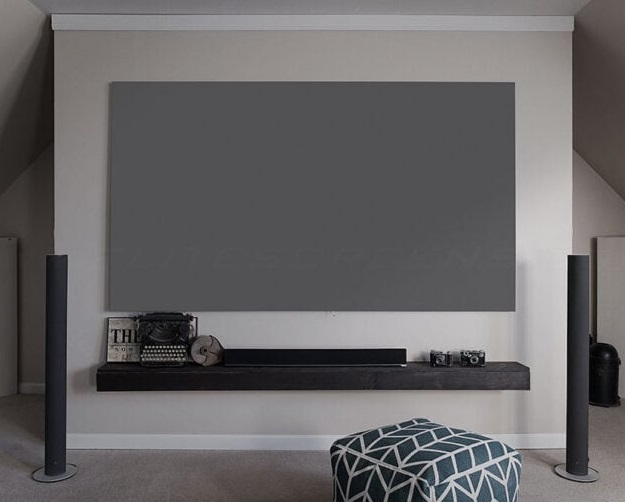 The CineGrey 3D is the screen to beat for the most common living-room setup of all: a regular projector on a ceiling mount or a rear shelf, throwing across the room.
It is a fixed-frame screen covered in Elite’s angular-reflective ALR material, sold in the slim Aeon edge-free frame and in a black velvet Sable Frame version.
The material works like a carefully aimed mirror. Light arriving along the projector’s path, roughly level and head-on, is reflected toward the seating area. Light arriving from above or from steep side angles is largely absorbed or scattered away, and Elite rates that rejection at 65 percent.
That geometry preserves black levels and color saturation in a way a white screen simply cannot match in a lit room. The surface is ISF certified for color accuracy, and it is rated for 4K and 8K content, so the screen will not be the limiting factor for a modern projector.
The honest trade-off is the viewing cone. Angular-reflective materials concentrate light, so the 90-degree viewing angle (45 degrees to each side) rewards viewers seated in front of the screen and short-changes anyone watching from a wide side chair.
Key Specifications
- Material: CineGrey 3D angular-reflective ALR
- Gain: 1.2
- Viewing angle: 90 degrees
- Ambient light rejection: 65 percent
- Projector type: Standard and long throw only (minimum throw ratio 1.5 times image width)
- Sizes: 92, 100, 110, 120, 135 and 150 inches in 16:9; 2.35:1 sizes also available
- Format: Fixed frame, wall-mounted
- Certification: ISF certified; 4K and 8K ready
✓ Pros
- The only pick here built for standard and long-throw projectors
- 1.2 gain keeps the image bright instead of dimming it like most ALR surfaces
- ISF certification backs up its color-accuracy claims
- Huge size range, up to 150 inches
- Two frame styles, including a near-borderless edge-free option
✗ Cons
- Strictly not compatible with ultra-short-throw or short-throw projectors
- 90-degree viewing cone is unkind to wide side seating
- Fixed frame means a permanent, TV-sized presence on the wall
- Needs a long throw distance, so small rooms may not qualify
When NOT to choose this one: Skip it if your projector is an ultra-short-throw or short-throw model, because the surface geometry will reject the very light you want to keep. Also think twice if your seating wraps wide around the room, since off-axis seats lose brightness and contrast first.
2. VIVIDSTORM S PRO — Best Motorized Floor-Rising Screen
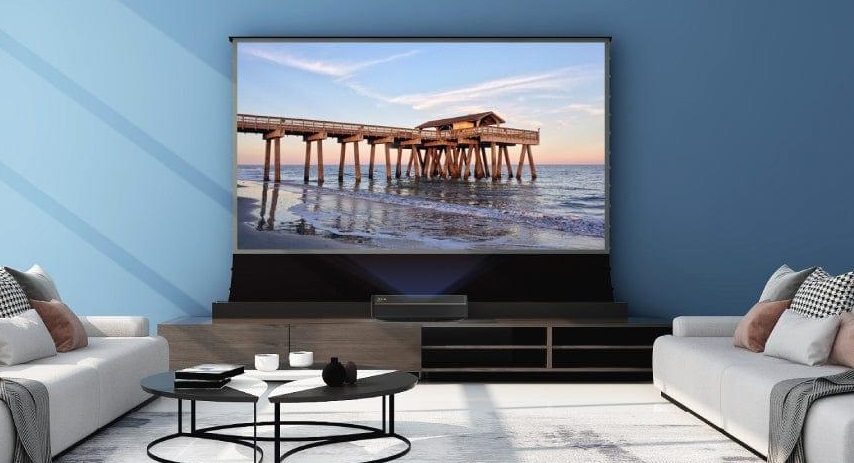 The S PRO solves the other living-room problem: the wall itself. It is a motorized screen that lives in a low housing on the floor and rises at the touch of a remote, so the wall stays bare and the room stays a room until movie time starts.
Its surface is a lenticular material with a fine sawtooth profile, tuned for ultra-short-throw projectors sitting just below it.
The sawtooth facets catch the projector’s steep upward beam and reflect it forward toward the sofa, while the black structure between them swallows ceiling light.
VIVIDSTORM rates that ceiling-light rejection at over 97 percent, the strongest figure in this roundup. Tab tensioning keeps the fabric flat as it rises, which matters because any ripple in a UST image shows up as wavy lines in the picture.
The price of that contrast is brightness. The 0.6 gain surface returns a darker, richer image rather than a brighter one, so it pairs best with a bright UST laser projector.
The 170-degree viewing angle, on the other hand, is generous enough for the whole sofa and the chairs beside it.
Key Specifications
- Material: Lenticular UST ALR (sawtooth structure)
- Gain: 0.6
- Viewing angle: 170 degrees
- Ambient light rejection: Over 97 percent of ceiling light
- Projector type: Ultra-short throw only
- Sizes: 72, 84, 92, 100, 110 and 120 inches
- Format: 16:9, motorized floor-rising, tab-tensioned
- Resolution support: 4K and 8K ready
✓ Pros
- Highest ceiling-light rejection figure in this roundup
- Disappears into its floor housing when not in use, so no wall mounting and no permanent screen
- Renter-friendly and easy to relocate compared with a fixed frame
- Wide 170-degree viewing angle suits group seating
- Tab tensioning keeps the rising surface flat
✗ Cons
- 0.6 gain needs a bright UST projector to shine
- Ultra-short throw only; useless with a standard projector
- The housing is a substantial piece of floor furniture and needs an outlet nearby
- Motorized parts add long-term maintenance questions a fixed frame never raises
When NOT to choose this one: Pass if your projector is not an ultra-short-throw model, or if it is a dimmer UST unit that cannot spare the light a 0.6 gain surface absorbs. Also skip it if the floor space in front of your wall is already spoken for, because the housing needs a clear, level run of it.
3. Epson SilverFlex Ultra ALR — Best ALR Projector Screen
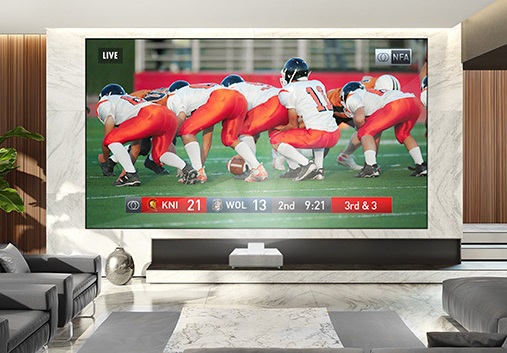 The SilverFlex Ultra is Epson’s own answer to a simple question: what screen should sit in front of its EpiqVision Ultra laser projectors? It is a fixed-frame, 120-inch UST screen with a slim bezel that hangs like a very large, very dark television.
Epson rates the surface to absorb up to 90 percent of ambient light. In practice, that means the overhead fixtures and window light that normally grey out a UST image get soaked up before they can flatten it.
The standout figure is the viewing angle. Epson claims up to 180 degrees, with a half-gain angle of 80 degrees, which is unusually forgiving for an ALR surface. Guests on the end seats of a long sofa keep far more brightness than they would with the directional screens elsewhere in this list.
The compromise is flexibility. There are just two sizes, 100 and 120 inches, and the screen was engineered around Epson’s own UST projectors. Owners of other UST brands should confirm their projector’s throw geometry against the screen before ordering.
Like every fixed UST screen, it also demands precision at install time. The projector’s distance from the wall and the screen’s height have to match the throw geometry closely, because a fixed frame leaves no roll-up margin for error. Measure twice against the projector’s placement chart before the brackets go in.
Key Specifications
- Material: SilverFlex Ultra ambient light-absorbing surface
- Ambient light absorption: Up to 90 percent
- Viewing angle: Up to 180 degrees (80-degree half-gain angle)
- Projector type: Ultra-short throw only, designed for Epson EpiqVision Ultra projectors
- Sizes: 100 and 120 inches (this model: 120 inches)
- Format: 16:9, fixed frame with slim bezel
- Model: ELPSC36
✓ Pros
- Widest viewing angle in this roundup, so every seat gets a fair picture
- Up to 90 percent ambient light absorption keeps daytime viewing respectable
- First-party match for Epson EpiqVision Ultra owners, with no guesswork
- Slim-bezel fixed frame looks like a large TV on the wall
✗ Cons
- Only two sizes, and 120 inches is the ceiling
- Tuned for Epson UST projectors; other brands need a compatibility check
- Epson does not publish a peak gain figure, so brightness comparisons are harder
- Fixed frame is a permanent wall fixture once installed
When NOT to choose this one: Skip it if you run a standard-throw projector, because no UST screen will work with one. Also look elsewhere if you need a screen larger than 120 inches, or if your UST projector’s maker specifies a different screen geometry and you cannot verify the pairing.
4. Formovie Fresnel ALR Screen — Best Fresnel Screen for Bright Rooms
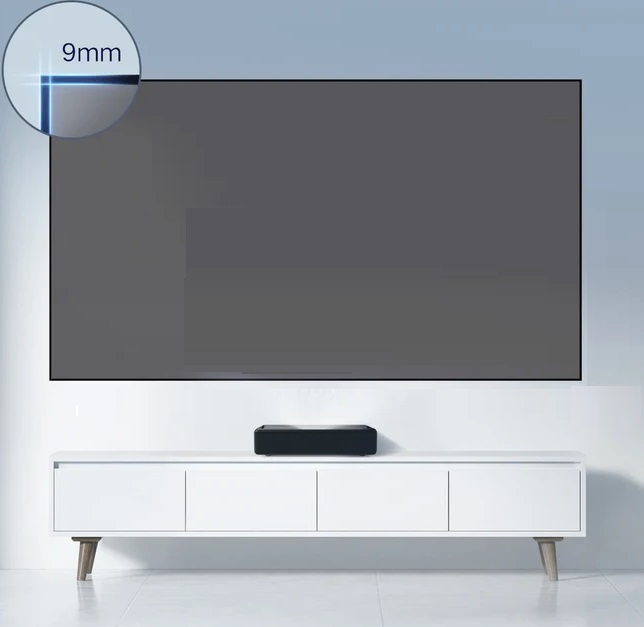 Most UST screens fight light from one direction: overhead. The Formovie Fresnel fights it from two directions, which is exactly what a living room with windows beside the sofa actually needs.
Its surface is a true Fresnel lens, a pattern of fine concentric rings molded into an ultra-thin film. The rings gather the projector’s steep upward light and focus it toward the seating area, while light arriving from the ceiling and the sides is turned away.
Formovie rates that ambient occlusion at 85 percent or better, covering ceiling and side light alike. The film itself is only about half a millimeter thick and ships as a rollable sheet that mounts on a segmented fixed frame, so the finished screen stays remarkably slim against the wall.
Fresnel focus comes with a well-known cost: direction. The published viewing angle is 50 degrees, by far the narrowest in this roundup. Sit inside that cone, and the picture is bright and punchy for a UST setup; drift outside it, and the image falls off quickly.
Key Specifications
- Material: Fresnel optical ALR film, ultra-thin rollable design
- Gain: 1.0 peak
- Viewing angle: 50 degrees
- Ambient light rejection: 85 percent or more (ceiling and side light)
- Projector type: Ultra-short throw only
- Sizes: 100 inches
- Format: 16:9, fixed frame, wall-mounted
- Model: S10FFNN
✓ Pros
- Rejects side light as well as ceiling light, a rare combination among UST screens
- Fresnel structure focuses light efficiently, keeping the picture lively in bright rooms
- Ultra-thin film and segmented frame make for a slim, manageable install
- Anti-glare surface suits rooms with mixed lighting
✗ Cons
- 50-degree viewing angle is the narrowest here by a wide margin
- One size only: 100 inches
- Ultra-short throw only
- Fresnel surfaces can show a visible hotspot near the center seat if the projector sits off-spec
When NOT to choose this one: Avoid it if your seating spreads wide, because anyone outside the 50-degree cone gets a noticeably dimmer picture. Also pass if you want more than 100 inches, or if your room’s problem light is mild and a wider-angle screen would serve your seating better.
5. XY Screens PET Crystal ALR Screen — Best Slim-Bezel Value Screen
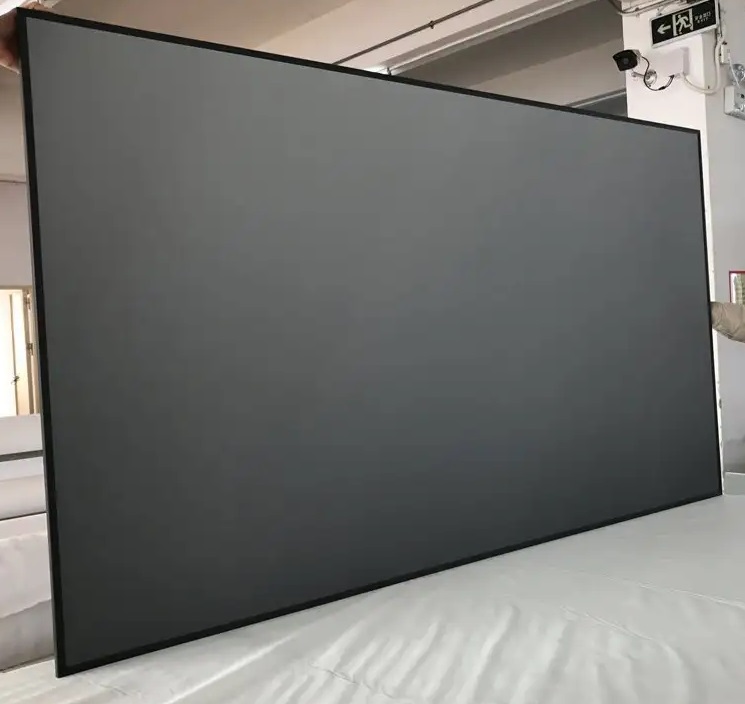 XY Screens sells factory-direct from Guangzhou, and the PET Crystal is its flagship UST fabric. It takes the same lenticular approach as the premium UST screens and wraps it in a frame with a bezel just 12 millimeters wide.
The fabric uses the familiar sawtooth structure: angled facets catch the projector’s light from below and send it forward, while the dark layers between them absorb ambient light. XY rates that rejection at around 93 percent, with a 0.8 gain and a 160-degree viewing angle.
Those numbers land in a sensible middle. The gain is higher than the floor-rising S PRO, so the image keeps more brightness, and the viewing cone is wide enough for family seating without Fresnel-style compromises.
The catch is everything around the fabric. You assemble and tension the screen yourself; documentation and support are thinner than the big brands offer, and exact specifications vary slightly between production runs and resellers.
Buyers comfortable with a hands-on install get a lot of screen for the money; buyers who want white-glove support should look up this list.
Key Specifications
- Material: PET Crystal lenticular ALR (sawtooth structure)
- Gain: 0.8
- Viewing angle: 160 degrees
- Ambient light rejection: Around 93 percent
- Projector type: Ultra-short throw only
- Sizes: 80, 90, 100, 110 and 120 inches
- Format: 16:9, fixed frame with 12 mm slim bezel
- Fabric: Cleanable and moisture-resistant
✓ Pros
- Genuine lenticular UST performance without the premium-brand markup
- 12 mm bezel gives it the closest thing to a giant TV look in this roundup
- Balanced figures: 0.8 gain, 160-degree angle, around 93 percent rejection
- Good spread of sizes from 80 to 120 inches
✗ Cons
- Self-assembly and tensioning take patience to get perfectly flat
- Documentation and after-sales support are thinner than the major brands
- Published figures vary a little between listings and production runs
- Ultra-short throw only
When NOT to choose this one: Skip it if you want a screen that arrives with hand-holding, detailed setup help and an easy returns path. Also skip it, like every UST screen here, if your projector is a standard-throw model.
Best Living Room Ambient Light Rejecting Screen 2026 – Buyer’s Guide
How to Choose an Ambient Light Rejecting Screen for Your Living Room
How ALR Works: Three Ways to Bend Light
Every ALR screen is an exercise in geometry. A normal screen scatters light in all directions, which is why room light and projector light get treated the same. An ALR surface is selective: it accepts light from the projector’s direction and refuses light from everywhere else.
Angular-reflective materials, like the CineGrey 3D above, work like a dark, precision mirror. They reflect the projector’s beam toward the seats at the mirror angle and absorb off-axis light, which is why they pair with standard-throw projectors firing roughly level at the screen.
Lenticular materials use rows of microscopic sawtooth ridges. On UST screens, the ridges catch the steep beam rising from below and push it forward, while ceiling light strikes the black tops of the teeth and dies there.
Fresnel materials use concentric lens rings to do a similar focusing job, which is how the Formovie screen also turns away side light.
A third family, retro-reflective surfaces, sends light back toward its source and belongs mostly to specialized short-throw setups. For living rooms, angular-reflective and lenticular or Fresnel designs cover nearly every real case.
Ceiling Light and Side Light Are Different Enemies
Look at where your room’s light actually comes from before you fall for a rejection percentage. Most UST screens are tested against ceiling light, because that is the light their sawtooth profile is built to block.
A wall of windows to the left of the sofa is a different problem. Side light can slip past a lenticular screen’s defenses, and in a room like that a Fresnel design, which rejects light from the sides as well as above, earns its narrower viewing angle.
Standard-throw angular screens sit between the two. Their mirror geometry shrugs off steep ceiling light well and does a fair, if imperfect, job with side windows, especially once basic curtains enter the picture.
Gain, Explained Without the Jargon
Gain measures how much light a screen returns compared with a plain white reference surface. A gain of 1.0 matches that reference; below 1.0 the picture trades brightness for deeper blacks, and above 1.0 the screen concentrates light into a brighter but narrower viewing cone.
That trade-off explains this entire list. The VIVIDSTORM’s 0.6 gain looks dim on a spec sheet and gorgeous in a bright room, while the CineGrey 3D’s 1.2 gain keeps a standard projector’s output lively for the seats in front of it. For a deeper look at the relationship, read what screen gain actually does to brightness before you decide which side of 1.0 you need.
As a rule of thumb, pair low-gain screens with bright projectors and higher-gain screens with modest ones. And never chase gain alone: the viewing angle printed beside it tells you how many seats share that brightness.
Why ALR Screens Look Grey (and Sometimes Almost Black)
Newcomers often ask why these screens are not white. The dark tint is the first line of defense, because a grey or black surface absorbs a share of the ambient light that strikes it instead of bouncing it back into the image.
The projector’s beam is strong enough to overcome that tint, while weaker room light is not. The result is a lower black floor and richer perceived contrast, which is the entire point of the category.
If you are weighing a plain grey screen against a true ALR model, the comparison of a white or grey surface for your room lays out where a tinted surface alone helps and where real optical rejection takes over.
Brightness: Your Projector Has to Meet the Screen Halfway
An ALR screen redistributes light; it does not create it. Every point of contrast you gain in a lit room is paid for with some of the projector’s output, so the projector’s brightness decides how aggressive a screen you can afford.
As a working rule, low-gain UST surfaces in the 0.6 range ask for a bright laser projector, while screens around 0.8 to 1.2 gain are kinder to mid-brightness models. A dim projector on an aggressive screen gives you deep blacks wrapped around a picture too dull to enjoy.
Check your projector’s rated output honestly before choosing. Manufacturer lumen figures are optimistic across the industry, so if your projector only just copes on a white wall today, choose the gentler screen, not the darkest one.
The Throw Rule: Match the Screen to the Projector First
This is the one rule in this guide that cannot be bent. ALR screens are angle-specific, so the projector type you own decides your shortlist before gain, size, or price enters the conversation.
Standard and long-throw projectors, ceiling-mounted or on a rear shelf, need an angular-reflective screen like the CineGrey 3D. Elite specifies a minimum throw ratio of 1.5 times the image width for that material, and mounting the projector closer than that invites hotspots and uneven brightness.
Ultra-short-throw projectors need a lenticular or Fresnel UST screen, full stop. Their beam arrives from inches below the screen at a steep angle that a standard ALR surface reads as ambient light and rejects.
Putting a UST projector on a standard screen, or a standard projector on a UST screen, produces a dim, blotchy image no setting can rescue.
Screen Size and Seating Distance
For mixed living-room use, most households land between 100 and 120 inches. That size feels cinematic from a typical sofa distance of roughly 8 to 12 feet, and it fits the size ranges every screen in this roundup shares.
Measure the wall before the catalog seduces you. A 120-inch 16:9 screen is about 105 inches wide before the frame, and it needs a flat, unobstructed wall (or floor, for a rising screen) plus a few inches of breathing room on each side.
Then check your seating against the viewing angle you chose. Narrow-cone screens like the Fresnel reward a centered sofa; wide-angle lenticular screens forgive the armchairs at the edges. Size is only a bargain if every regular seat can actually see the picture properly.
Fixed Frame, Pull-Down, or Floor-Rising?
Fixed frames are the optical champions. The fabric is tensioned once, at installation, and stays drum-flat for years, which keeps focus uniform and UST geometry honest. The cost is commitment: a dark, TV-sized rectangle lives on your wall full time.
Motorized floor-rising screens like the S PRO trade a little of that permanence for a disappearing act. The room stays a living room by day, and the screen rises for the evening. Look for tab tensioning on any retractable ALR screen, because an untensioned sheet will ripple, and ripples are distortion on a UST image.
Ceiling-recessed and pull-down ALR models exist too, mostly for standard throw. Whatever the mechanism, the question to ask is the same: how flat is the surface on its hundredth use, not its first?
Installation Realities: Flat Walls and Honest Tension
UST screens are brutally honest about walls. A bow or bump that a television would hide becomes a warped straight line on a 120-inch UST image, because the projector fires at such a shallow angle. Check the wall with a long straightedge before you commit to a size.
Fixed-frame assembly is a two-person job that rewards patience. The fabric is stretched across the frame with springs or rods, and working gradually from the center outward is what separates a glass-flat finish from a corner wrinkle you will stare at for years.
Floor-rising screens skip the wall work but demand a level floor and a clear footprint. They also need the projector positioned at a precise distance and height, so budget an evening for alignment rather than expecting perfection in ten minutes.
Care and Cleaning
Structured ALR surfaces are not wipe-down whiteboards. The ridges and lens rings that bend the light can be damaged by hard scrubbing, and solvents can strip the optical coating permanently.
For routine care, a soft, dry microfiber cloth and a light touch along the surface direction are enough for dust. Anything beyond that should follow the manufacturer’s instructions for that specific material, because lenticular, Fresnel, and angular-reflective surfaces each have their own tolerances.
Keep the screen covered or retracted when the room hosts toddlers, pets or a renovation. A scratch across an optical surface does not fade into the picture the way a scuff on a wall does.
Frequently Asked Questions
Do ALR screens work with any projector?
No. Every ALR screen is built for one projection angle. Standard-throw projectors need angular-reflective screens, ultra-short-throw projectors need lenticular or Fresnel UST screens, and mixing the two produces a dim, uneven picture.
Can you watch an ALR screen in a dark room?
Yes. ALR screens work in the dark as well, and their tinted surfaces often deepen perceived black levels at night. Just note that low-gain models will look dimmer than a white screen in the dark, so very low-gain screens pair best with bright projectors.
What gain is best for a living room?
There is no single best number. Bright rooms with strong projectors suit low-gain screens around 0.6 to 0.8, which favor contrast. Dimmer projectors benefit from gain near or above 1.0, as long as your seating fits inside the narrower viewing cone that comes with it.
Is a grey screen the same as an ALR screen?
No. A plain grey screen only tints the surface, which helps black levels a little. A true ALR screen adds an optical structure, angular-reflective, lenticular, or Fresnel, that actively rejects light arriving from the wrong angles. The tint is the supporting act, not the headline.
Do ALR screens reduce projector brightness?
Most do, to some degree. Surfaces below 1.0 gain return less light than a white screen, which is the deliberate price of deeper blacks in a lit room. Higher-gain ALR screens preserve brightness but narrow the viewing angle instead. Either way, the trade is contrast for light.
How do you clean an ALR screen?
Gently. Use a soft, dry microfiber cloth, wipe lightly along the surface, and avoid solvents, abrasives and hard pressure, all of which can damage the optical structure. For anything beyond dust, follow the specific care instructions for your screen’s material.
Bottom Line
The best ambient light rejecting screen for living room viewing depends first on your projector, and only then on your room.
Standard-throw owners should start and finish their search with the Elite Screens CineGrey 3D: its 1.2 gain, ISF-certified color and broad size range make it the most complete standard-throw ALR package here.
UST owners have the richer menu. Choose the VIVIDSTORM S PRO if the screen must disappear, the Epson SilverFlex Ultra 120-Inch if wide seating matters most, the Formovie Fresnel ALR Screen if side windows are your main enemy, and the XY Screens PET Crystal ALR Screen if you want the slim-bezel look without the premium markup.
And if hanging any screen feels like too much commitment for the room, the wall itself can do the job: our screen paint picks for the same wall cover the paint-on alternative, with its own honest trade-offs. Match the throw first, mind the viewing angle, and your living room can finally keep its lights on.