What Projector Screen Material Is Best for Outdoors in 2026
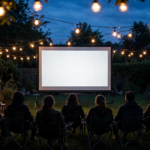
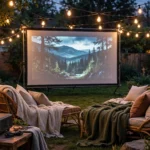
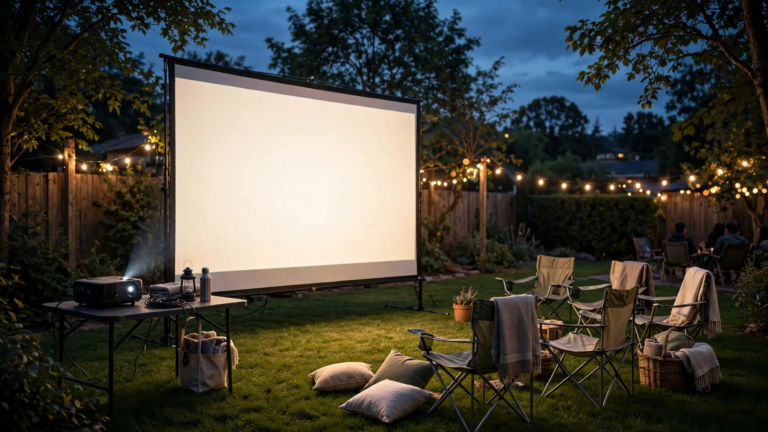
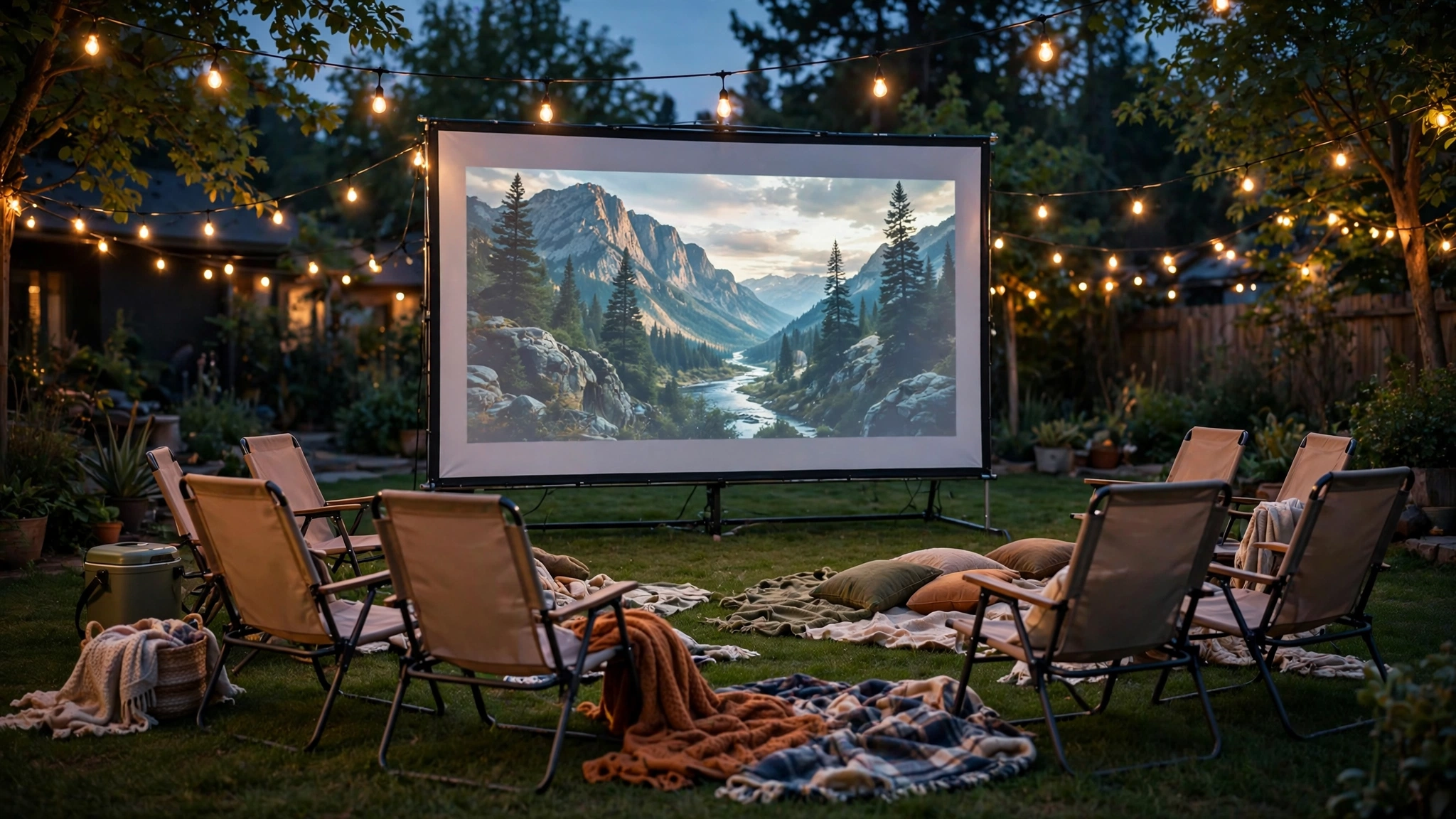
If you’re asking what projector screen material is best for outdoors, here’s the short answer: for most backyard movie nights, matte white vinyl on a sturdy freestanding or fixed-frame screen is the best all-rounder.
It handles wrinkles and wind well, shows accurate colors, and forgives uneven ground and imperfect placement. But “best” depends on when you watch.
If you start your movies at dusk while there’s still ambient light in the sky, an ambient-light-rejecting (ALR) material can save the picture. If portability is your priority, inflatable PVC screens are a different trade-off entirely. And if the budget is zero, DIY options like blackout cloth or a painted wall can absolutely work.
This guide compares every common outdoor screen material on the factors that actually matter outside: gain, viewing angle, how it behaves in wind, wrinkle resistance, weather resistance, and cleanability. By the end, you’ll know exactly which material fits your yard, your projector, and how you like to watch.
Matte White Screen Material: The Best All-Rounder for Outdoors
Matte white is the default screen material for a reason, and it’s the safest recommendation for outdoor use. It typically has a gain of 1.0, which means it reflects the projector’s light evenly in all directions without boosting or dimming any part of the image.
Colors stay accurate, whites stay white, and you don’t get the hot-spotting (a bright spot in the center with dimmer edges) that some high-gain materials cause.
The viewing angle is also the widest of any common material — roughly 180 degrees, which is effectively “everyone sees the same picture no matter where their chair is.” That’s a big deal in a backyard where guests scatter across the lawn, sit off to the sides, or sprawl on blankets far from center.
Matte white is also the most forgiving material physically. It tolerates light wrinkles better than glossy or high-gain surfaces, where a crease catches the light and becomes a visible distortion.
Quality outdoor matte-white screens come with tensioning systems (snaps, bungees, or weighted bottom bars) that keep the surface flat even in a breeze. Pair a good matte-white screen with one of our best outdoor projectors, and you have a setup that works for nearly any yard.
The honest limitation: matte white does nothing to fight ambient light. Once the sun drops fully and it’s properly dark, it’s perfect. But if you like starting the movie at 7 p.m. in late summer while the sky still glows, the image will look washed out unless your projector has very high lumens output.
ALR (Ambient-Light-Rejecting): Best for Dusk Viewing
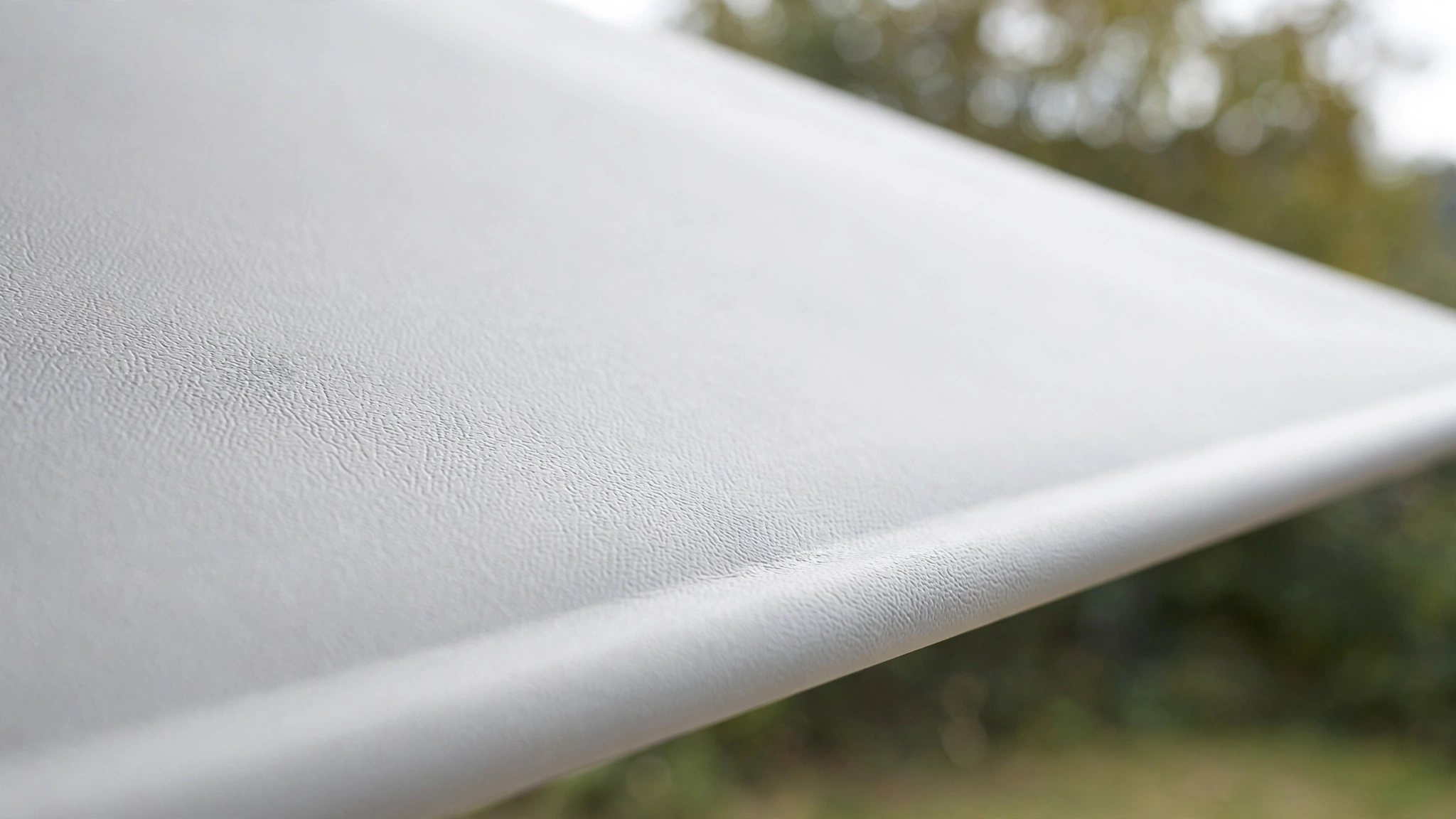
ALR screen material is engineered to reject light coming from above and the sides while reflecting the projector’s beam (coming from straight-on) toward the audience. It does this with a layered optical structure — essentially tiny ridges or filters that discriminate light by angle.
In practice, an ALR screen keeps the image punchy and contrasty even when it’s not fully dark, which is exactly the condition most backyard hosts face.
That dusk performance comes with real trade-offs. First, ALR material has a narrow viewing angle — typically 80 to 100 degrees total. Guests sitting far off to the sides will see a noticeably dimmer image, so your seating arrangement needs to be a proper audience arc, not scattered lawn chairs.
Second, it’s far less wrinkle-tolerant; creases in ALR material visibly distort the picture, so it needs a well-tensioned frame and careful handling. Third, it’s expensive — an ALR screen can cost several times more than an equivalent matte-white one.
ALR is worth it when your projector is on the dimmer side, your movie nights reliably start before full darkness, or you want the image to hold up against neighbor porch lights and string lights.
If you’re projecting in real darkness with a bright projector, you pay the ALR premium for benefits you won’t see. For help choosing between a dimmer-friendly screen and a brighter projector, our guide to the best projectors for daylight viewing explains the lumens side of the equation.
Inflatable PVC Screens: Best for Portability and Wow Factor
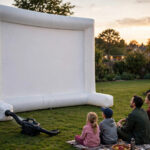
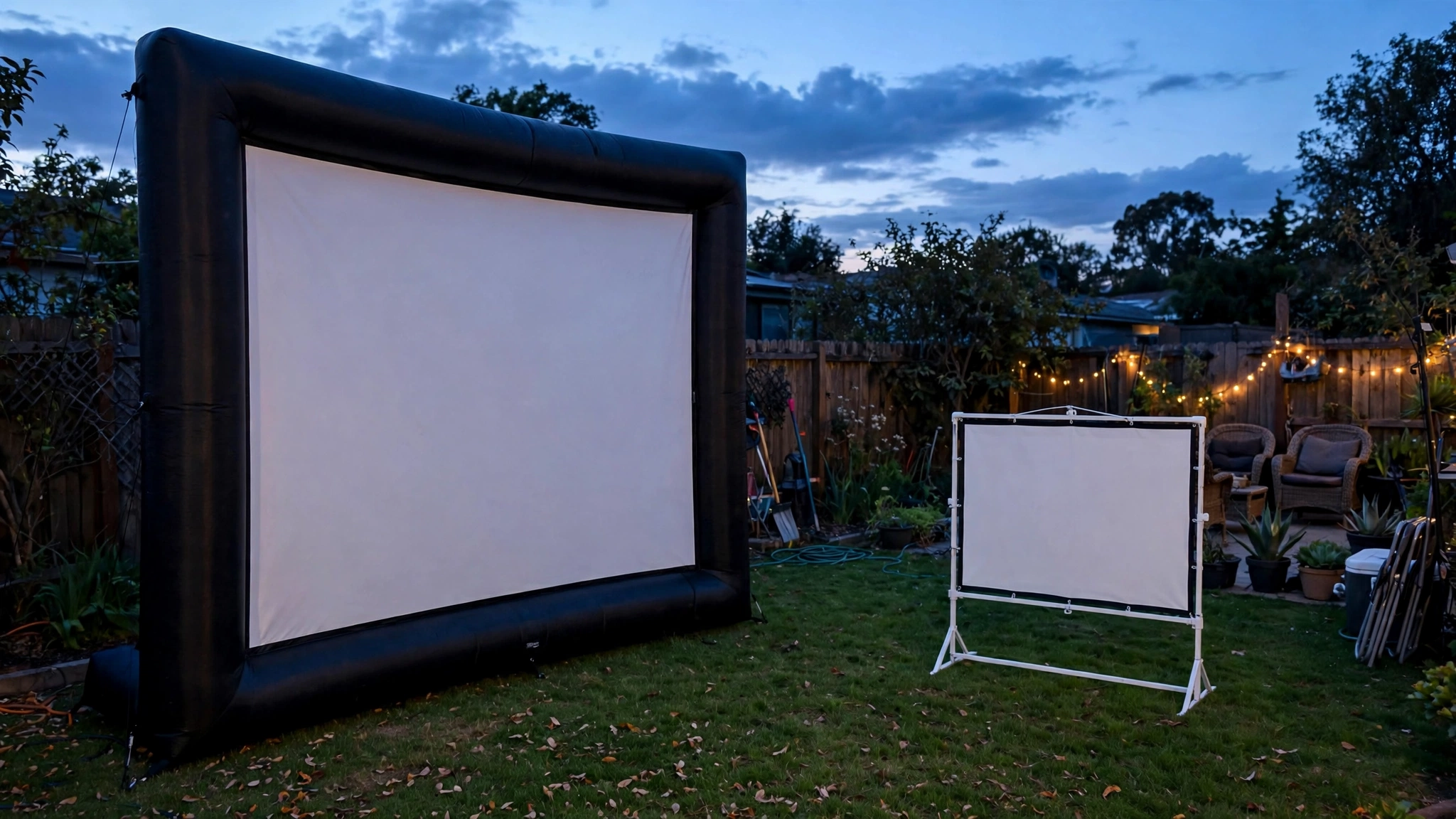
Inflatable screens are the ones you see at community movie nights and big family parties — a giant black frame that inflates in minutes, holding a white PVC projection surface. The surface itself is usually a matte or slightly glossy PVC with gain around 1.0, and the picture can look genuinely good.
The strength of inflatables is pure logistics: a 14-foot screen packs into a bag, sets up without tools, and the huge surface is achievable with a mid-range projector because the material is efficient. Kids love them. For occasional big events, nothing else touches the convenience.
The weaknesses show up in wind. An inflatable is basically a sail. Anything beyond a light breeze makes the frame sway, and the projection surface ripples — visible motion in the image. You must stake them down properly, and on gusty nights some owners partially deflate for stability, which defeats the purpose.
PVC also shows wrinkles more than tensioned vinyl if it’s not fully inflated or if it’s aging. Weather resistance is decent (the material is waterproof), but you can’t leave one set up in rain or storms — they’re event screens, not permanent fixtures. UV exposure degrades PVC over seasons, so store them out of the sun.
DIY Options: Blackout Cloth and Painted Walls
If you’re not ready to buy a screen, two DIY materials perform surprisingly well outdoors.
Blackout cloth
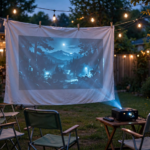
Blackout cloth — the thick white fabric sold for curtains — is the classic budget outdoor screen. Hang it from a line or a frame, and you get a matte-white surface with gain near 1.0 for a few dollars.
The catch: it wrinkles. Without tensioning, folds and waves in the fabric show up in the picture, especially during bright scenes. It also soaks up water and stays wet, so never leave it out overnight. But stretched tight with grommets and bungee cords, blackout cloth is a legitimately good picture for the money.
Painted wall
A flat exterior wall painted with matte white or dedicated projector screen paint is the ultimate no-wrinkle option — nothing flaps in the wind because there’s no fabric. Use flat/matte paint only; anything with sheen creates hot spots.
The downsides: you can’t take it with you, texture in stucco or siding shows through, and you need a big unobstructed wall. Screen paint (formulated for controlled gain and color neutrality) performs noticeably better than plain white paint, though at a higher cost per square foot of wall.
For a curated list of ready-made screens worth buying instead of building, see our best outdoor projector screens roundup, which covers freestanding, fixed-frame, and inflatable picks.
Gain and Viewing Angle: What the Numbers Mean
Two specs describe almost everything about how a screen material behaves, so it’s worth understanding them before you shop.
Gain measures how much light the screen reflects compared to a perfect white reference surface. Gain 1.0 reflects evenly. Gain above 1.0 (like 1.3 or 1.5) concentrates more light back toward the audience — the image looks brighter from the center seats, but you pay for it with a narrower viewing angle and possible hot-spotting.
Gain below 1.0 (gray screens, around 0.8) actually darkens the image slightly to improve perceived contrast — useful in moderate ambient light, and gray screens are more forgiving of light pollution than white ones.
Outdoors, gain 1.0 matte white is the balanced default; go higher only if your projector is dim, lower (gray) only if you fight ambient light and have the lumens to spare.
Viewing angle is how far off-center the audience can sit before the image noticeably dims. Matte white gives the widest angle; ALR and high-gain materials narrow it. Outdoors, where seating is informal and scattered, a wide viewing angle is worth more than a brightness boost — everyone getting a good picture beats the center row getting a great one.
If you want to go deeper on how these specs interact with projector brightness, Epson‘s projector guides are a solid neutral starting point.
Wind, Wrinkles, Weather, and Cleaning
Beyond image quality, outdoor materials live or die on four practical factors.
Wind behavior: tensioned matte-white screens on freestanding frames handle wind best, especially with sandbagged or staked feet. Inflatable screens handle it worst. A useful trick for any fabric screen: don’t over-tension in gusty conditions — a slightly softer tension lets the material absorb gusts instead of transferring every shudder to the image.
Wrinkle resistance: matte vinyl with a tensioning system is the most wrinkle-proof fabric option. Loose-hang blackout cloth is the worst. ALR is the most wrinkle-sensitive in terms of image impact. Whatever material you use, store it rolled (never folded) to avoid permanent creases.
Weather resistance: quality outdoor screen vinyl is waterproof and mildew-resistant, but “outdoor-rated” does not mean “leave it up all season.” Rain won’t ruin a good vinyl screen, but standing water in a bottom pocket or repeated soak-and-dry cycles shorten its life.
Bring screens inside during storms and store them dry. PVC inflatables and painted walls are the most weather-tolerant; blackout cloth is the least.
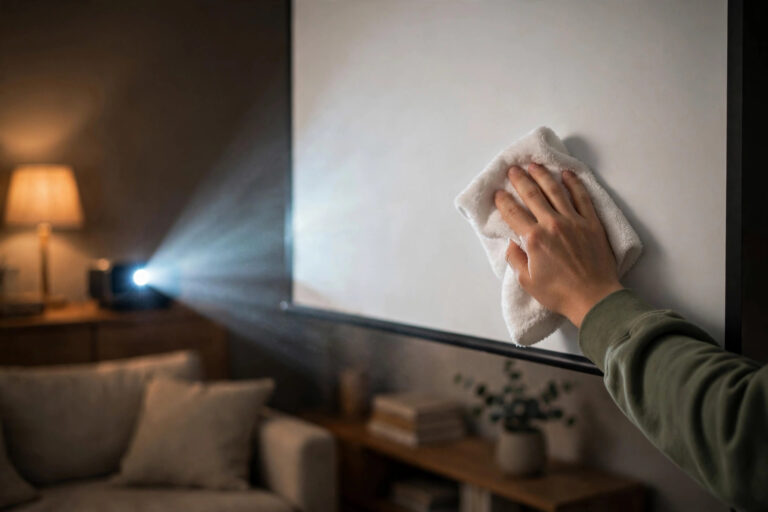
Cleanability: vinyl and PVC wipe down easily with a damp cloth — pollen, dust, and the occasional bug splatter come right off. Blackout cloth can be machine-washed but fades over time. Painted walls can be wiped but not scrubbed aggressively. Whichever material you own, give it a proper cleaning before movie season starts.
Frequently Asked Questions
Can I use a regular indoor projector screen outside?
You can for a night or two, but indoor screens aren’t built for moisture, UV, or wind. The material can warp or grow mildew, and the frames aren’t stable on grass. If movie nights become a habit, get an outdoor-rated screen.
Is a gray screen better than white for outdoor use?
Gray screens (around 0.8 gain) improve perceived contrast when there’s some ambient light, but they need a brighter projector to compensate for the light they absorb. In full darkness, white is better; at dusk with a bright projector, gray is a solid option.
What gain should an outdoor projector screen have?
Gain 1.0 matte white is the safe default for most backyards. Choose higher gain (1.3+) only if your projector is on the dim side and your seating is mostly centered; choose lower gain gray (0.8) only for dusk viewing with a bright projector.
How do I stop my outdoor screen from blowing in the wind?
Use a freestanding frame with staked or sandbagged feet, keep the surface properly tensioned, and orient the screen so the wind hits it edge-on if possible. For inflatables, stake every anchor point and skip movie night in gusty conditions.
Can I leave my projector screen outside overnight?
Occasionally, if it’s dry — but don’t make it a habit. Overnight dew, surprise rain, and UV all shorten screen life. Bring fabric screens inside after each use and store them rolled, never folded.
Bottom Line
For most backyard movie nights, matte white vinyl on a tensioned frame is the best outdoor projector screen material: accurate color, the widest viewing angle, good wrinkle and wind behavior, and easy cleaning.
Choose ALR only if you consistently watch at dusk with ambient light to fight and can live with the narrow viewing angle and higher price. Pick an inflatable PVC screen for big portable events where setup speed matters more than wind stability.
And if the budget is zero, blackout cloth or a painted wall will still give you a genuinely good picture — just mind the wrinkles and the weather.